CIO Guide to No-Code Development: Building Enterprise Applications
Digital transformation is no longer about replacing paper-based processes with software; it's about enabling businesses to adapt faster than ever before. For CIOs, that means delivering secure, scalable applications while managing budgets, technical debt, and growing business expectations.
Traditional development often struggles to keep pace with evolving business requirements. Projects can take months to deliver, development resources are limited, and IT backlogs continue to grow.
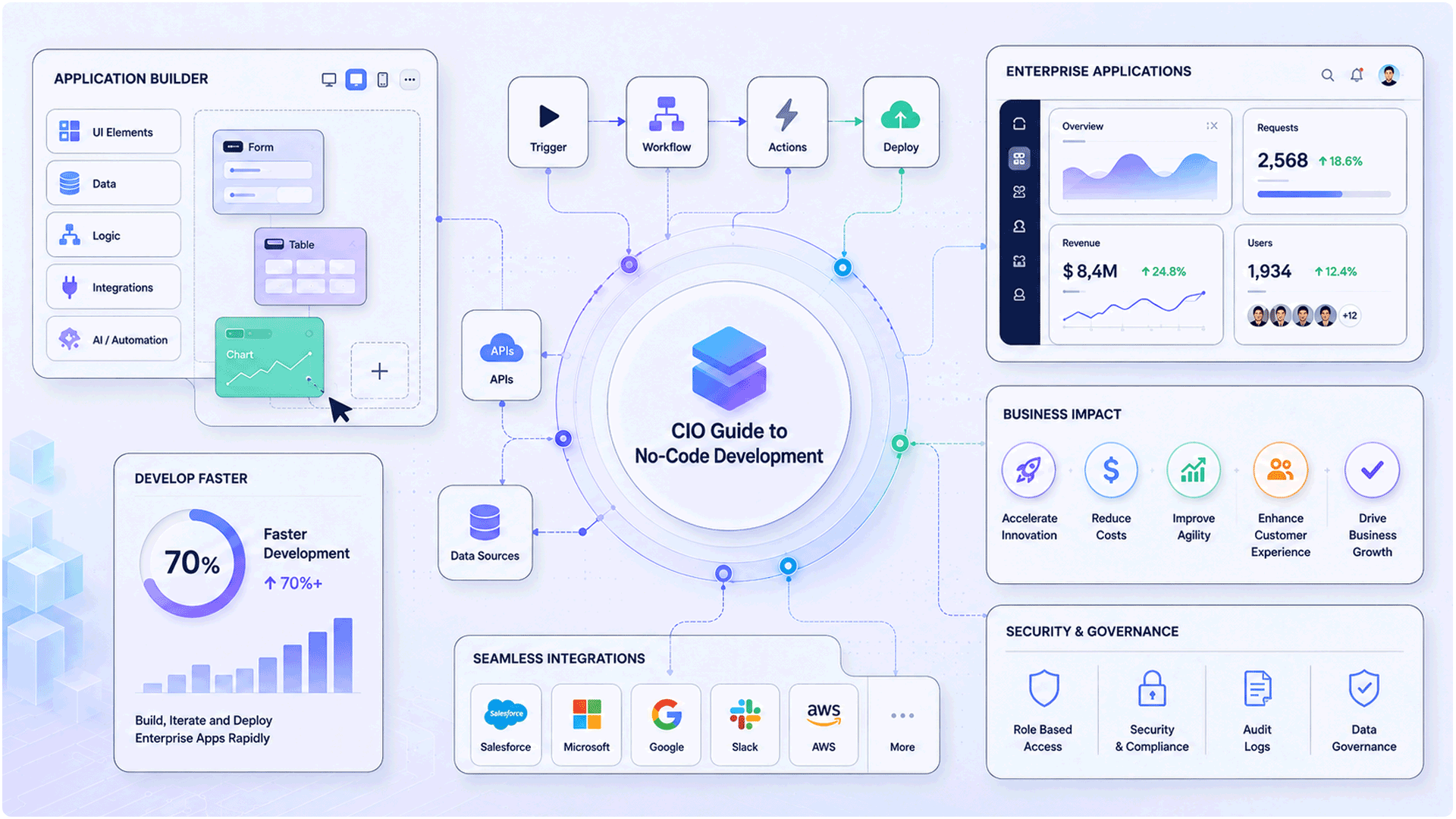
This is why many enterprise technology leaders are incorporating no-code development into their application strategy. Modern visual development platforms allow IT teams to build internal systems, customer-facing applications, and workflow automation solutions much faster without compromising governance or security.
This guide explains how CIOs can evaluate no-code development, where it delivers the greatest value, and what to consider before adopting it enterprise-wide.
Why CIOs Are Adopting No-Code Platforms
Enterprise IT teams face increasing pressure to deliver applications faster while maintaining security, compliance, and operational stability.
Some of the most common challenges include:
- Growing application backlogs
- Limited engineering capacity
- Rising software development costs
- Demand for digital transformation
- Business teams requesting custom solutions
- Legacy system modernization
No-code platforms help reduce these challenges by accelerating application delivery while allowing IT teams to retain oversight.
Where No-Code Delivers the Most Value
Modern no-code platforms are no longer limited to simple forms or landing pages.
Enterprise organizations use them to build:
- Employee portals
- Customer portals
- Vendor management systems
- Loan origination platforms
- Healthcare applications
- Approval workflows
- Operations dashboards
- Business process automation
Many of these applications begin as departmental initiatives before evolving into enterprise-wide business process automation solutions.
Governance Should Come First
Successful enterprise adoption starts with governance, not development speed.
CIOs should establish policies around:
- User roles and permissions
- Data ownership
- Security standards
- Application lifecycle management
- Deployment approvals
- Audit logging
A governed no-code environment enables innovation while reducing operational risk.
Security and Compliance Considerations
Security remains one of the biggest concerns for enterprise leaders evaluating no-code platforms.
Before selecting a platform, assess whether it supports:
- Role-based access control (RBAC)
- Single Sign-On (SSO)
- API security
- Encryption at rest and in transit
- Audit logs
- Backup and disaster recovery
- Compliance requirements such as HIPAA or GDPR
Enterprise-ready no-code platforms should provide these capabilities as standard rather than optional add-ons.
Integration Is Critical
No application exists in isolation.
Your no-code platform should integrate with:
- ERP systems
- CRM platforms
- Identity providers
- Payment gateways
- Data warehouses
- REST APIs
- Existing databases
Organizations already using Airtable, SQL databases, or third-party services should prioritize platforms with robust integration capabilities.
AI Is Changing Enterprise Development
Artificial intelligence is transforming how applications are designed, built, and maintained.
Instead of replacing developers, AI helps teams:
- Generate application logic
- Accelerate development
- Create workflows
- Improve documentation
- Identify optimization opportunities
For CIOs planning long-term digital transformation, understanding what an AI application platform offers is becoming increasingly important.
Choosing the Right Enterprise No-Code Platform
When evaluating vendors, ask:
Can it scale?
Your applications should support business growth without requiring complete redevelopment.
Is it secure?
Enterprise security should be built into the platform from day one.
Does IT maintain governance?
Business users should be empowered while IT retains oversight.
Can it integrate?
The platform should fit into your existing technology ecosystem.
Does it support AI?
AI-assisted development will increasingly become part of enterprise application delivery.
Why CIOs Choose DrapCode
DrapCode is an AI-assisted Visual Development Platform built for organizations that need production-ready enterprise applications.
With DrapCode, IT teams can:
- Build secure web applications
- Develop customer and employee portals
- Automate business workflows
- Connect enterprise APIs
- Manage users and permissions
- Accelerate digital transformation initiatives
Unlike platforms focused on simple automation, DrapCode enables organizations to build scalable business applications while maintaining governance, flexibility, and control.
Organizations comparing enterprise development approaches may also benefit from understanding the differences between low-code and no-code enterprise applications before selecting a platform.
Common Mistakes CIOs Should Avoid
Avoid these common pitfalls:
- Treating no-code as a replacement for IT
- Ignoring governance policies
- Choosing platforms without enterprise security
- Building applications without long-term scalability
- Overlooking integration requirements
- Allowing shadow IT without oversight
The most successful organizations combine business agility with centralized governance.
Final Thoughts
No-code development is no longer a niche technology; it has become an important component of enterprise application strategy.
For CIOs, the objective isn't simply to build applications faster. It's to deliver secure, scalable solutions that empower business teams while maintaining governance, compliance, and operational excellence.
By selecting an enterprise-ready platform and implementing clear governance policies, organizations can reduce development bottlenecks, accelerate innovation, and respond more quickly to changing business needs.
Technology leaders planning broader modernization initiatives should also evaluate how to build custom software without coding, particularly when replacing legacy systems or developing new digital services.
Frequently Asked Questions
Q1. Why should CIOs consider no-code development?
No-code platforms help CIOs reduce application backlogs, accelerate software delivery, and enable business teams to build solutions faster while maintaining IT governance and security.
Q2. Is no-code suitable for enterprise applications?
Yes. Enterprise-grade no-code platforms support security, scalability, API integrations, role-based access control, compliance, and workflow automation, making them suitable for production applications.
Q3. What should CIOs evaluate before selecting a no-code platform?
Key considerations include security, governance, scalability, integration capabilities, compliance, AI-assisted development, deployment flexibility, and vendor support.
Q4. Can no-code replace traditional software development?
No. No-code complements traditional development by accelerating the delivery of business applications and reducing pressure on engineering teams. Complex or highly specialized systems may still require custom development.
Q5. How does no-code support digital transformation?
No-code platforms enable organizations to modernize legacy processes, automate workflows, build internal tools, and launch customer-facing applications more quickly, helping businesses respond faster to changing market demands.