No-Code vs Low-Code Platforms: Which Is Better for Building Enterprise Applications in 2026?
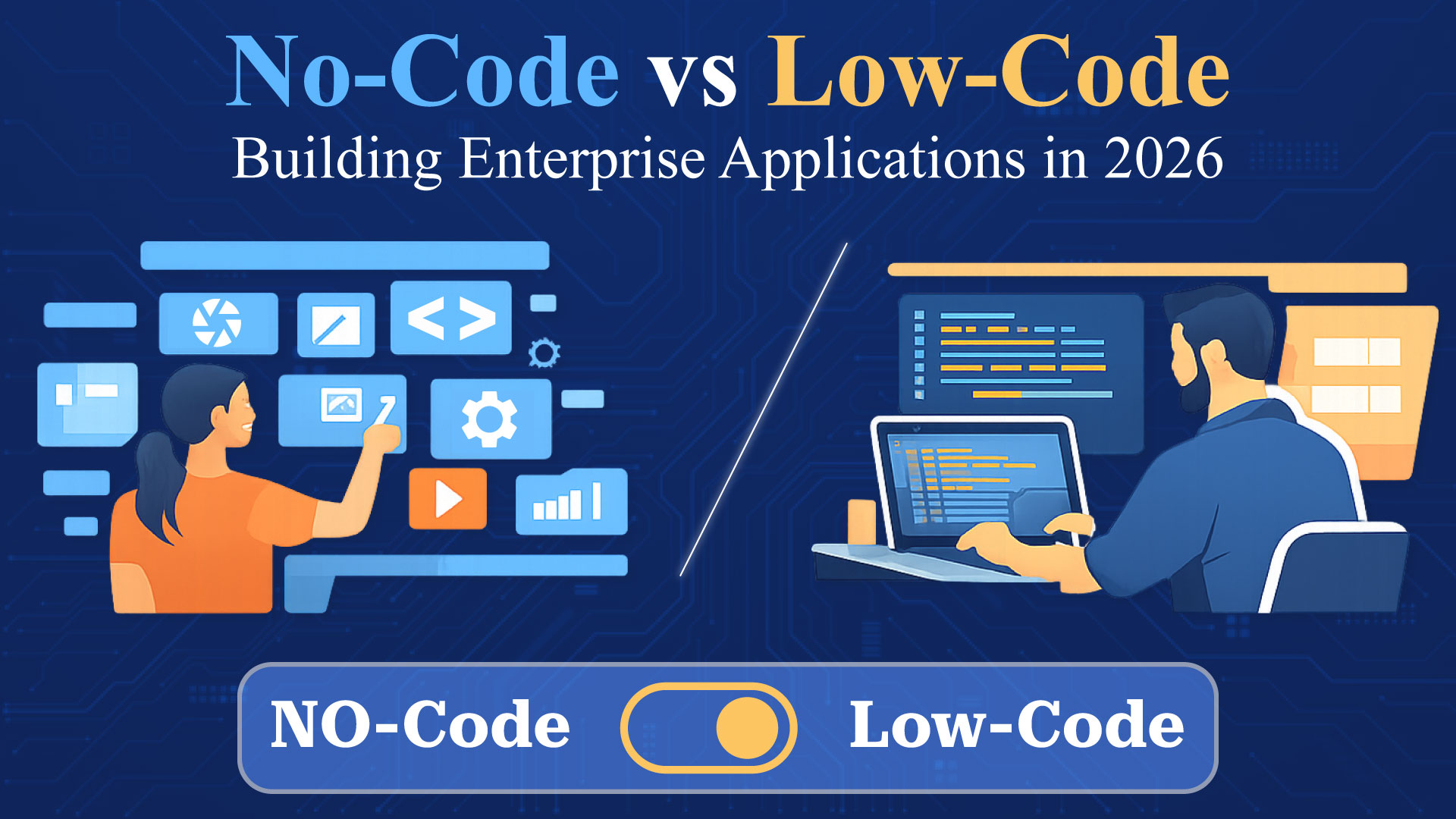
Enterprise software development is evolving faster than ever. As organizations push for speed, scalability, and cost efficiency, traditional development models are no longer enough. In 2026, the debate around no-code vs low-code 2026 is no longer theoretical; it directly impacts how enterprises approach enterprise app development and select the best platform for scalable web apps.
Both no-code and low-code platforms promise faster delivery and reduced engineering overhead, but they serve different needs. This guide breaks down the fundamental differences, practical use cases, and decision factors enterprises must consider before choosing the right approach.
Why Enterprises Are Rethinking Application Development in 2026
Enterprise application requirements have changed dramatically. Today’s systems must integrate with multiple data sources, support thousands of users, meet compliance standards, and scale without performance issues.
At the same time, enterprises face:
- Shortage of skilled developers
- Rising development and maintenance costs
- Pressure to launch products faster
- Demand for continuous iteration
This is why enterprise app development teams are increasingly adopting visual development platforms that reduce dependency on traditional coding.
Understanding No-Code Platforms in 2026
No-code platforms allow users to build applications using visual interfaces, drag-and-drop components, and configuration-based logic without writing code.
Key Characteristics of No-Code Platforms
- Visual UI builders and workflow designers
- Prebuilt integrations and APIs
- Minimal technical expertise required
- Faster time to market
No-code is no longer limited to simple apps. Modern platforms support complex workflows, database-driven applications, and enterprise-grade security.
Platforms like DrapCode enable teams to design full-stack applications visually while maintaining flexibility and scalability for production use cases. This approach is increasingly attractive for internal tools, customer portals, and operational dashboards.
Understanding Low-Code Platforms in 2026
Low-code platforms blend visual development with the ability to write custom code when needed. They are designed for professional developers who want speed without sacrificing control.
Key Characteristics of Low-Code Platforms
- Visual logic combined with scripting
- Custom code extensions
- Developer-centric workflows
- Higher technical learning curve
Low-code platforms shine in scenarios requiring advanced customization, complex business logic, or deep system integrations.
However, low-code still requires experienced developers, making it less accessible for non-technical teams and slower to scale across departments.
No-Code vs Low-Code 2026: Core Differences That Matter
1. Speed of Development
No-code platforms significantly outperform low-code when speed is the priority. Applications that traditionally take months can be delivered in weeks or even days. Low-code accelerates development compared to traditional coding, but still involves engineering cycles and testing overhead.
2. Accessibility Across Teams
No-code platforms empower product managers, business analysts, and operations teams to contribute directly. This democratization reduces bottlenecks. Low-code remains primarily for developers, limiting cross-functional collaboration.
3. Cost Efficiency
No-code reduces:
- Development costs
- Maintenance overhead
- Dependency on large engineering teams
Low-code reduces cost compared to custom development but still requires skilled developers, making it less cost-effective for large-scale internal adoption.
Scalability and Performance for Enterprise Applications
One of the biggest misconceptions is that no-code platforms cannot scale. In 2026, this is no longer true.
Modern no-code platforms support:
- Scalable cloud infrastructure
- Optimized database performance
- Role-based access control
- Secure API integrations
When evaluating the best platform for scalable web apps, the underlying architecture matters more than whether the platform is no-code or low-code.
DrapCode, for example, enables enterprises to build scalable applications with frontend flexibility and backend integrations while maintaining performance at scale.
Security, Compliance, and Governance Considerations
Enterprises cannot compromise on security. In the 2026 discussion on no-code vs. low-code, governance is a deciding factor.
No-Code Security Advantages
- Centralized access control
- Built-in compliance standards
- Controlled deployment pipelines
Low-Code Security Considerations
- Security depends on custom code quality
- Higher risk of inconsistent implementations
- Requires stricter governance frameworks
Enterprises increasingly prefer platforms that offer security by design rather than security as an afterthought.
Enterprise Use Cases: No-Code vs Low-Code
Where No-Code Excels
- Internal enterprise dashboards
- Customer and partner portals
- Workflow automation systems
- MVPs and rapid product launches
No-code is ideal when speed, collaboration, and cost efficiency matter most.
Where Low-Code Fits Better
- Complex algorithm-heavy systems
- Applications requiring deep legacy integrations
- Highly specialized industry-specific logic
Many enterprises adopt a hybrid approach using no-code for most applications and low-code only when necessary.
Impact on Engineering Teams and Innovation
In 2026, the goal is not to replace developers but to enable them to focus on high-impact work.
No-code platforms:
- Reduce technical debt
- Free engineers from repetitive tasks
- Enable faster experimentation
Low-code platforms:
- Still requires engineering bandwidth
- Improve productivity, but not democratization
From an innovation perspective, no-code allows enterprises to test ideas faster, validate assumptions, and iterate continuously.
Choosing the Best Platform for Scalable Web Apps in 2026
When deciding between no-code and low-code, enterprises should evaluate:
- Application complexity
- Expected scale and growth
- Team composition
- Budget and timelines
- Security and compliance needs
For most enterprise use cases in 2026, no-code platforms provide a better balance of speed, scalability, and governance.
Platforms like DrapCode bridge the gap by offering no-code simplicity with enterprise-grade capabilities, making them suitable for startups scaling fast and large enterprises modernizing legacy systems.
Future Outlook: No-Code vs Low-Code Beyond 2026
The future is moving toward:
- AI-assisted visual development
- Smarter automation workflows
- Unified no-code ecosystems
As these platforms mature, the distinction between no-code and low-code will blur—but accessibility and speed will remain decisive advantages.
According to industry research, visual development adoption is expected to grow rapidly as enterprises prioritize agility and innovation (Gartner Low-Code Market Insights).
Final Verdict: Which Is Better for Enterprise Applications?
In the no-code vs low-code 2026 debate, there is no one-size-fits-all answer. However:
- Choose no-code if speed, collaboration, and scalability are priorities
- Choose low-code if deep customization is unavoidable
For most enterprises and startups building modern applications in 2026, no-code platforms are emerging as the preferred foundation for enterprise app development and the best platform for scalable web apps.
The future of enterprise development is faster, more brilliant, and visual, and it’s already here.