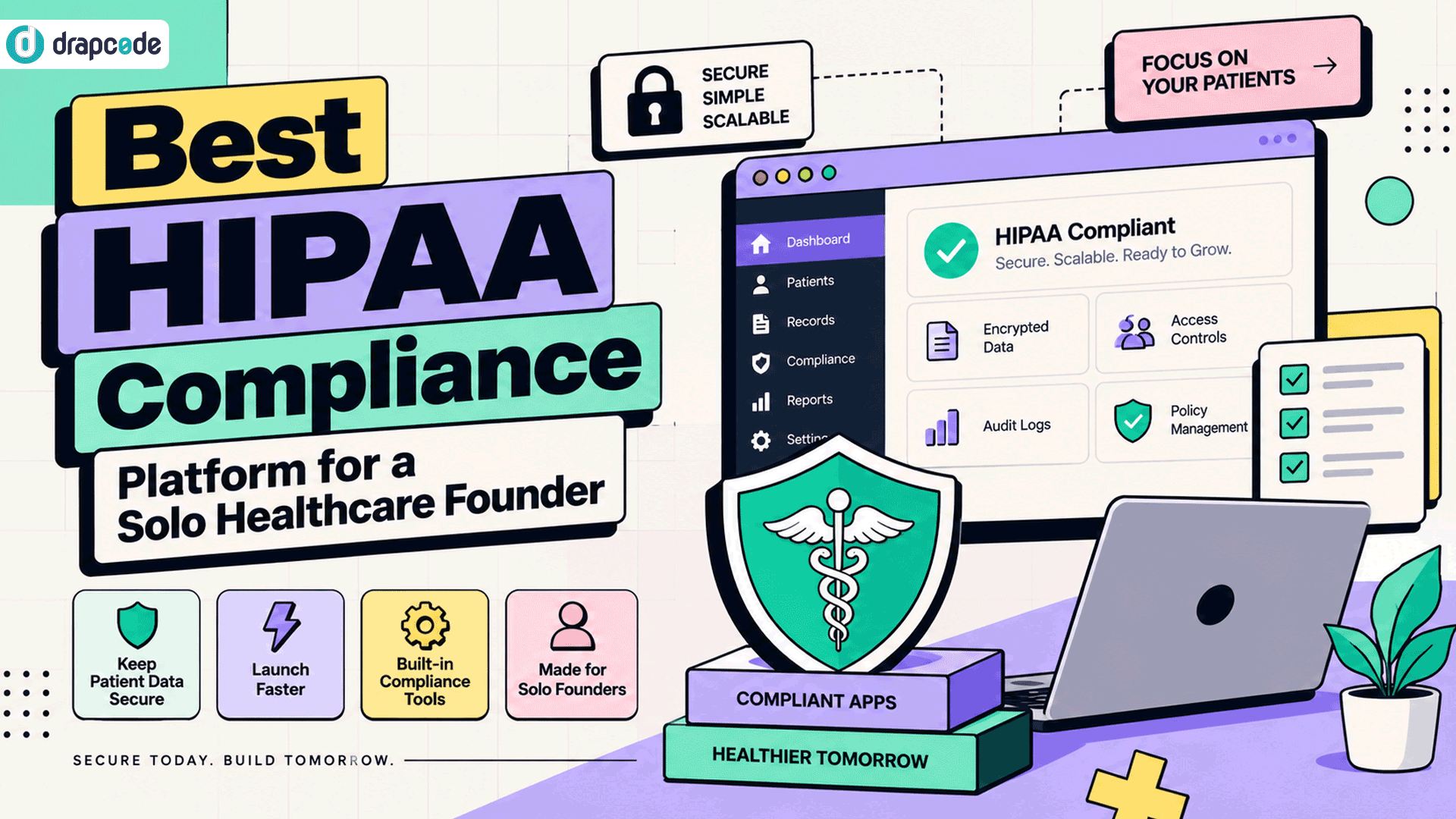
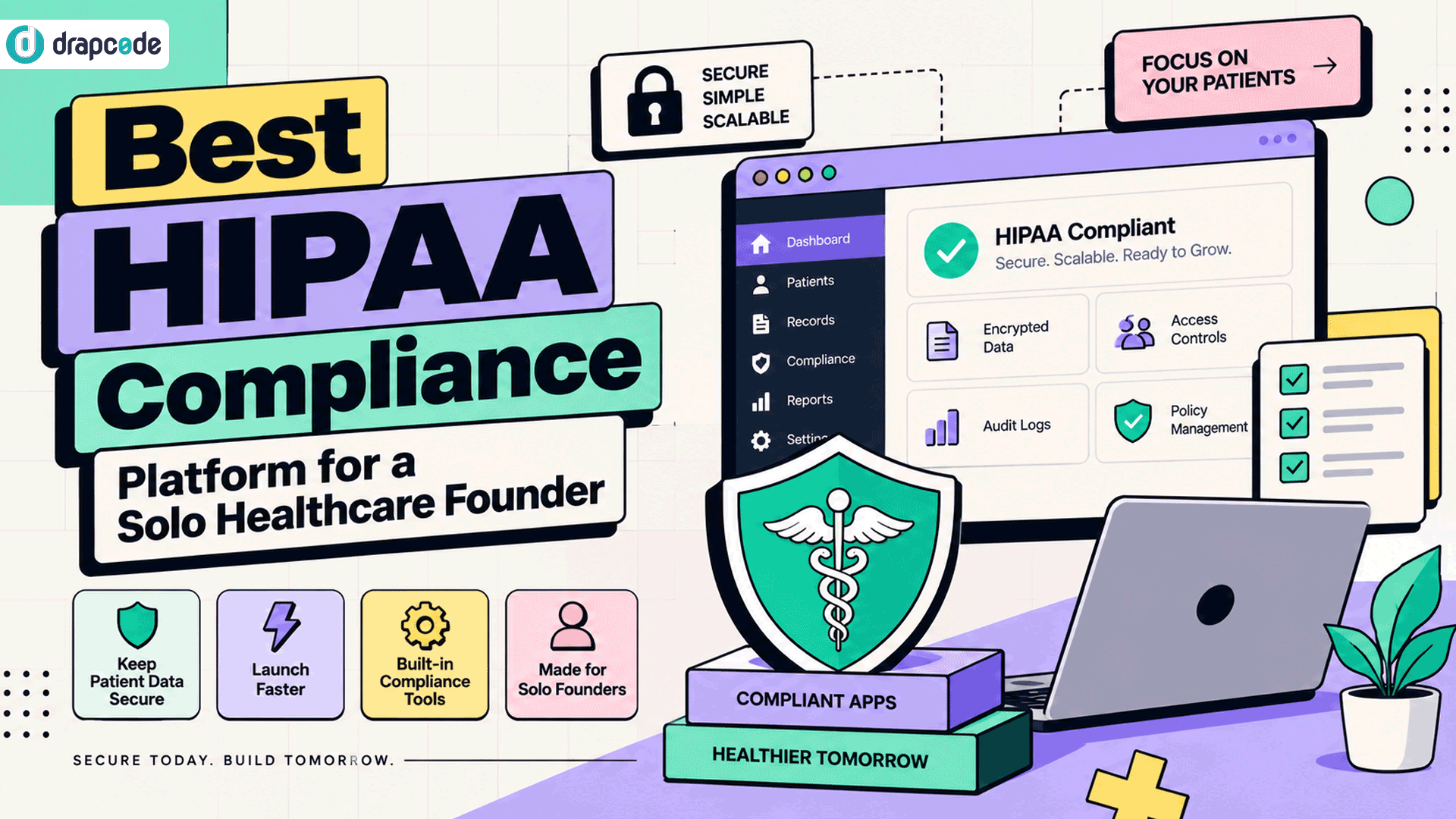
Best HIPAA Compliance Platform for a Solo Healthcare Founder
Building a healthcare startup alone means you're probably doing several jobs at once. You're talking to potential customers, working on the product, fixing bugs, choosing vendors, preparing demos, and trying to understand what needs to happen before real patient data can enter the application.
Then HIPAA enters the conversation.
A clinic asks whether you can sign a BAA. An enterprise prospect sends a security questionnaire. You realize your application needs audit logs, tighter permissions, better documentation, and a proper risk analysis.
For a larger company, these questions might go to security, legal, engineering, and compliance teams. For a solo founder, they all come back to you.
That's why the best HIPAA compliance platform for a solo healthcare founder isn't necessarily the platform with the longest feature list. It is the one that solves the part of HIPAA compliance you actually need help with without creating another full-time job.
Start With Your Problem
Before comparing platforms, there's an important distinction to make.
A HIPAA compliance platform can mean two very different things:
- Compliance management software helps with policies, risk assessments, evidence collection, employee training, vendor management, and compliance tracking.
- Healthcare application platforms help you build and operate the actual software that handles patient information, including the database, permissions, auditability, integrations, and infrastructure.
A solo founder may need one or both.
For example, Vanta provides automated evidence collection, HIPAA controls, policies, testing, and continuous monitoring. That can be useful when your primary problem is managing and demonstrating a compliance program.
But if your main problem is that the healthcare application itself still needs secure patient data storage, role-based permissions, audit logs, healthcare integrations, and production infrastructure, compliance-management software doesn't build those parts of your product for you.
Knowing which problem you have makes the shortlist much easier.
What a Solo Founder Actually Needs
HHS doesn't prescribe one specific technology stack for every organization. The Security Rule is intended to be scalable, and organizations can consider their size, complexity, capabilities, technical environment, costs, and risks when deciding which safeguards are reasonable and appropriate.
For a solo founder, that makes a few capabilities particularly important.
Risk Guidance
You need a practical way to understand where ePHI exists and what could put it at risk.
HHS describes risk analysis as foundational to Security Rule compliance. The analysis should consider all ePHI the organization creates, receives, maintains, or transmits.
Policies
Writing every policy from a blank document isn't a great use of founder time. A useful compliance-management platform can provide structured policy workflows and help keep required documentation organized.
Vendor Tracking
Your application may rely on hosting, databases, email, SMS, analytics, video, AI, and other services. You need to know which vendors interact with ePHI and whether appropriate contractual arrangements are required.
BAA Support
If a service provider creates, receives, maintains, or transmits ePHI on your behalf as a business associate, an appropriate BAA may be required. HHS specifically addresses this requirement for cloud service providers handling ePHI.
Application Security
This is the area generic compliance tools don't necessarily solve. Your actual product still needs appropriate authentication, authorization, data protection, auditability, backups, security controls, and secure infrastructure.
For a solo founder building a healthcare product, this can be the hardest part.
Platforms Worth Considering
There isn't one platform that is the right choice for every solo healthcare founder. These options solve different pieces of the problem.
Vanta
Vanta is primarily a trust and compliance management platform. Its HIPAA offering provides automated evidence collection, guided controls, policies, tests, training, and continuous monitoring.
For a solo founder, Vanta can make sense when:
- Your application architecture already exists.
- You need to organize your HIPAA program.
- Customers are requesting compliance evidence.
- You expect to pursue SOC 2 alongside HIPAA.
- You want automated monitoring across connected systems.
The important limitation is that Vanta manages the compliance process around your systems. It doesn't become the backend of your patient portal, EHR application, or care-management platform.
Sprinto
Sprinto takes a similar automation-oriented approach and supports HIPAA alongside frameworks such as SOC 2 and ISO 27001.
Its positioning is particularly relevant to startups where nobody owns compliance full time. The platform focuses on scoping compliance programs, connecting systems, identifying gaps, and maintaining readiness.
Sprinto may fit a solo founder who already has a technical product and primarily needs help operating the compliance program around it.
Again, this solves a different problem from building the healthcare application itself.
HHS Security Risk Assessment Tool
Don't overlook the free option.
HHS and the Office of the National Coordinator provide a Security Risk Assessment Tool intended to help small and medium-sized healthcare practices and business associates perform risk assessments.
For a founder at a very early stage, this can be useful when:
- You're still understanding your HIPAA obligations.
- You don't yet need a full compliance automation platform.
- Your budget is extremely limited.
- You want to begin identifying risks before selecting commercial tooling.
It isn't a replacement for your entire compliance program, but paying for a large compliance platform before understanding your actual risk environment isn't necessarily the best first move either.
DrapCode
DrapCode belongs in a different category.
It is relevant when the founder's problem isn't simply "How do I document HIPAA compliance?" but "How do I actually build and run the healthcare application?"
For a solo healthcare founder, that can mean building the application around capabilities such as:
- Role-based access
- Audit logging
- Encryption
- Healthcare-focused infrastructure
- Patient and provider workflows
- EHR and FHIR integrations
- Backups and recovery
- BAA support
- Production deployment
This approach makes more sense when you're still building the product and want healthcare requirements considered in the architecture instead of adding them after the application is finished.
For example, if you're trying to build a HIPAA-compliant patient portal, the problem isn't solved by completing a risk-assessment questionnaire. The portal itself still needs patient and provider permissions, secure records, auditability, healthcare integrations, and appropriate infrastructure.
Compliance Software vs Healthcare Platform
For a solo founder, the distinction can be summarized like this:
Need
Better Fit
Risk assessment and policy management
Compliance management platform
Automated compliance evidence
Vanta or Sprinto-type platform
Free starting point for risk analysis
HHS SRA Tool
SOC 2 + HIPAA compliance management
Compliance automation platform
Build the healthcare application
Healthcare application platform
Patient/provider permissions
Application architecture
Audit logs inside the product
Application architecture
EHR/FHIR connectivity
Healthcare application platform
Production healthcare backend
Healthcare application platform
Organizational HIPAA documentation
Compliance management process
Many healthcare startups eventually need both sides.
A healthcare-focused development platform can help address how the product is built, while compliance-management tooling can help organize and demonstrate the organization's broader compliance program.
Neither automatically replaces the other.
The Solo Founder Trap
One common mistake is buying compliance software before fixing the product.
Imagine you've built a healthcare MVP quickly using a general development stack. You purchase compliance software, complete policies, perform a risk assessment, and organize your documentation.
Then the technical review finds:
- Everyone effectively has administrator-level access.
- Important patient activity isn't logged.
- PHI appears inside application logs.
- One third-party service won't sign an appropriate BAA.
- Patient documents aren't properly isolated.
- Backups haven't been tested.
- The application has no meaningful disaster-recovery process.
Your compliance dashboard may look much more organized, but your engineering backlog just became considerably larger.
For an early healthcare startup, it often makes sense to understand the technical gaps before investing heavily in automating the paperwork around them.
Start With PHI
A solo founder doesn't need a 200-item checklist on day one.
Start by mapping PHI.
Document:
- What PHI the application collects.
- Where that information enters the system.
- Where it is stored.
- Which users can access it.
- Which third parties receive it.
- Which systems maintain copies or backups.
- How it leaves the application.
This immediately gives you a better picture of what your compliance stack needs to cover.
HHS requires risk analysis to consider all ePHI an organization creates, receives, maintains, or transmits, rather than focusing only on the primary application database.
Then Look at Your Vendors
Solo founders often rely heavily on SaaS products because building everything internally isn't realistic.
That makes vendor selection particularly important.
Review your:
- Cloud provider
- Database
- Authentication provider
- Email provider
- SMS provider
- Analytics tools
- Error monitoring
- File storage
- AI services
- Customer support software
Determine whether each service touches PHI and whether the required contractual and security arrangements are available.
HHS states that using a cloud provider to store or process ePHI is permitted when the required BAA is in place, and the organization otherwise complies with HIPAA. The organization still needs to understand the cloud environment and conduct its own risk analysis.
A vendor saying "HIPAA compliant" does not remove your responsibility to understand how you're actually using that service.
Don't Build Everything Yourself
Solo founders are usually good at keeping costs low.
But there's a difference between avoiding unnecessary spending and becoming your own security engineer, compliance officer, healthcare integration specialist, DevOps engineer, and lawyer simultaneously.
The areas worth avoiding from-scratch reinvention include:
- Authentication
- Authorization
- Audit infrastructure
- Encryption
- Backup systems
- Security monitoring
- Healthcare interoperability
- Production infrastructure
If you're building a healthcare product, using an existing healthcare application development platform for these foundations can reduce how much custom infrastructure you need to own and maintain yourself.
That leaves more founder time for the part nobody else can do for you: understanding the healthcare problem you're trying to solve.
What Should You Choose?
Instead of looking for one product with a "HIPAA" badge, decide which problem you're currently solving.
Choose compliance-management software when:
- Your application is already technically mature.
- Your biggest problem is policies and evidence.
- Customers are requesting compliance documentation.
- You need continuous compliance monitoring.
- You're preparing for additional frameworks such as SOC 2.
Choose a healthcare application platform when:
- You're still building the product.
- Your backend isn't ready for PHI.
- You need patient/provider permissions.
- You need healthcare-specific workflows.
- You need EHR or FHIR connectivity.
- You don't want to build healthcare infrastructure from scratch.
Use both when:
- The application needs healthcare-focused technical infrastructure.
- The company also needs structured organizational compliance management.
For many solo healthcare founders, that third scenario becomes relevant as the company grows.
Why DrapCode Fits the Solo Founder Stage
A solo founder rarely needs another dashboard telling them they have 47 compliance tasks remaining.
They need fewer things to own.
DrapCode is a healthcare application development company that helps founders build secure healthcare software, including patient portals, EMRs, care-management platforms, telehealth applications, and FHIR-connected systems.
Instead of assembling the healthcare architecture independently, founders can build around infrastructure and capabilities intended for healthcare applications from the beginning.
For a founder working toward a production healthcare product, this can reduce the amount of technical compliance work that needs to be designed from scratch.
If the product needs interoperability, DrapCode can also support FHIR application development rather than leaving EHR connectivity as another custom project for the founder to solve later.
A Simple Decision
If you're a solo healthcare founder, don't begin by asking:
"Which HIPAA platform has the most features?"
Start with three questions:
- Do I need help managing my compliance program?
- Look at dedicated compliance-management software.
- Do I need help making the application itself ready for healthcare?
- Look at a healthcare-focused application platform.
- Do I need both?
- Use each tool for the job it is actually designed to solve.
HIPAA doesn't require a solo startup to operate like a 5,000-person hospital. HHS specifically allows organizations to consider size, complexity, capabilities, costs, and risks when selecting reasonable and appropriate security measures.
It does, however, require regulated organizations to take ePHI protection seriously.
For a solo founder, the goal should therefore be straightforward: reduce the number of compliance and infrastructure problems you have to solve yourself while maintaining appropriate control over your healthcare product.
Frequently Asked Questions
Q1. What is the best HIPAA compliance platform for a solo founder?
It depends on what you need. Dedicated platforms such as Vanta or Sprinto focus on compliance management and evidence, while DrapCode focuses on building and operating the healthcare application itself. Very early founders can also begin risk-analysis work with the HHS Security Risk Assessment Tool.
Q2. Do I need HIPAA compliance software?
Not necessarily. HIPAA doesn't require you to purchase a particular compliance platform. HHS focuses on implementing reasonable and appropriate safeguards based on your organization's environment and risks.
Q3. Is there a free HIPAA compliance tool?
HHS and ONC provide a Security Risk Assessment Tool intended to help small and medium-sized healthcare practices and business associates perform security risk assessments.
Q4. Can a solo founder become HIPAA compliant?
Organization size does not exempt a regulated entity from applicable HIPAA requirements, but the Security Rule is scalable. HHS says organizations can consider factors including size, complexity, capabilities, infrastructure, costs, and risk when selecting security measures.
Q5. Does using a HIPAA-compliant platform make my startup compliant?
No. Using appropriate infrastructure or compliance software can help, but compliance also depends on your application's configuration, PHI workflows, vendors, policies, procedures, risk management, and organizational practices.
Build the Healthcare Product Without Building Everything Around It
If you're a solo founder, spend your time understanding patients, providers, workflows, and the healthcare problem you're solving, not rebuilding healthcare infrastructure that already exists.
DrapCode helps founders move from a healthcare idea to a production application with healthcare-focused security, infrastructure, integrations, and development built around the product.
Talk to DrapCode about your healthcare application.