Replit to HIPAA Compliance
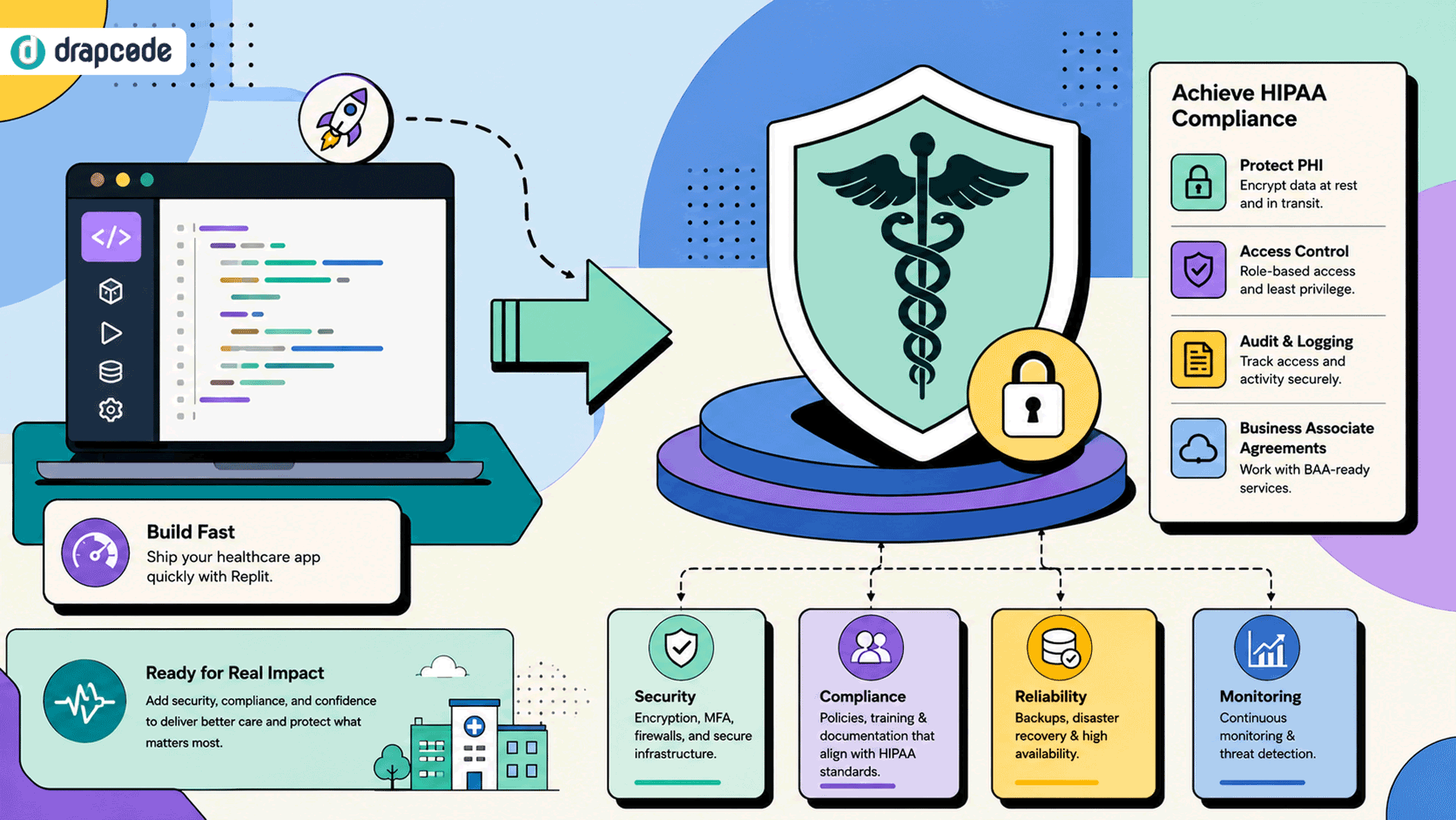
Replit can take you surprisingly far.
You can start with an idea, describe what you want to build, and quickly end up with a working application. You can write and edit code in the browser, use AI to accelerate development, connect a database, add authentication, deploy the application, and keep iterating without setting up a traditional local development environment.
For a healthcare startup, that speed is hard to ignore.
You might build a patient portal, a provider dashboard, an appointment platform, or an internal clinical workflow tool in Replit. You may even have a working application that looks and behaves like something you could launch tomorrow.
Then someone asks a very different question:
"What happens when this application starts handling real patient information?"
That's where the conversation changes.
A working Replit application and a HIPAA-compliant healthcare application are not automatically the same thing. Based on publicly available information at the time of writing, Replit provides a range of security and enterprise controls, but those capabilities alone don't make every application built on the platform HIPAA-compliant.
The application still needs to be designed, configured, deployed, and operated appropriately for its intended healthcare use.
So if you've already built your healthcare application in Replit, what comes next?
The Application Is Built. Now the Questions Get Harder.
During the early stages of a healthcare product, most questions are about the product itself.
Does the patient understand the workflow?
Can a physician complete the task quickly?
Does the dashboard provide the information a care team needs?
Can the application solve the problem we're targeting?
Replit is particularly useful during this phase because it lets teams move quickly from an idea to working software.
But healthcare customers eventually start asking questions that aren't visible in the interface.
Where is PHI stored?
Who can access it?
How are permissions enforced?
What gets recorded in an audit trail?
Which third-party services receive patient information?
How are backups handled?
What happens when an employee leaves the organization?
Those questions aren't about whether your application works.
They're about whether your application can be trusted.
And that's the real transition from a Replit project to production healthcare software.
Replit Gives You the Building Blocks. Your Architecture Still Matters.
It's easy to assume that a platform's security features automatically translate into a secure application.
They don't.
Think about identity management.
Having authentication available doesn't mean your application has correctly implemented authorization.
A user might successfully log in, but can they access another patient's records?
The same principle applies to databases.
A secure database service doesn't automatically mean every query, API endpoint, backup, and administrative workflow has been configured correctly for a healthcare workload.
The distinction matters:
Platform security is one layer. Application security is another.
For a healthcare application, both need to be considered.
This is particularly important when AI is involved in development. AI can help generate code remarkably quickly, but generated code still needs to be reviewed for authentication, authorization, data exposure, error handling, dependency vulnerabilities, and the application's specific security requirements.
Speed is valuable.
Healthcare software needs speed with engineering discipline.
Don't Confuse Enterprise Controls With HIPAA Compliance
Replit has introduced security and enterprise capabilities designed for organizations that need greater control over their development environments. Publicly available information describes features including role-based access controls, audit logs, SSO/SCIM, private deployments, isolated environments, and security tooling.
Those are meaningful capabilities.
But there's an important distinction healthcare teams shouldn't overlook.
Having security controls is not the same as having a HIPAA-compliant application.
HIPAA compliance involves more than infrastructure.
It encompasses administrative, physical, and technical safeguards, as well as policies and procedures governing how an organization handles protected health information.
The application itself also needs appropriate controls.
That means a healthcare team should evaluate the entire system rather than simply asking whether its development platform offers enterprise security features.
Start With the Data, Not the Framework
Before changing your Replit architecture, map your data.
This is one of the most useful exercises a healthcare startup can perform.
Take every piece of information your application handles and ask:
Is this PHI?
Then map where that information travels.
For example:
Patient → Mobile/Web App → API → Database → EHR/FHIR Service → Notification System
Every point in that chain deserves attention.
You need to understand:
- What information is being transmitted
- Where it is stored
- Which services can access it
- How it is encrypted
- Who can modify it
- What activity is logged
- Which third parties process it
Once you've mapped the data flow, the gaps become much easier to identify.
You may discover that the biggest compliance concern isn't Replit itself.
It could be an external API.
It could be an analytics service.
It could be a database configuration.
It could be an authentication workflow.
That's why healthcare compliance should be evaluated at the system level, not by looking at one tool in isolation.
The Backend Is Where Healthcare Complexity Starts Showing Up
A healthcare application can look deceptively simple.
Consider a patient scheduling application.
The screen might only show:
Choose provider → Select appointment → Confirm
Behind those three clicks, however, the application could be doing much more.
It may need to:
- Authenticate the patient
- Verify provider availability
- Retrieve appointment information
- Update a scheduling system
- Send a confirmation
- Record relevant activity
- Synchronize information with an EHR
Now imagine expanding that application to include medical records.
Then add care management.
Then clinical notes.
Then FHIR interoperability.
Then multiple healthcare organizations.
The architecture becomes significantly more important.
This is where healthcare-specific development expertise can make a difference. Building the interface is only one part of the job. Designing how healthcare data moves through the system is another.
What Should You Check Before Putting PHI Into Your Replit App?
There isn't one checkbox that turns an application into a HIPAA-compliant system.
Instead, healthcare teams should review the complete environment.
Authentication and Access
Make sure users aren't simply authenticated; they are authorized correctly.
A patient should see their information.
A physician should see the information necessary for their role.
An administrator shouldn't automatically have unrestricted access to every record simply because they have administrative privileges.
Auditability
Healthcare applications need visibility into important activity.
Consider whether your architecture can answer questions such as:
- Who accessed a record?
- When was it accessed?
- What changed?
- Who changed it?
- Which system initiated the action?
Data Protection
Review encryption for data in transit and at rest, along with secrets management and database access.
Don't leave sensitive credentials inside application code or exposed client-side.
Third-Party Services
Your application may depend on services for email, analytics, storage, authentication, AI, payments, messaging, or healthcare integrations.
Every service that interacts with PHI deserves scrutiny.
Healthcare Interoperability
If your application needs to communicate with clinical systems, think about interoperability early.
FHIR support can become critical when integrating with modern EHR ecosystems.
Building healthcare integrations as an afterthought can create substantial technical debt.
When a Replit Application Starts Looking Like a Healthcare Platform
There's a natural point where the development conversation changes.
At first, you might be building a single application for a single use case.
Then customers ask for additional workflows.
A provider portal.
A patient portal.
An administrator dashboard.
FHIR integration.
Care management.
Reporting.
Multiple organizations.
At that point, you're no longer simply maintaining an application.
You're building a healthcare platform.
And the requirements around architecture, security, scalability, interoperability, and governance become much more significant.
This is where a healthcare-focused development approach can help.
Instead of treating healthcare as one more industry use case, the architecture is designed around healthcare workflows from the beginning.
Replit vs DrapCode: Where Each Approach Fits
Replit is a powerful environment for developers and teams that want to build and iterate quickly, especially when they want direct control over their code and development workflow.
DrapCode takes a different approach.
It is a healthcare application development company focused specifically on building healthcare software for providers, healthcare organizations, and digital health businesses.
|
Requirement |
Replit |
DrapCode |
|
Rapid application development |
✓ |
✓ |
|
AI-assisted development |
✓ |
✓ |
|
Full-stack application development |
✓ |
✓ |
|
Healthcare application expertise |
General-purpose |
✓ Healthcare-focused |
|
Patient portals |
✓ Custom development |
✓ |
|
EMR applications |
Custom development |
✓ |
|
Care management platforms |
Custom development |
✓ |
|
FHIR interoperability |
Custom implementation |
✓ Healthcare integration support |
|
Healthcare-specific workflows |
Build and configure |
✓ |
|
HIPAA-focused application development |
Requires appropriate architecture and controls |
✓ Healthcare-focused approach |
This isn't about saying that Replit can't be used to build healthcare software.
It can be a powerful development environment.
The question is how much healthcare architecture and engineering responsibility your team wants to own.
Your Replit App May Be Closer Than You Think
If you've already built your healthcare application in Replit, don't assume the answer is to throw it away.
You may already have something valuable:
A validated workflow.
A working product.
Real user feedback.
A codebase.
A clear understanding of what customers want.
The next step is to evaluate what you have against the requirements of a production healthcare environment.
Some components may be reusable.
Others may need to be redesigned.
Some integrations may need to be replaced.
And some security controls may need to be introduced before PHI ever enters the system.
That's a much more practical approach than starting over simply because your first version was built with a general-purpose development platform.
The Bottom Line
Replit can help a healthcare startup move from an idea to a working application remarkably quickly.
But once patient information enters the picture, the definition of "ready" changes.
A production healthcare application needs more than working code.
It needs secure data flows, appropriate access controls, auditability, reliable infrastructure, carefully evaluated third-party services, interoperability where required, and an organization capable of maintaining those controls over time.
So the question isn't simply:
"Can Replit build my healthcare app?"
It can help you build one.
The more important question is:
"Is the complete application architecture ready to handle healthcare data responsibly?"
If the answer isn't clear yet, that's where a healthcare-focused development partner can help.
DrapCode works with healthcare organizations, providers, and digital health businesses to build secure, scalable applications from patient portals and EMRs to care management platforms and FHIR-enabled healthcare software.
Your Replit application may have been where the idea came to life.
The next step is making sure the technology behind that idea is ready for healthcare.
Frequently Asked Questions
Q1. Can a Replit application be made HIPAA compliant?
A Replit-built application may be designed to support HIPAA requirements, but using Replit alone does not automatically make an application HIPAA compliant. Compliance depends on the complete architecture, infrastructure, data handling, security controls, third-party services, and organizational processes.
Q2. Does Replit itself make my application HIPAA compliant?
No platform should be treated as a substitute for application-level compliance. Based on publicly available information at the time of writing, Replit offers various enterprise security capabilities, but healthcare teams still need to evaluate how their specific application handles PHI.
Q3. Should I rebuild my Replit healthcare application?
Not necessarily. Existing code, workflows, and interfaces may be reusable. A technical and security assessment can identify which components can remain and which areas need to be redesigned or strengthened.
Q4. What should I review before handling PHI?
Review authentication, authorization, encryption, database access, audit logging, secrets management, backups, infrastructure, third-party services, data flows, and healthcare integrations. Also evaluate the policies and operational safeguards surrounding the application.
Q5. Can DrapCode help migrate a Replit healthcare application?
DrapCode can help healthcare organizations evaluate and develop production-ready healthcare applications, including patient portals, EMRs, care management systems, and FHIR-enabled solutions. The appropriate migration approach depends on the existing Replit application's architecture and requirements.
Take Your Healthcare Application From Working to Production
You've already proved that the product can work.
Now make sure it can work safely, reliably, and at healthcare scale.
DrapCode is a healthcare application development company helping healthcare organizations and digital health businesses build secure, scalable software with healthcare workflows, interoperability, and production requirements in mind.
Build your healthcare application with DrapCode.