How Much Does It Cost to Make an App HIPAA Compliant?
If you already have an application and are preparing to use it in healthcare, one of the first questions is usually financial:
How much will it cost to make the app HIPAA compliant?
There is no universal HIPAA compliance price tag.
A simple application that collects limited patient information may require relatively modest changes. A platform that handles clinical records, connects to EHRs, supports multiple healthcare organizations, and stores large volumes of PHI may require a much larger investment.
The important point is that you aren't simply paying for a "HIPAA certification." HHS does not require covered entities to obtain a specific HIPAA certification, nor does it recognize private certifications as a substitute for an organization's legal obligations.
What you're actually paying for is the work required to identify risks, fix vulnerabilities, implement appropriate safeguards, document processes, and maintain those controls over time.
So, what should you budget?
A Realistic Cost Range
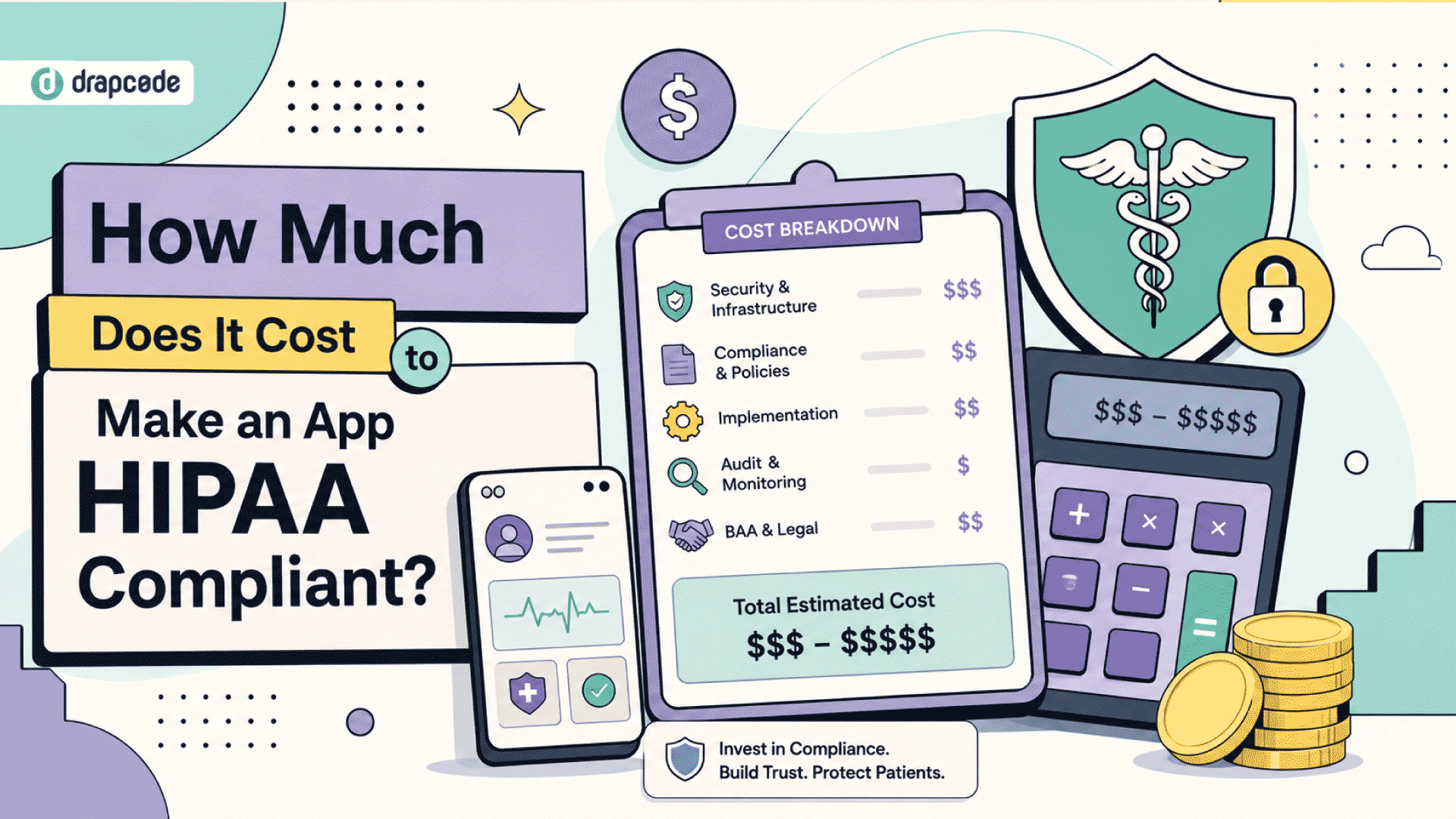
For planning purposes, a rough market estimate for bringing an existing application toward HIPAA compliance might look like this:
|
Area |
Approximate Cost |
|
HIPAA risk assessment/gap assessment |
$2,000–$10,000+ |
|
Application security remediation |
$5,000–$30,000+ |
|
HIPAA-compliant infrastructure |
$500–$5,000+/month |
|
Policies and compliance documentation |
$3,000–$15,000+ |
|
Security testing/penetration testing |
$2,000–$15,000+ |
|
Ongoing monitoring and maintenance |
$1,000–$10,000+/month |
These are planning ranges, not HIPAA-prescribed fees or fixed industry prices. Actual costs can be substantially higher or lower depending on the application, organization, existing architecture, PHI exposure, infrastructure, integrations, and required remediation.
HHS specifically states that the Security Rule is designed to be scalable and that organizations should consider their size, complexity, capabilities, technology, costs, and the probability and criticality of risks when selecting security measures.
That is why two applications can have completely different HIPAA compliance budgets.
First, Find Out What You Already Have
Before spending money on compliance, determine how close the application already is.
This is where a HIPAA risk analysis becomes important.
HHS describes risk analysis as a foundational part of Security Rule compliance. Organizations need to assess potential risks and vulnerabilities affecting the confidentiality, integrity, and availability of electronic PHI.
A useful assessment should examine:
- Where PHI is stored
- Where PHI enters the application
- How PHI moves between systems
- Who can access it
- Existing authentication controls
- Authorization and user roles
- Encryption
- Audit logging
- Backups
- Infrastructure
- Third-party services
- APIs and integrations
- Incident response
- Existing policies and procedures
You may discover that your application already has some of these controls.
You may also discover that several need rebuilding.
That difference can dramatically change the final cost.
The Biggest Cost Factor: Your Existing Architecture
Retrofitting an application is usually more complicated when security wasn't considered during the original development.
Imagine two applications.
Application A
A modern healthcare application was designed from the beginning with:
- Role-based access
- Encryption
- Audit logging
- Secure authentication
- Segmented data access
- Secure cloud infrastructure
- Controlled third-party integrations
The team may need to validate and document the existing controls, address gaps, and establish the required operational processes.
Application B
The application was built quickly with:
- Shared administrator accounts
- No meaningful audit trail
- PHI scattered across databases
- Hard-coded credentials
- Unvetted third-party services
- Weak authorization
- No documented backup strategy
The second application may require substantial redevelopment.
This is why "How much does HIPAA compliance cost?" is often the wrong first question.
A better question is:
"How much work does my application need before it can appropriately handle PHI?"
Cost of a HIPAA Risk Assessment
The first significant expense may be understanding the problem.
A risk assessment examines the application's environment and identifies vulnerabilities and risks.
HHS explains that organizations should identify where ePHI is stored, received, maintained, or transmitted; document threats and vulnerabilities; assess existing security measures; determine risk levels; and use the results to guide corrective actions.
For a small application, a focused assessment may be relatively straightforward.
For a healthcare platform with multiple environments, databases, APIs, cloud services, integrations, and user roles, the assessment can become considerably more involved.
A rough planning range is:
$2,000–$10,000+
The assessment itself doesn't make the application compliant.
It tells you what needs to happen next.
Application Security Costs
This is where costs can increase quickly.
Depending on the application's current state, you may need to implement or improve:
Authentication
Secure login, MFA, password controls, session management, and identity verification.
Authorization
Users should only access the information appropriate to their role.
A physician, patient, billing administrator, and system administrator should not necessarily have the same permissions.
Encryption
Sensitive information needs appropriate protection during transmission and storage.
Audit Logging
You need visibility into important activity involving ePHI.
Data Isolation
This becomes particularly important for multi-tenant healthcare applications.
Secure Development
Vulnerability management, dependency updates, secure coding practices, and testing become ongoing requirements.
Depending on the extent of redevelopment required, application remediation can range from several thousand to tens of thousands of dollars.
For a complex healthcare platform, the cost can be considerably higher.
Infrastructure Adds an Ongoing Cost
Making an application HIPAA-appropriate isn't just about changing the application code.
Your infrastructure matters too.
You may need to review:
- Cloud hosting
- Databases
- Storage
- Backups
- Network configuration
- Encryption keys
- Monitoring
- Access management
- Disaster recovery
- Logging
And don't look only at your primary cloud provider.
Your application may also use separate services for:
- SMS
- Analytics
- File storage
- Authentication
- AI
- Payments
- Video
- Customer support
If those services handle PHI on behalf of a covered entity, their contractual and security arrangements need to be evaluated.
HHS explains that a cloud service provider acting as a business associate generally requires a BAA when it creates, receives, maintains, or transmits ePHI on behalf of a covered entity or business associate.
That can influence both architecture and operating costs.
What Does a BAA Cost?
This is an area where people often misunderstand HIPAA.
A Business Associate Agreement (BAA) is not simply a "HIPAA certificate" that you buy.
When a covered entity uses a business associate to perform functions involving PHI, HIPAA generally requires a written business associate contract or other arrangement that includes the required provisions.
Whether a particular vendor needs a BAA depends on the relationship and whether the vendor is acting as a business associate.
The cost can therefore vary:
- Some vendors include a BAA with an eligible plan.
- Some require an enterprise agreement.
- Some charge for a healthcare-specific tier.
- Some vendors may not support the required arrangement at all.
So don't budget for "a BAA fee."
Budget for vendors and services that can appropriately support your intended PHI workflow.
Compliance Documentation Has a Cost Too
Technical security controls are only one part of the work.
Healthcare organizations also need appropriate policies and procedures.
Depending on your environment, this can include:
- Security policies
- Privacy procedures
- Incident response
- Breach response
- Workforce access procedures
- Risk management
- Data retention
- Backup procedures
- Disaster recovery
- Vendor management
- Employee training
- Documentation of safeguards
The exact requirements depend on the organization's role and circumstances.
This is why a healthcare application cannot become compliant simply by moving it to a HIPAA-supporting cloud.
The technology and the organization have to work together.
Security Testing Can Add Another $2,000–$15,000+
Security testing is another cost to consider.
Depending on the application's risk profile, you may conduct:
- Vulnerability scanning
- Application security testing
- Network testing
- Penetration testing
- Code review
- Configuration review
A small application with a limited attack surface won't necessarily require the same scope as a large multi-tenant healthcare platform.
The important thing is to identify testing requirements based on the actual risk environment rather than buying the biggest security package available.
HHS emphasizes that HIPAA risk analysis should consider the organization's environment, threats, vulnerabilities, existing security measures, likelihood, and potential impact.
Ongoing HIPAA Compliance Costs
One of the biggest budgeting mistakes is treating HIPAA as a one-time project.
It isn't.
Your application changes.
Your infrastructure changes.
Your vendors change.
New vulnerabilities emerge.
Employees join and leave.
You introduce new integrations.
You may start collecting additional types of PHI.
HHS describes risk analysis and risk management as ongoing processes and says organizations should update their security measures as needed.
That means your annual budget may include:
- Security monitoring
- Vulnerability management
- Penetration testing
- Risk assessments
- Compliance reviews
- Employee training
- Infrastructure
- Backups
- Incident response
- Security tooling
- Application maintenance
The ongoing cost can therefore be as important as the initial implementation cost.
What If You're Building the App From Scratch?
This is where the economics become interesting.
Suppose you're starting with a new healthcare application.
You have two options.
Option 1: Build Normally, Then Retrofit
You build the application quickly.
Later, a healthcare customer asks:
"Can you sign our BAA?"
Now you discover that the architecture wasn't designed around healthcare requirements.
You may need to redesign:
- Authentication
- Authorization
- Data storage
- Infrastructure
- Audit logging
- Integrations
- Vendor stack
The original development work may have to be partially redone.
Option 2: Design for Healthcare From the Beginning
You establish the data model, security architecture, infrastructure, user roles, integrations, and compliance requirements before production.
The initial development may cost more than a basic prototype.
But you can reduce the amount of expensive retrofitting later.
For healthcare applications, that difference can be significant.
How Much Does a HIPAA-Compliant App Actually Cost?
For a simple existing application, a realistic planning budget might start in the low five figures once assessment, remediation, documentation, testing, and infrastructure work are considered.
For a moderately complex healthcare application, the investment can reach tens of thousands of dollars.
For an enterprise healthcare platform spanning multiple organizations, extensive PHI, EHR/FHIR integrations, complex authorization, and high-availability requirements, costs can reach well into six figures.
These aren't HIPAA-mandated price bands.
They are planning ranges intended to illustrate how scope changes the economics.
The actual number should come from a technical and compliance assessment of your application.
What Makes HIPAA Compliance More Expensive?
Several factors can push the cost upward.
Legacy Architecture
Older applications may require extensive redevelopment.
Large Amounts of PHI
More sensitive data generally means more systems and workflows to evaluate.
Multiple Tenants
Multi-organization healthcare applications require careful data isolation and authorization.
EHR Integrations
FHIR and EHR connectivity introduce additional data flows and security considerations.
Third-Party Services
Every service touching PHI can affect your compliance architecture.
Weak Access Controls
Retrofitting granular permissions can be difficult if authorization wasn't designed into the application.
Missing Audit Logs
Adding comprehensive auditability later may require changes across the application.
Enterprise Requirements
Large healthcare customers often introduce additional security, privacy, procurement, and contractual requirements.
How to Reduce the Cost
The best way to reduce HIPAA-related development costs isn't to remove security controls.
It's to avoid expensive rework.
Start with a risk assessment.
Map PHI before designing the data architecture.
Choose vendors that can support the required healthcare relationships.
Build authorization into the application from the beginning.
Design auditability into important workflows.
Choose infrastructure appropriate for your intended PHI workload.
And avoid introducing third-party services simply because they're convenient during prototyping.
Most importantly:
Don't wait until the application is finished to think about HIPAA.
Build HIPAA Requirements Into the Application From Day One
If you already have an application, the first step should be a gap assessment.
If you're starting from scratch, you have a better opportunity.
You can design the application around healthcare requirements before technical debt accumulates.
That's one reason a healthcare-focused development approach can be more efficient than building a generic application first and attempting to retrofit it later.
DrapCode focuses specifically on healthcare application development, helping healthcare organizations and digital health businesses build applications such as patient portals, EMRs, care management systems, telemedicine platforms, and FHIR-connected healthcare software.
Rather than treating HIPAA as an add-on after development, the application can be designed around healthcare security, workflows, interoperability, and production requirements from the outset.
The Bottom Line
So, how much does it cost to make an app HIPAA compliant?
There isn't one number.
A small application with a strong existing security architecture may require a relatively limited investment.
A legacy application that handles large volumes of PHI may require substantial redevelopment.
And a complex healthcare platform can require a six-figure investment when architecture, integrations, infrastructure, testing, documentation, and ongoing security are all included.
The biggest cost variable isn't the HIPAA label.
It's how much work your application needs to safely handle PHI.
And there is no official HHS "HIPAA certification" that you simply purchase to make the problem disappear. HHS explicitly says that the Security Rule does not require organizations to certify compliance and that private certifications do not replace an organization's legal obligations.
The smarter approach is to assess your current architecture, identify the gaps, prioritize the risks, and build the required safeguards into the application.
If you're starting a healthcare application today, designing for those requirements from the outset can be considerably more practical than trying to retrofit them after the product is already built.
Frequently Asked Questions
Q1. Is there a fixed cost for HIPAA compliance?
No. HIPAA does not prescribe a fixed compliance fee. Costs depend on the organization's size, complexity, infrastructure, risks, and existing security controls.
Q2. Does HIPAA require a certification?
No. HHS states that the HIPAA Security Rule does not require covered entities to certify compliance, and HHS does not recognize private certifications as a substitute for compliance obligations.
Q3. How much does it cost to make an existing app HIPAA compliant?
A relatively simple application may require several thousand dollars in assessment and remediation, while more complex applications can require tens of thousands or more. The actual cost depends heavily on the existing architecture and security gaps.
Q4. Does a HIPAA-compliant cloud make my app HIPAA compliant?
No. Cloud infrastructure is only one component. Your application, access controls, data flows, vendors, policies, procedures, and operational safeguards also need to be evaluated.
Q5. Do I need a BAA for my app?
It depends on the relationship between your organization and the service provider. When a vendor acts as a business associate and handles PHI on behalf of a covered entity, HIPAA generally requires an appropriate written agreement.
Q6. Is HIPAA compliance a one-time expense?
No. Security and risk management need ongoing attention. HHS describes risk analysis and risk management as continuing processes, with security measures reviewed and updated as circumstances change.
Build Healthcare Software Without Retrofitting Compliance Later
If you're building a new healthcare application, don't wait until launch to ask whether the architecture can handle PHI.
DrapCode helps healthcare organizations and digital health companies build secure, scalable healthcare applications from patient portals and EMRs to care management platforms and FHIR integrations.
Build your healthcare application with DrapCode.