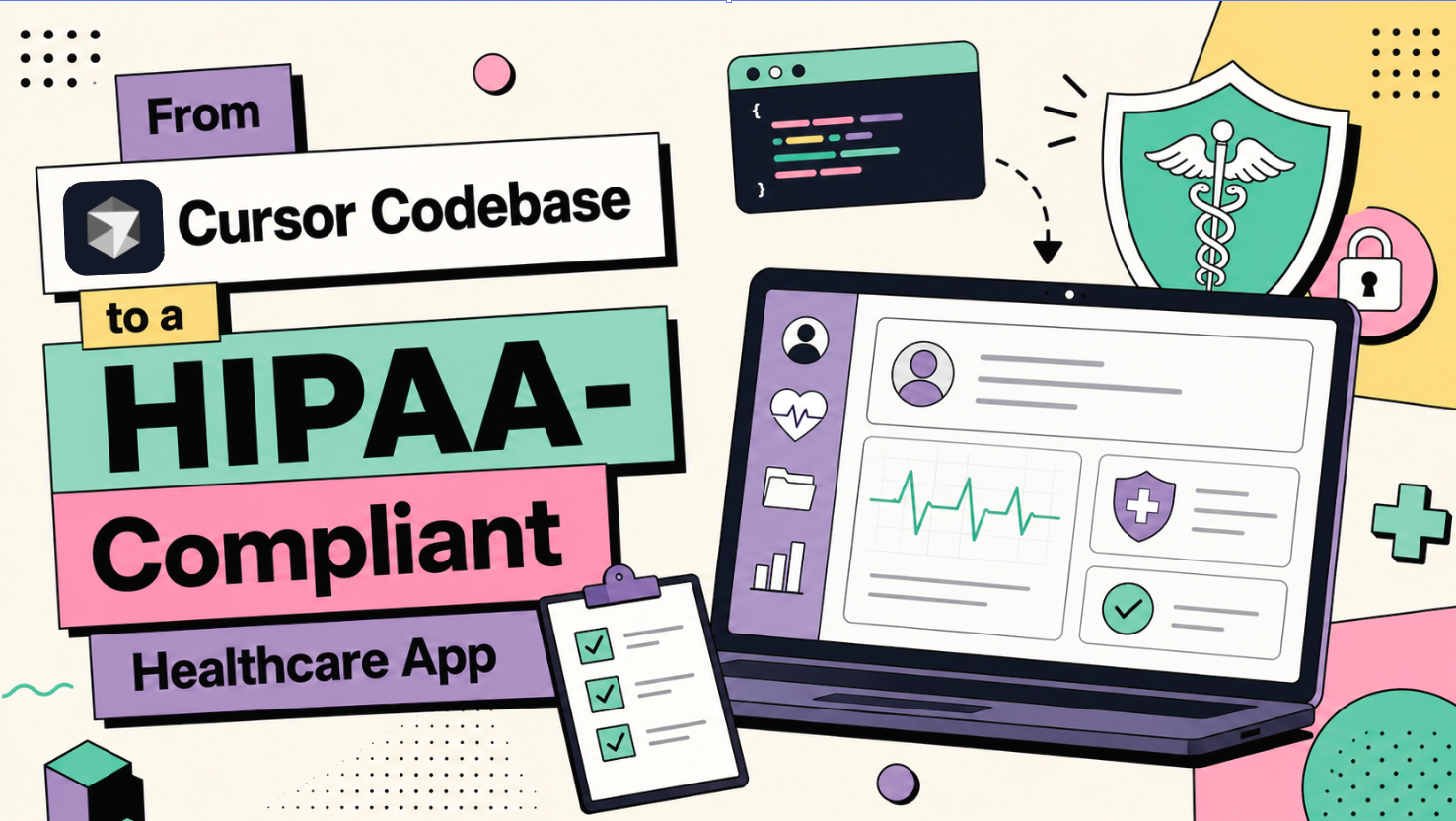
Cursor Codebase to a HIPAA-Compliant Healthcare App
Cursor has changed the way many developers write software.
Instead of treating an AI assistant as a separate chatbot, Cursor puts AI directly inside the development environment. It can understand a codebase, generate and modify files, explain unfamiliar code, help debug problems, and work across multiple parts of an application.
For a healthcare developer, that can be extremely useful.
You can use Cursor to build a patient portal, create APIs, develop authentication flows, work on FHIR integrations, generate database models, and move much faster through repetitive development work.
But there is an important distinction between using Cursor to develop healthcare software and using Cursor with healthcare data.
Those are not the same thing.
Based on Cursor's publicly available Terms of Service and data-use documentation at the time of writing, developers should not send HIPAA-regulated information, including PHI, to Anysphere through the service unless a separate arrangement permits it. Cursor's Terms specifically restrict Anysphere's provision of data regulated by laws such as HIPAA.
That doesn't mean you have to abandon a healthcare application built with Cursor.
It means you need to separate the development environment from the production healthcare environment.
Cursor Can Build the Code. It Doesn't Make the Application HIPAA Compliant.
This is the first distinction worth understanding.
Cursor is an AI-powered coding environment. It helps developers write and modify software.
It isn't a healthcare hosting platform, an EHR, a patient data platform, or a compliance framework.
You could use Cursor to create:
- A patient portal
- A provider dashboard
- An appointment management system
- A telemedicine application
- A care management platform
- An FHIR integration
- A healthcare CRM
- A remote patient monitoring application
But the fact that Cursor helped generate the code doesn't determine whether the resulting application is HIPAA compliant.
That depends on the architecture around the code.
- Where is PHI stored?
- How is it encrypted?
- How are users authenticated?
- How is access authorized?
- Are patient records isolated correctly?
- Are accesses logged?
- Which external services receive data?
- How are backups protected?
Those decisions remain the responsibility of the application and its operating environment.
The Real Issue Is What Cursor Sees
This is where Cursor is different from the other development tools in this series.
Your application code may not contain PHI.
But your development activity might.
Imagine you're debugging a patient portal and paste this into Cursor:
"Why does this patient record fail to load?"
Then you include an API response containing:
- Patient name
- Date of birth
- Medical record number
- Diagnosis
- Appointment information
You've just introduced PHI into an AI development workflow.
The problem isn't that Cursor generated the code.
The problem is that real healthcare data became part of the prompt or context.
Cursor's current Terms specifically prohibit providing information regulated by HIPAA and other laws with specific security requirements, absent an applicable arrangement.
For healthcare developers, that means the safest principle is straightforward:
Develop with synthetic or de-identified data. Keep real PHI out of Cursor unless your organization's legal and compliance teams have confirmed an appropriate contractual and technical arrangement.
Privacy Mode Helps, but It Isn't a HIPAA Checkbox
Cursor offers Privacy Mode, an important security feature.
According to Cursor's current documentation, when Privacy Mode is enabled, customer data isn't used for model training, and Cursor maintains zero-data-retention agreements with its model providers. Cursor also says that some temporary processing can still occur, including risk-classifier processing in certain circumstances.
Cursor also currently has SOC 2 Type II attestation and describes additional security controls, including encryption, enterprise identity management, compliance logging, and security controls for agents and MCP.
Those are meaningful controls.
But Privacy Mode does not override Cursor's Terms of Service.
It also doesn't turn Cursor into a HIPAA-compliant hosting environment.
That's an important distinction because "zero data retention" and "HIPAA compliant" are not interchangeable concepts.
Privacy Mode answers a question about how Cursor handles your development data.
HIPAA compliance involves a much broader set of technical, administrative, and contractual requirements.
Your Codebase Can Still Leave Your Machine
There's another detail healthcare development teams should understand.
Cursor's current data-use documentation says that when you index a codebase, Cursor uploads portions of the codebase to its servers to calculate embeddings. The plaintext of that request is not retained, whereas embeddings and metadata, such as hashes and filenames, may be stored. Cursor also temporarily caches file contents during requests.
That doesn't mean Cursor is casually storing your entire source repository.
It does mean developers shouldn't assume:
"It's an editor on my laptop, so none of my project information leaves my machine."
The actual data flow depends on the feature and privacy configuration.
For a healthcare development team, that distinction matters.
Before using Cursor with a sensitive codebase, security teams should understand:
- What information is transmitted
- Which Cursor features trigger transmission
- Which model providers receive requests
- How Privacy Mode is configured
- What enterprise controls are available
- What data is retained
- What happens when agents or external tools are enabled
Agents Add Another Security Question
Cursor has moved beyond simple autocomplete.
Its agent capabilities can work across a codebase and perform development tasks. Cursor also provides controls around agents, MCP servers, hooks, and cloud-agent functionality.
That's powerful.
It also expands the security surface.
An AI agent that can access your repository, execute commands, call external services, or interact with MCP servers has more capabilities than an AI assistant that simply suggests a line of code.
For healthcare development, every additional capability deserves review.
Consider an agent that can:
Read → Modify → Execute → Call external service → Return result
If any part of that chain can access sensitive information, you need to understand the resulting data flow.
This doesn't make AI agents unsuitable for healthcare development.
It means they should be governed like any other development capability with access to sensitive systems.
Build With Synthetic Data First
One of the easiest ways to reduce unnecessary exposure is also one of the simplest:
Don't develop against real patient data.
Instead, create realistic synthetic datasets.
For example:
Patient: Sarah Miller
DOB: 03/14/1987
Condition: Type 2 diabetes
Provider: Dr. Example
The data looks realistic enough to test the application.
But it isn't a real person's medical information.
This allows developers to use Cursor for:
- Debugging
- API development
- UI development
- Database queries
- FHIR mapping
- Authentication workflows
- Error investigation
- Automated tests
without putting actual PHI into the AI development workflow.
When real data is necessary for testing, use de-identified data appropriately and follow your organization's policies.
Your Production Environment Is a Separate Problem
Let's say Cursor helped you successfully build the application.
You now have:
- Frontend
- Backend
- Database
- Authentication
- APIs
- Healthcare integrations
The next question is where that application runs.
That's where your production architecture needs to take over.
Your healthcare application should have deliberate controls around:
Authentication
Users need secure identity verification.
Authorization
A successful login should not mean unlimited access.
A physician, patient, administrator, nurse, and billing user may all need different permissions.
Audit Logging
Important activity should be traceable.
Encryption
Sensitive information should be protected in transit and at rest.
Data Isolation
Patients should only be able to access records they are authorized to see.
Backup and Recovery
Healthcare applications need reliable recovery processes.
Third-Party Services
Every external service that receives sensitive information needs to be evaluated.
Interoperability
Applications connecting to EHRs and other healthcare systems may need FHIR, APIs, or other healthcare integration mechanisms.
Cursor can help developers write many of these components.
It doesn't replace the architecture required to operate them securely.
What Happens to Your Cursor Code Next?
This is where a healthcare-focused development platform can become useful.
You don't necessarily need to throw away your Cursor code.
The existing codebase may contain months of valuable development work.
Your team may already have:
- Validated workflows
- UI components
- Business logic
- API definitions
- Database schemas
- Integration code
- Automated tests
The question is whether those components can be moved into a production environment designed around your healthcare requirements.
That process might involve reviewing the existing architecture, replacing unsuitable dependencies, restructuring data access, implementing healthcare-specific authorization, establishing auditability, and connecting the application to compliant infrastructure and healthcare systems.
In other words:
The goal isn't to replace the product. It's to make the production architecture appropriate for the product.
Cursor vs DrapCode
Cursor and DrapCode solve different problems.
Cursor is fundamentally a developer productivity environment. It gives developers AI-powered tools for writing and working with software.
DrapCode is a healthcare application development company focused on building healthcare software for providers, healthcare organizations, and digital health businesses.
|
Cursor |
DrapCode |
|
|
AI-assisted coding |
✓ |
✓ |
|
Full application development |
✓ |
✓ |
|
Developer code control |
✓ |
✓ |
|
Healthcare-focused development |
General-purpose |
✓ |
|
Patient portals |
Custom development |
✓ |
|
EMR applications |
Custom development |
✓ |
|
Care management |
Custom development |
✓ |
|
FHIR integrations |
Developer implementation |
✓ Healthcare-focused |
|
Healthcare architecture |
Developer responsibility |
✓ |
|
HIPAA-focused production development |
Requires appropriate architecture and arrangements |
✓ |
|
Healthcare application expertise |
General-purpose |
✓ |
This doesn't make Cursor a bad choice for healthcare developers.
Quite the opposite.
A development team can find Cursor extremely useful while building healthcare software.
The important distinction is that Cursor can be part of the development workflow without being the environment where PHI is processed.
When Cursor Stops Being Enough
You may reach a point where the development challenge isn't writing code anymore.
It's putting all the pieces together.
Your application needs to:
- Authenticate thousands of users
- Separate patient and provider access
- Connect with an EHR
- Exchange FHIR resources
- Maintain audit trails
- Store clinical documents
- Support multiple healthcare organizations
- Meet security requirements
- Scale reliably
At that point, you're building a healthcare platform, not simply writing software.
That's when healthcare-specific application architecture becomes increasingly important.
A developer can build an excellent API.
A healthcare application needs an API that also fits into the broader clinical, security, interoperability, and compliance environment.
A Practical Path From Cursor to Production
If your application has already been developed with Cursor, here's a more sensible path than starting again.
1. Review the codebase
Identify the frontend, backend, database, authentication, APIs, dependencies, and external services.
2. Remove PHI from development workflows
Use synthetic or appropriately de-identified data during development and testing.
3. Map the data
Document where PHI will be entered, moved, processed, and stored.
4. Review third parties
Identify all external services involved in the application and determine whether they are appropriate for your intended use in healthcare.
5. Reassess authorization
Healthcare applications need more than login screens. Define permissions around actual healthcare roles and data access.
6. Establish production infrastructure
Move the application into an environment appropriate for your healthcare requirements, including required contractual and security controls.
7. Add interoperability
Implement FHIR, EHR, EMR, laboratory, or other integrations based on your product requirements.
8. Validate before using real PHI
Don't make the first production patient your compliance test.
Review the application, infrastructure, vendors, policies, and operational controls before real PHI enters the system.
The Bottom Line
Cursor can be an excellent tool for building healthcare software.
But there's a line healthcare developers need to keep clear:
Cursor can help write the application. It should not be treated as the place to put PHI.
Under Cursor's current Terms of Service, HIPAA-regulated information should not be provided to Anysphere unless a separate arrangement permits it. Cursor's Privacy Mode, SOC 2 Type II attestation, encryption, and enterprise controls provide important security capabilities, but they don't, by themselves, make a healthcare application HIPAA-compliant.
If you've already built your healthcare application with Cursor, that doesn't mean you have to start over.
Your codebase can be the foundation.
The next step is to put that code into an architecture designed for healthcare, with appropriate security, PHI controls, interoperability, and production requirements.
That's where DrapCode can help.
DrapCode focuses specifically on healthcare application development, helping organizations build patient portals, EMRs, care management systems, telehealth applications, FHIR-enabled platforms, and other healthcare software.
Build the code with the tools your developers prefer. Build the production healthcare application on an architecture designed for healthcare.
Frequently Asked Questions
Q1. Is Cursor HIPAA compliant?
Based on Cursor's publicly available information at the time of writing, Cursor should not be treated as a HIPAA-compliant environment for processing PHI. Its Terms of Service specifically restrict users from providing HIPAA-regulated information to Anysphere unless an applicable arrangement permits it.
Q2. Can I use Cursor to build a HIPAA-compliant healthcare app?
Yes, Cursor can be used as a development tool when building healthcare software, provided your development workflow and data handling are appropriately designed. The resulting application still needs a suitable production architecture, infrastructure, security controls, and operational safeguards.
Q3. Does Cursor Privacy Mode make it HIPAA compliant?
No. Privacy Mode prevents customer data from being used for training and provides additional data-retention protections, but it should not be interpreted as a HIPAA compliance certification or authorization to send PHI to Cursor.
Q4. Can I use real patient data while coding with Cursor?
You should not send PHI to Cursor under its current standard Terms of Service unless you have confirmed that an applicable separate arrangement permits it. Use synthetic or appropriately de-identified data during development instead.
Q5. Do I need to rebuild an application created with Cursor?
Not necessarily. Existing code, workflows, APIs, and interfaces may be reusable. The right approach is to assess the current architecture and determine which components need to be changed before moving the application into a production healthcare environment.
Q6. Can DrapCode help with a Cursor-built healthcare application?
Yes. DrapCode focuses on healthcare application development and can help organizations develop or transition applications such as patient portals, EMRs, care management platforms, and FHIR-connected healthcare applications toward production.
From Cursor Code to Production Healthcare Software
Your Cursor codebase can be the starting point.
But healthcare production requires more than good code.
It requires an architecture that protects patient information, controls access, supports interoperability, provides visibility into critical activity, and scales with the organization that uses it.
Turn your healthcare codebase into a production-ready healthcare application with DrapCode.