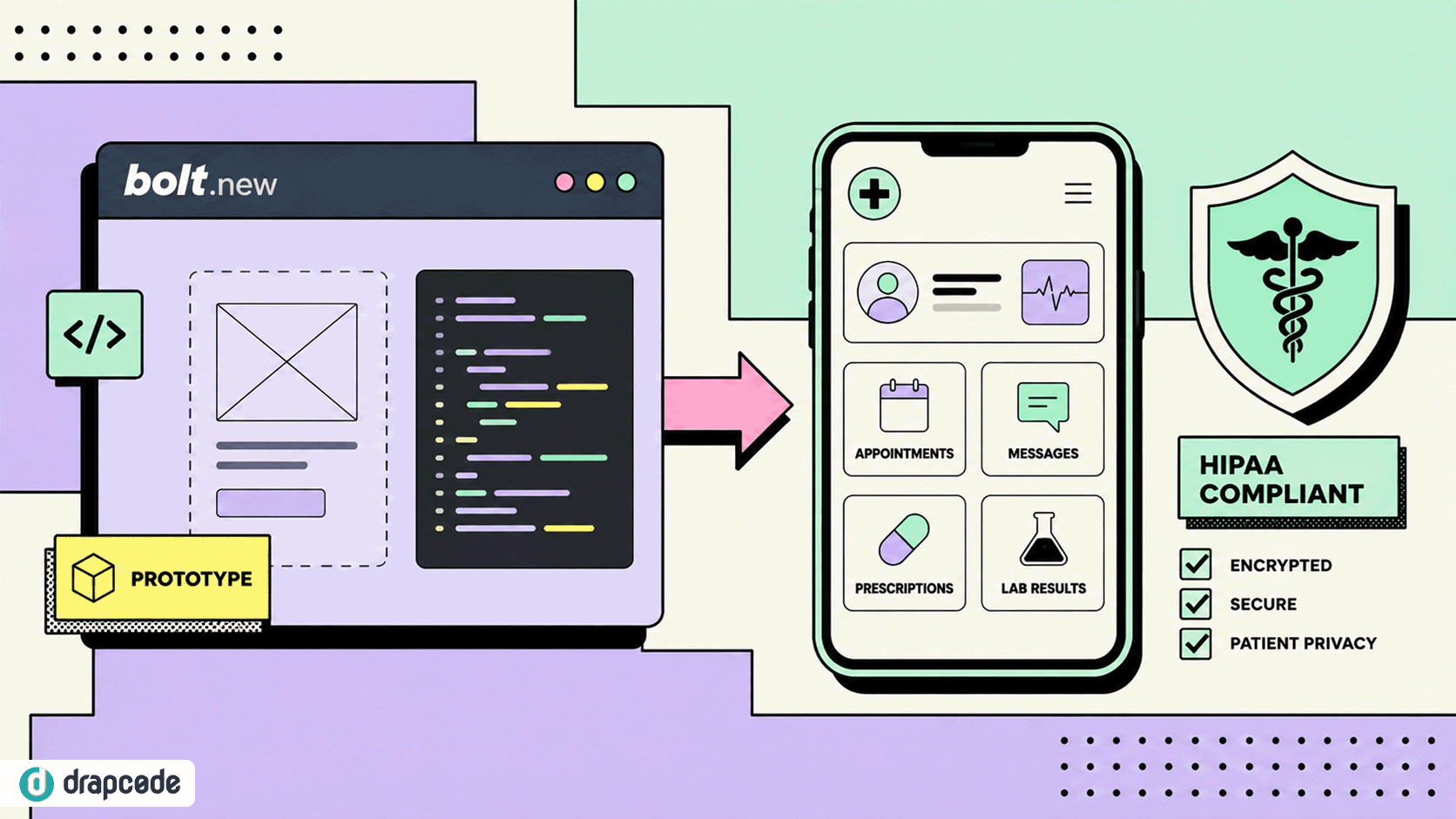
Bolt.new Prototype to a HIPAA-Compliant Healthcare App
There's a moment every healthcare founder remembers.
You've spent days refining prompts, tweaking features, and watching Bolt.new generate a real, working application. Authentication is in place, APIs are connected, the database is working, and your dashboard actually looks like a product, not a prototype.
For the first time, your idea feels real.
You send the demo to a potential investor.
A physician tries it and says, "This could actually help our patients."
A healthcare startup accelerator invites you to present.
Then someone asks a question that changes the entire conversation.
"Can this handle patient data securely?"
Until that point, your biggest challenge was building software quickly.
Now, your biggest challenge is building software that healthcare organizations can trust.
That's an important distinction.
Bolt.new excels at helping developers and founders build applications at remarkable speed. But healthcare software isn't judged by how fast it was built. It's judged by how safely it handles Protected Health Information (PHI), how well it integrates with healthcare systems, and whether providers can rely on it every single day.
The good news?
If you've already built your MVP in Bolt.new, you're much closer to the finish line than you think.
The journey isn't about replacing your application.
It's about strengthening the foundation underneath it.
Bolt.new Already Solved the First Problem
Every startup begins with uncertainty.
Will users understand the product?
Does the workflow make sense?
Are we solving the right problem?
Traditionally, answering those questions meant months of development before anyone could even test the product.
Bolt.new changed that.
Instead of waiting for engineering sprints, founders can describe their idea in natural language and quickly generate working applications with modern interfaces, backend logic, authentication, and integrations.
That's an incredible advantage.
By the time you're thinking about HIPAA compliance, you've probably already achieved something many startups never do:
- Validated the product idea
- Demonstrated it to investors
- Gathered feedback from clinicians
- Tested user journeys
- Improved the overall experience
Those lessons are valuable.
The interface isn't the problem.
Even much of the generated code isn't the problem.
The next stage is about preparing that application for real healthcare environments.
Why "Working Software" Isn't the Same as "Healthcare Software"
One of the biggest surprises for first-time healthcare founders is discovering that software can be technically complete while still being far from production-ready.
Your application may already support:
- User registration
- Secure login
- Appointment booking
- Messaging
- File uploads
- Dashboards
- Notifications
Everything works exactly as expected.
But healthcare organizations don't only evaluate features.
They also ask questions such as:
- Where is patient information stored?
- Who can access medical records?
- Can every action be audited?
- How are permissions managed across different roles?
- Which vendors process healthcare data?
- How does the application exchange information with existing healthcare systems?
These questions rarely come up during an MVP demonstration.
They become critical the moment your application begins handling real patient information.
The Code Doesn't Need a Rewrite; The Architecture Needs an Upgrade
Many founders assume migrating beyond Bolt.new means rebuilding everything from scratch.
In most cases, that's unnecessary.
Bolt.new has already helped generate valuable application logic, user interfaces, and workflows.
The challenge isn't the code itself.
The challenge is ensuring the surrounding architecture can support healthcare requirements.
Think of your application like a newly constructed medical clinic.
The walls are painted.
The reception desk is ready.
The waiting room looks welcoming.
Patients would probably feel comfortable walking inside.
But before the clinic opens, much more work needs to happen.
Access to medical records must be restricted.
Clinical systems need to communicate securely.
Emergency procedures must be documented.
Every important action must be traceable.
Healthcare software follows the same principle.
A polished application is only one part of the overall system.
The architecture supporting that application is what builds trust.
What Should Stay and What Should Change?
One of the smartest migration strategies is separating the parts that already create value from the parts that need additional engineering.
|
Keep Building On |
Strengthen Before Production |
|
Product vision |
Authentication strategy |
|
User interface |
Backend architecture |
|
Business workflows |
Role-based access control |
|
Customer feedback |
Audit logging |
|
Forms and dashboards |
Infrastructure security |
|
Application logic |
Healthcare integrations |
This approach saves time because you're improving what already works instead of discarding months of progress.
Your users don't care whether you rewrote every line of code.
They care that the application is secure, reliable, and easy to use.
The First Hospital Customer Changes Everything
Early users are often forgiving.
Pilot customers understand they're helping shape a new product.
Healthcare organizations are different.
Once a hospital, clinic, or digital health provider considers using your platform, expectations become much higher.
Instead of asking about features, decision-makers begin asking about trust.
Can the application integrate with our Electronic Health Record (EHR)?
How are patient permissions managed?
Can administrators review user activity?
How is sensitive information protected?
Can this support multiple departments?
Those conversations signal an important transition.
Your application is no longer just an MVP.
It's becoming healthcare software that people may depend on every day.
That shift doesn't require abandoning Bolt.new.
It requires building a stronger operational foundation around everything you've already created.
Think Beyond the Demo
One of the easiest traps for founders is optimizing only for the next product demonstration.
Every feature is built to impress investors.
Every improvement is designed for the next customer meeting.
Healthcare products eventually outgrow that mindset.
Production software must perform consistently long after the demo ends.
It must support updates without disrupting users.
It must integrate with existing healthcare ecosystems.
It must remain secure as new customers, providers, and administrators join the platform.
That's why the transition from prototype to production isn't measured by the number of features you add.
It's measured by how confidently healthcare organizations can rely on your application.
A Practical Checklist Before You Handle Your First Patient Record
The moment your application starts handling Protected Health Information (PHI), the questions you're answering become very different.
You're no longer asking, "Does this feature work?"
You're asking, "Can healthcare organizations trust this platform?"
Before moving beyond a prototype, it's worth reviewing a few key areas.
1. Review Your Authentication Strategy
Healthcare applications often involve multiple user types: patients, physicians, nurses, administrators, billing teams, and support staff.
Each role should have only the access needed to perform its job.
Strong authentication and well-defined access controls become essential as the application grows.
2. Evaluate Where Patient Data Lives
Patient information shouldn't simply be stored wherever it's most convenient.
Healthcare teams should understand:
- Where data is stored
- How it's encrypted
- Who has access
- How backups are managed
- Which services process that information
These decisions influence both security and long-term scalability.
3. Plan for Auditability
Healthcare organizations frequently need visibility into important system activity.
For example:
- Who viewed a patient record?
- When was information updated?
- Which administrator changed user permissions?
- What actions were performed within the application?
Designing audit capabilities early is far easier than introducing them after deployment.
4. Think Beyond Today's Features
Your MVP might support appointment scheduling today.
Six months from now, customers may request:
- Telehealth consultations
- Clinical documentation
- Care management workflows
- FHIR integrations
- Laboratory connectivity
- Patient messaging
- Remote patient monitoring
Planning your architecture with future growth in mind reduces the need for major redesigns later.
From Prototype to Production: A Smarter Migration Path
Many founders imagine migration as a complete rebuild.
In reality, it's usually a structured evolution.
A practical roadmap often looks like this.
Phase 1: Preserve What Users Already Love
Keep the parts that have already been validated:
- User journeys
- Navigation
- Product branding
- Core workflows
- Customer feedback
These represent real product learning, not technical debt.
Phase 2: Strengthen the Foundation
Focus engineering efforts on:
- Backend services
- Identity and authentication
- Role-based permissions
- Database architecture
- API security
- Infrastructure planning
This is where the application becomes capable of supporting healthcare workloads.
Phase 3: Introduce Healthcare Capabilities
Once the architecture is ready, expand into healthcare-specific functionality such as:
- FHIR interoperability
- Patient record management
- Provider workflows
- Clinical data exchange
- Secure notifications
- Reporting and audit trails
Phase 4: Prepare for Enterprise Adoption
Before onboarding healthcare providers, evaluate areas including:
- Performance
- Security testing
- Operational monitoring
- Disaster recovery
- Deployment processes
- Long-term maintenance
By following this approach, your Bolt.new prototype evolves into software that's prepared for real-world healthcare environments rather than remaining a successful demo.
Bolt.new vs DrapCode: Different Stages of the Product Journey
Bolt.new and DrapCode aren't solving the same problem.
Bolt.new helps founders and developers move from an idea to a working application with remarkable speed.
DrapCode helps healthcare organizations move from a validated application to a production-ready healthcare platform.
Here's how they compare.
|
Product Goal |
Bolt.new |
DrapCode |
|
Generate working applications with AI |
✓ Core capability |
✓ AI-assisted healthcare development |
|
Validate product ideas |
✓ Excellent |
✓ Supported |
|
Rapid frontend and backend scaffolding |
✓ Strong capability |
✓ Supported |
|
Patient portals |
Prototype quickly |
✓ Production-ready development |
|
Care management platforms |
Requires additional engineering |
✓ Supported |
|
EMRs and EHR applications |
Custom implementation |
✓ Supported |
|
FHIR interoperability |
Build separately |
✓ Native healthcare integration support |
|
Healthcare workflow automation |
Custom development |
✓ Visual healthcare workflows |
|
Healthcare application expertise |
General-purpose AI builder |
✓ Healthcare application development company |
This isn't a story about replacing Bolt.new.
It's about knowing when your product has reached the point where healthcare-specific architecture, interoperability, and security become the priority.
Building Trust Is the Next Milestone
Every startup celebrates its first working application.
Healthcare companies celebrate something different.
They celebrate their first successful pilot.
Their first provider deployment.
Their first healthcare organization that says:
"We trust your platform with our patients."
That level of trust isn't earned through beautiful interfaces or AI-generated code alone.
It's earned through secure architecture, thoughtful engineering, reliable integrations, and an understanding of how healthcare organizations actually operate.
The prototype gets you noticed.
The production platform earns long-term customers.
Final Thoughts
Bolt.new has changed how quickly founders can transform ideas into working software.
For healthcare startups, that speed can dramatically reduce the time needed to validate concepts, attract investors, and gather meaningful customer feedback.
But every successful healthcare company eventually reaches the same point.
The focus shifts from building quickly to building responsibly.
That doesn't mean abandoning your Bolt.new application.
It means strengthening the systems behind it so the software can support healthcare organizations with confidence.
If you've already validated your idea, you're not starting over.
You're building on proven foundations, and that's a much better place to be.
Frequently Asked Questions
Q1. Can I use my Bolt.new prototype as the foundation for a healthcare application?
Yes. In many cases, the application's interface, workflows, and business logic can continue to evolve. Healthcare teams typically strengthen the backend architecture, authentication, security controls, and integrations before production deployment.
Q2. Does Bolt.new make an application HIPAA compliant?
No. Based on publicly available information at the time of writing, Bolt.new helps generate applications, but HIPAA compliance depends on the complete solution, including infrastructure, data handling, security controls, operational processes, and any required Business Associate Agreements (BAAs).
Q3. Do I need to rebuild my entire application?
Usually not. Most teams preserve validated product ideas and user experiences while improving the underlying architecture to support production healthcare requirements.
Q4. When should I migrate beyond the prototype stage?
It's a good time to start planning when you're preparing for pilot customers, handling real patient information, integrating with healthcare systems, or moving toward commercial deployment.
Q5. Why choose DrapCode after building an MVP?
DrapCode is a healthcare application development company that helps healthcare organizations build secure patient portals, EMRs, care management platforms, telehealth applications, and FHIR-enabled software using AI-assisted visual development and healthcare-focused architecture.
Turn Your Bolt.new Prototype Into Software Healthcare Organizations Can Trust
Your prototype proved the idea.
Now it's time to build the security, interoperability, and reliability that healthcare organizations expect.
DrapCode is a healthcare application development company that helps startups, providers, and digital health businesses transform AI-generated prototypes into production-ready healthcare applications. From patient portals and EMRs to telehealth platforms and FHIR-enabled solutions, we help teams move from MVP to real-world deployment with confidence.