DrapCode vs Databutton
DrapCode and Databutton support rapid application development from different directions. DrapCode focuses on production healthcare software, while Databutton is an AI development platform for generating full-stack applications with Python and React.
DrapCode for Healthcare Applications
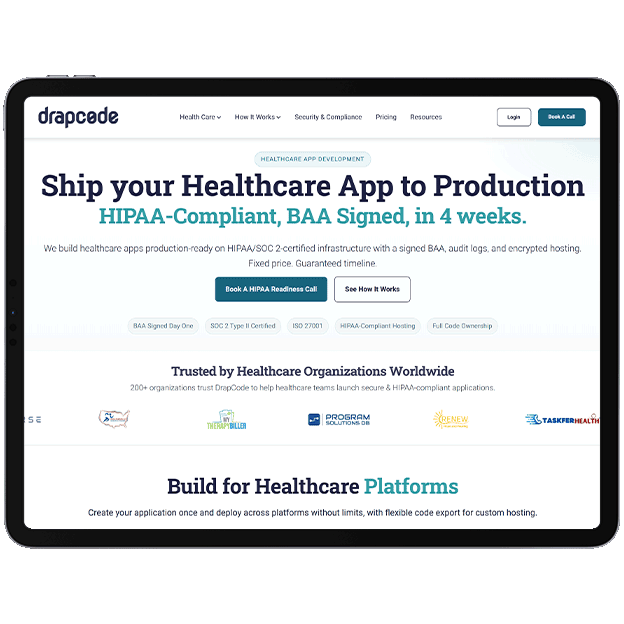
DrapCode is designed for healthcare organizations building software for patients, providers, care teams, and healthcare operations. Its platform combines healthcare application development with HIPAA-focused infrastructure, interoperability, and production deployment. Teams can build patient portals, EHR-connected applications, care management systems, telemedicine platforms, and remote patient monitoring software around specific healthcare workflows.
Databutton for AI App Development
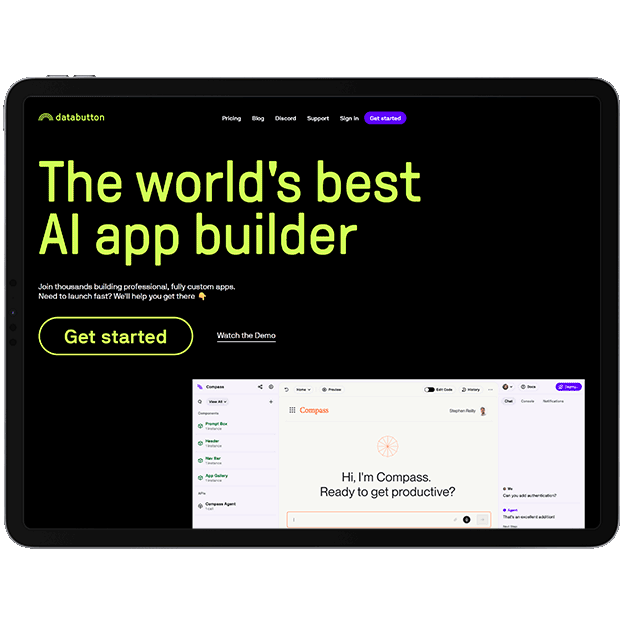
Databutton is an AI development platform that generates full-stack applications from user instructions. Its development stack has centered on React with TypeScript for the frontend and Python with FastAPI for the backend. Databutton also provides built-in deployment, database capabilities, authentication, secrets management, and code editing. Its platform is intended for a broad range of applications rather than healthcare-specific software.
Healthcare App Development Comparison
Compare DrapCode and Databutton across healthcare specialization, compliance, interoperability, technology stacks, application infrastructure, and deployment.
| Healthcare Capability | DrapCode | Databutton |
|---|---|---|
| Platform Focus | Healthcare application development and deployment. | AI-powered full-stack application development. |
| Healthcare Specialization | Designed specifically for healthcare software requirements. | General-purpose platform for different application types. |
| HIPAA Compliance | Supports HIPAA-compliant healthcare application development. | No public HIPAA compliance commitment identified. |
| BAA | BAA available for healthcare projects. | No public BAA offering identified. |
| FHIR Integration | Supports FHIR-based healthcare interoperability. | No dedicated FHIR capability publicly documented. |
| EHR Integration | Supports applications connecting with EHR and healthcare systems. | Requires custom API development for external healthcare systems. |
| Frontend Stack | Supports healthcare application interfaces and workflows. | React with TypeScript. |
| Backend Stack | Healthcare application backend and workflow capabilities. | Python with FastAPI. |
| Database | Data architecture suited to healthcare applications. | Built-in PostgreSQL infrastructure for applications. |
| Authentication | Supports role-based access for healthcare applications. | Built-in user authentication for applications. |
| Code Export | Export the complete application source code. | Export application code as a downloadable project. |
| Deployment | Healthcare-focused cloud and deployment options. | One-click managed deployment and custom domains. |
| Best Fit | Production healthcare applications and digital health products. | AI-generated internal tools, SaaS apps, and data-driven applications. |
When to Choose DrapCode
Choose DrapCode when healthcare requirements need to influence the application's architecture from development through production.
Healthcare Workflows
Build workflows designed around patients, providers, care teams, and care delivery.
PHI Protection
Develop applications intended to process protected health information in production.
FHIR Projects
Build products requiring standards-based interoperability with healthcare data systems.
EHR Connectivity
Connect applications with EHR and EMR platforms and healthcare information systems.
Compliance Support
Use a healthcare-focused approach to security and regulatory requirements.
Product Development
Create production healthcare products rather than general internal business utilities.
When to Choose Databutton
Choose Databutton when you want an AI developer to handle much of the technical implementation across a flexible full-stack environment.
Python Backend
Build applications using Python and the FastAPI ecosystem.
Data Applications
Create applications involving data processing, analysis, or AI functionality.
AI Development
Use an AI agent to plan tasks, write code, test functionality, and debug issues.
Custom APIs
Create custom API endpoints and Python-based integrations.
Internal Tools
Develop operational software for teams and general business workflows.
Managed Deployment
Use managed deployment and application infrastructure provided by the platform.
Why Healthcare Organizations Choose DrapCode
Build healthcare applications around interoperability, security, specialized workflows, patient experiences, and production requirements.
Patient Portals
Develop patient-facing applications for appointments, communication, records, and healthcare services.
EHR Connectivity
Connect healthcare applications with electronic health record and clinical information systems.
FHIR Interoperability
Build applications that exchange structured healthcare information through FHIR-based integrations.
Provider Applications
Create specialized tools for clinicians, administrators, and healthcare operations teams.
Care Management
Support patient coordination, treatment workflows, follow-ups, and ongoing care programs.
Remote Monitoring
Develop applications for remote patient monitoring and connected healthcare services.
Frequently Asked Questions
Is Databutton HIPAA compliant?
What type of applications is Databutton best suited for?
Does Databutton use Python?
Can Databutton connect to external APIs?
Can I export code from Databutton?
Is Databutton suitable for building an EHR application?
Built your healthcare app with Databutton?
Create healthcare software around interoperability, patient workflows, security, and production requirements with DrapCode.