DrapCode vs Base44
DrapCode and Base44 both help teams turn application ideas into working software, but their healthcare positioning is different. Compare healthcare development, HIPAA requirements, interoperability, customization, deployment, and long-term scalability.
What does DrapCode offer?
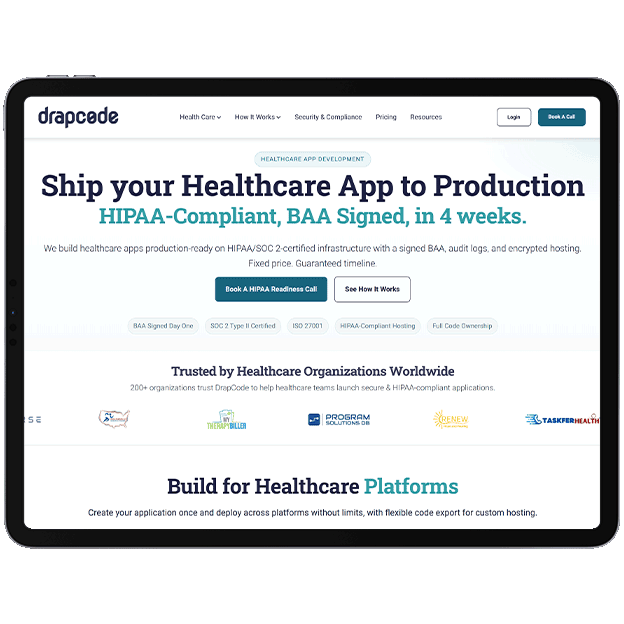
DrapCode is a Healthcare App Development Platform for healthcare organizations, providers, and digital health businesses. It combines healthcare-focused development with HIPAA-compliant infrastructure, interoperability, security, and production deployment. Teams can build patient portals, EHR/EMR applications, care management platforms, remote patient monitoring systems, provider applications, and custom healthcare workflows.
What Base44 Offers?
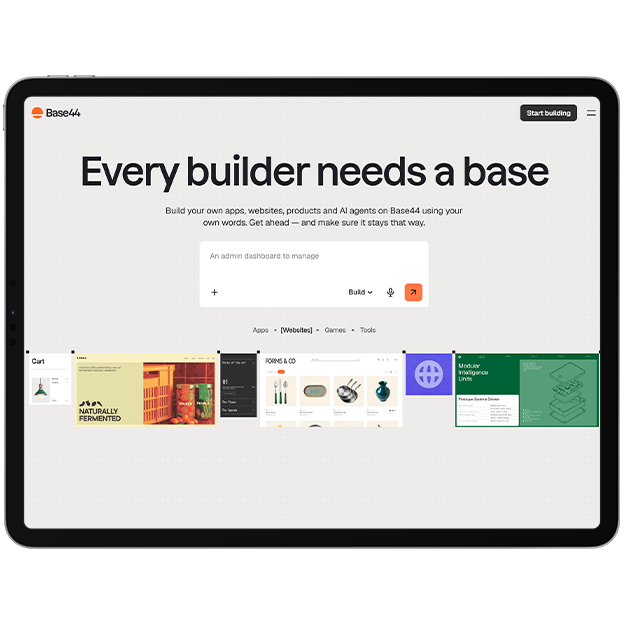
Base44 is a generative AI application-building platform operated by Wix. Users describe the software they want in natural language, and Base44 generates functional applications that include databases, authentication, backend logic, integrations, and hosting. Base44 can be used for healthcare-related applications and prototypes, including patient management and medical records. However, its current terms place specific restrictions on sensitive regulated data, including PHI, unless the required written agreement is in place.
Healthcare App Development Platform Comparison
Compare DrapCode and Base44 across the capabilities that become important when a healthcare application moves from an idea to production.
| Healthcare Capability | DrapCode | Base44 |
|---|---|---|
| Healthcare Orientation | Healthcare is the core focus for application development. | Healthcare is one of many supported application use cases. |
| Application Development | Build customized healthcare applications for production use. | Generate functional applications from natural-language requirements. |
| HIPAA | HIPAA-compliant infrastructure for healthcare applications handling PHI. | PHI requires specific written authorization and applicable agreements. |
| BAA | BAA signed for healthcare customers handling PHI. | Requires confirmation of applicable contractual arrangements. |
| FHIR | Supports FHIR-based healthcare interoperability and integrations. | FHIR connectivity requires custom implementation through available integrations. |
| EHR Integration | Connect applications with EHR, EMR, APIs, and healthcare systems. | External healthcare systems can be connected through APIs. |
| Healthcare Workflows | Build detailed clinical, patient, provider, and operational workflows. | Generate application workflows through natural-language instructions. |
| Customization | Customize interfaces, workflows, permissions, data, and business logic. | Modify generated applications through prompts and application controls. |
| Deployment | Supports controlled production and self-hosted deployment options. | Provides managed hosting with supported external deployment capabilities. |
| Code Ownership | Exports complete application source code and data. | Provides application code access and export capabilities. |
| Production Healthcare | Designed specifically for production healthcare software. | Better suited to rapid application creation and prototyping. |
When to Choose DrapCode
Choose DrapCode if your healthcare product needs compliance-focused infrastructure, interoperability, specialized workflows, and long-term production support.
Healthcare Focus
Build applications on a platform centered specifically on healthcare application development.
PHI Workloads
Develop applications intended to process protected health information in production.
FHIR Connectivity
Support structured interoperability with FHIR-based healthcare systems.
EHR Integration
Connect healthcare applications with existing EHR and EMR infrastructure.
Deployment Flexibility
Maintain control over hosting, infrastructure, and application deployment.
Production Scaling
Build healthcare products designed to support sustained organizational growth.
When to Choose Base44
Choose Base44 if rapid application creation, natural-language development, and quick product validation are your primary priorities.
Prompt Creation
Describe application requirements in natural language rather than manually building every feature.
Rapid Prototypes
Create functional applications quickly to validate product concepts.
General Applications
Build projects that do not require healthcare-specific application architecture from the outset.
Fast Iteration
Modify application functionality through conversational instructions.
Built-In Services
Use an integrated environment covering application logic, databases, authentication, and hosting.
Early Validation
Test workflows and product concepts before investing in a production healthcare architecture.
Why Healthcare Organizations Choose DrapCode
Build healthcare applications around compliance, interoperability, security, customization, and long-term production requirements.
Patient Portals
Build secure patient experiences for records, appointments, and care management.
EHR Connectivity
Connect applications with EHR, EMR, and healthcare data systems.
FHIR Integration
Support structured healthcare data exchange through FHIR-based integrations.
Care Management
Develop workflows for coordinating patients, treatment, and ongoing care.
Remote Monitoring
Build remote patient monitoring applications for connected healthcare workflows.
Secure Access
Implement controlled access for patients, administrators, and healthcare teams.
Frequently Asked Questions
What is the main difference between DrapCode and Base44?
Can Base44 be used to build healthcare applications?
Is Base44 HIPAA compliant?
Does DrapCode support FHIR and EHR integrations?
Which platform is better for production healthcare software?
Can I move a Base44 prototype to DrapCode?
Built your healthcare app with Base44?
Build healthcare applications on infrastructure designed for compliance, interoperability, security, and long-term production requirements.