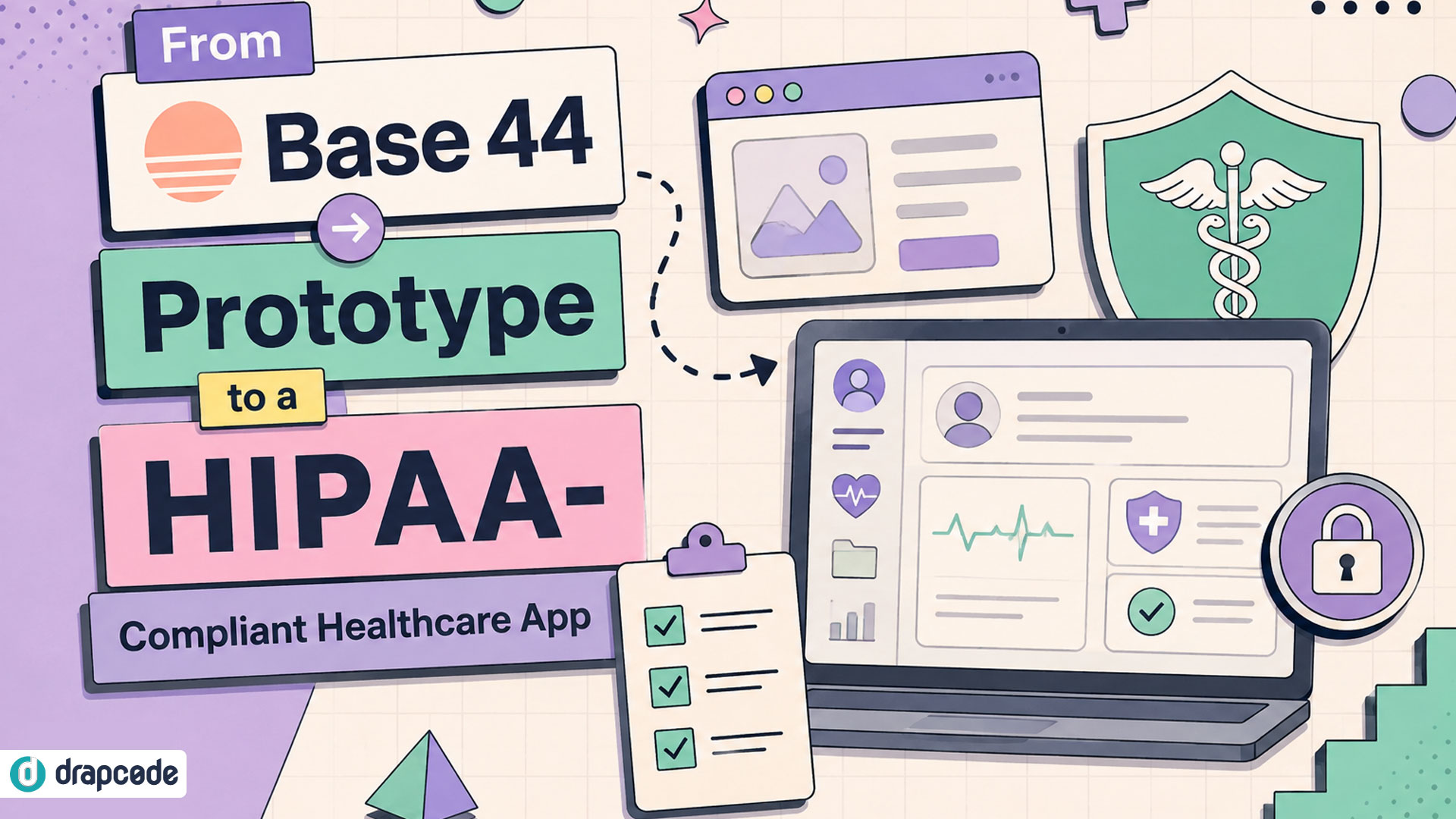
Base44 Prototype to a HIPAA-Compliant Healthcare App
Base44 makes a healthcare idea feel real very quickly.
You describe what you want in natural language, and the platform can turn that description into a functioning application with a database, authentication, backend logic, file storage, and hosting. Base44 even showcases healthcare use cases, such as medical records applications and patient management systems.
That speed is exactly why a healthcare founder might start there.
You can build a patient management workflow, show it to a clinician, iterate on the screens based on feedback, and have something tangible to demonstrate before committing to a larger development project.
But healthcare has a way of changing the questions once the prototype starts getting serious.
At first, you're asking:
"Can we build this?"
Later, someone asks:
"Can we put real patient information into it?"
That's a very different question.
And based on Base44's publicly available documentation, you should not assume that a healthcare app built on the standard platform is automatically HIPAA-compliant. Base44's security documentation describes SOC 2 Type II and ISO 27001 certification, encryption, row-level security, security scanning, SSO, and other controls.
At the same time, Base44's current Terms of Service state that sensitive data, such as protected health information, should not be shared with the platform unless expressly agreed to in writing by Base44 and the appropriate agreement is in place. The terms also place restrictions around certain health-service uses.
That's the point where a prototype needs to become something else.
Not necessarily a completely different product.
But a much more deliberate healthcare architecture.
Your Base44 Prototype Has Already Done Something Valuable
There's a temptation to think that if your prototype isn't ready for PHI, you've wasted your time.
You haven't.
A prototype answers questions that are difficult to answer with a requirements document.
You now know what the patient sees.
You know how a provider moves through the workflow.
You know which fields are actually needed.
You may have already discovered that a feature you thought was essential isn't important at all.
That's valuable product knowledge.
So the goal of migration shouldn't be:
"Throw away Base44 and start again."
It should be:
"Take what we've learned and build the production version on an architecture designed for healthcare."
Your user journeys, workflows, wireframes, business rules, and product requirements can continue to guide the next version.
The technology underneath them is what needs a closer look.
Base44's Security Features Are Not the Whole HIPAA Story
This is where the conversation gets nuanced.
Base44 currently documents several meaningful security controls. Its Trust Center describes TLS 1.2+ encryption in transit, AES-256 encryption at rest, cloud key management, row-level security, application security scans, SSO options, IP restrictions, and controlled application visibility.
Those are useful building blocks.
But HIPAA isn't a checklist where having encryption, authentication, and SOC 2 automatically produces compliance.
You need to consider the complete system.
For example, suppose your Base44 prototype has a patient record.
The record might contain:
- Patient name
- Date of birth
- Medical history
- Appointment information
- Clinical notes
- Uploaded documents
Now ask what happens when that record is created.
Where is it stored?
Which services process it?
Who can access it?
What happens when a provider changes it?
Is every relevant access recorded?
What happens when the patient's information moves to another healthcare system?
What happens when an employee leaves?
These are architecture and operational questions, not simply app-builder questions.
The Data Flow Is Where You Should Start
Before migrating anything, map your application's data.
Take a workflow as simple as:
Patient → Portal → API → Database → Provider Dashboard
Now add the systems your real product will eventually need:
Patient → Portal → Authentication → Healthcare Application → Database → FHIR/EHR Integration → Provider
Then add notifications, file storage, analytics, support tools, and other services.
Suddenly, the application isn't one platform.
It's an ecosystem.
Every component that touches PHI needs to be evaluated.
This is also why a vendor's general security certifications aren't enough to answer the healthcare question.
Your compliance posture depends on how the application is designed and configured, which services are involved, what contractual arrangements exist, and how your organization operates the system.
What Happens to Your Base44 Backend?
This is one of the biggest questions for a Base44 migration.
Base44 now offers a substantial backend layer: server-side functions, secrets, external API calls, business logic, row-level security, file storage, real-time synchronization, and hosting.
That's excellent for rapid application development.
But if your target is a production HIPAA-compliant healthcare application, you need to determine whether that entire backend environment and its contractual terms are appropriate for your intended PHI workload.
Base44's DPA outlines technical and organizational security measures and states that customers are responsible for reviewing the security information, making an independent determination of their legal requirements, and properly configuring the services.
For a healthcare startup, that's an important signal.
Don't migrate simply because the application works.
Migrate because you've established where PHI will live, how it will move, who can access it, and which vendors have the contractual and technical arrangements necessary for your use case.
Keep the Product. Rebuild the Trust Layer.
A Base44 prototype can give your development team a head start.
The next version should preserve the parts that have already been validated.
Keep your workflows
If physicians already understand the appointment workflow, don't redesign it simply because the technology changed.
Keep your product decisions
Your prototype has already answered questions about what users need.
Use that information.
Reconsider your data architecture
Production healthcare applications need deliberate decisions around patient records, permissions, auditability, retention, backups, and integrations.
Rework integrations where necessary
A prototype may use a convenient API or service.
A production healthcare application needs to evaluate whether that service is appropriate for PHI.
Design for interoperability
If the application eventually needs to communicate with an EHR, an FHIR server, a laboratory system, or another healthcare platform, build that requirement into the architecture rather than treating it as a final-stage add-on.
When the Prototype Becomes a Healthcare Product
There's a moment when your Base44 application stops being an experiment.
Maybe a clinic wants to pilot it.
Maybe a provider wants to use it with patients.
Maybe an investor asks when you're going into production.
Maybe an enterprise customer sends a security questionnaire.
That's when the requirements change.
You may suddenly need:
- Role-based access
- Detailed audit trails
- Healthcare integrations
- FHIR interoperability
- Secure file management
- Strong authentication
- Data segregation
- Deployment controls
- Incident-response processes
- Business Associate Agreements where applicable
At this stage, you're not simply building another SaaS application.
You're building healthcare software.
And that deserves a healthcare-specific development approach.
Base44 vs DrapCode: Two Different Paths
Base44 is built around making application creation remarkably accessible. Its natural-language approach can help teams turn an idea into a working application without traditional development overhead.
DrapCode approaches the problem from the other direction.
It's a healthcare application development company focused on building software for healthcare organizations, providers, and digital health businesses.
Features Base44
DrapCode
Rapid prototype development
✓
✓
Natural-language app creation
✓
✓
Built-in backend capabilities
✓
✓
Healthcare-focused development
Healthcare use cases supported
✓ Core focus
Patient portals
Prototype/use-case support
✓
EMR applications
Requires careful architecture and validation
✓
Care management
Prototype/use-case support
✓
FHIR healthcare integrations
Requires implementation
✓ Healthcare integration support
HIPAA-focused production development
Requires specific agreement and validation
✓ Healthcare-focused approach
Healthcare application expertise
General-purpose platform
✓
The important point isn't that Base44 is incapable of producing useful healthcare software.
It clearly can help teams create healthcare-related applications and prototypes.
The question is what happens after the prototype has proven the idea.
A Better Migration Strategy
If your Base44 application has traction, don't start by rewriting everything.
Start with an assessment.
Step 1: Map PHI.
Identify every piece of sensitive information and where it enters, moves, and gets stored.
Step 2: Audit dependencies.
List your database, authentication, storage, APIs, AI services, analytics, messaging, and other vendors.
Step 3: Define the production architecture.
Determine which components need to change to support your healthcare requirements.
Step 4: Recreate the validated workflows.
Use your Base44 prototype as the product blueprint rather than starting from a blank page.
Step 5: Add healthcare interoperability.
Plan FHIR, EHR, EMR, laboratory, or other integrations based on the actual product requirements.
Step 6: Validate compliance before PHI enters production.
Review the technical controls, contractual relationships, policies, and operational safeguards with the appropriate compliance and legal professionals.
This is usually a much better path than discovering the compliance problem after your first healthcare customer has already signed.
Your Base44 Prototype Wasn't the Wrong Decision
It was the right decision for a different stage of the journey.
You needed to learn whether the product worked.
You needed something clinicians could react to.
You needed to see the workflow outside your head.
Base44 helped you get there quickly.
Now you're facing a different problem.
You need to build something that can operate within the expectations of healthcare.
That's where the next architectural decision matters.
DrapCode helps healthcare organizations and digital health businesses build production-ready healthcare applications focused on security, healthcare workflows, interoperability, and long-term scalability.
Your Base44 prototype can be the beginning.
It doesn't have to be the final architecture.
Frequently Asked Questions
Q1. Can I use my Base44 prototype for a healthcare application?
Yes, Base44 can be useful for prototyping healthcare workflows and applications. Base44 itself showcases healthcare use cases, including medical records and patient management applications.
However, you should not assume that a prototype is ready to process PHI simply because it functions correctly.
Q2. Is Base44 HIPAA compliant?
Based on publicly available information at the time of writing, Base44 documents SOC 2 Type II and ISO 27001 certification and several security controls, but its current Terms of Service state that PHI and other specially regulated sensitive data should not be shared with the platform unless expressly agreed in writing and the appropriate agreement is in place.
Healthcare teams should therefore obtain written confirmation of the applicable HIPAA terms and BAA before processing PHI.
Q3. Do I need to throw away my Base44 application?
No. Your existing workflows, user research, product requirements, and interface decisions can be valuable during migration. The question is which technical components can safely support your production requirements.
Q4. When should I migrate my Base44 prototype?
Start planning the migration when you're preparing to handle real PHI, enter a healthcare pilot, integrate with EHR/EMR systems, or undergo enterprise security and compliance review.
Q5. Can DrapCode help build the production version?
DrapCode specializes in healthcare application development and can help organizations build patient portals, EMRs, care management systems, telehealth platforms, and FHIR-enabled healthcare software.
From Base44 Prototype to Production Healthcare Software
Your prototype answered the first question:
"Will this idea work?"
Now you need to answer the next one:
"Can healthcare organizations trust it with their data and workflows?"
DrapCode helps healthcare organizations make the transition from a validated product idea to a secure, scalable healthcare application.
Build your healthcare application with DrapCode.