Is Cursor HIPAA-Compliant Healthcare Software?
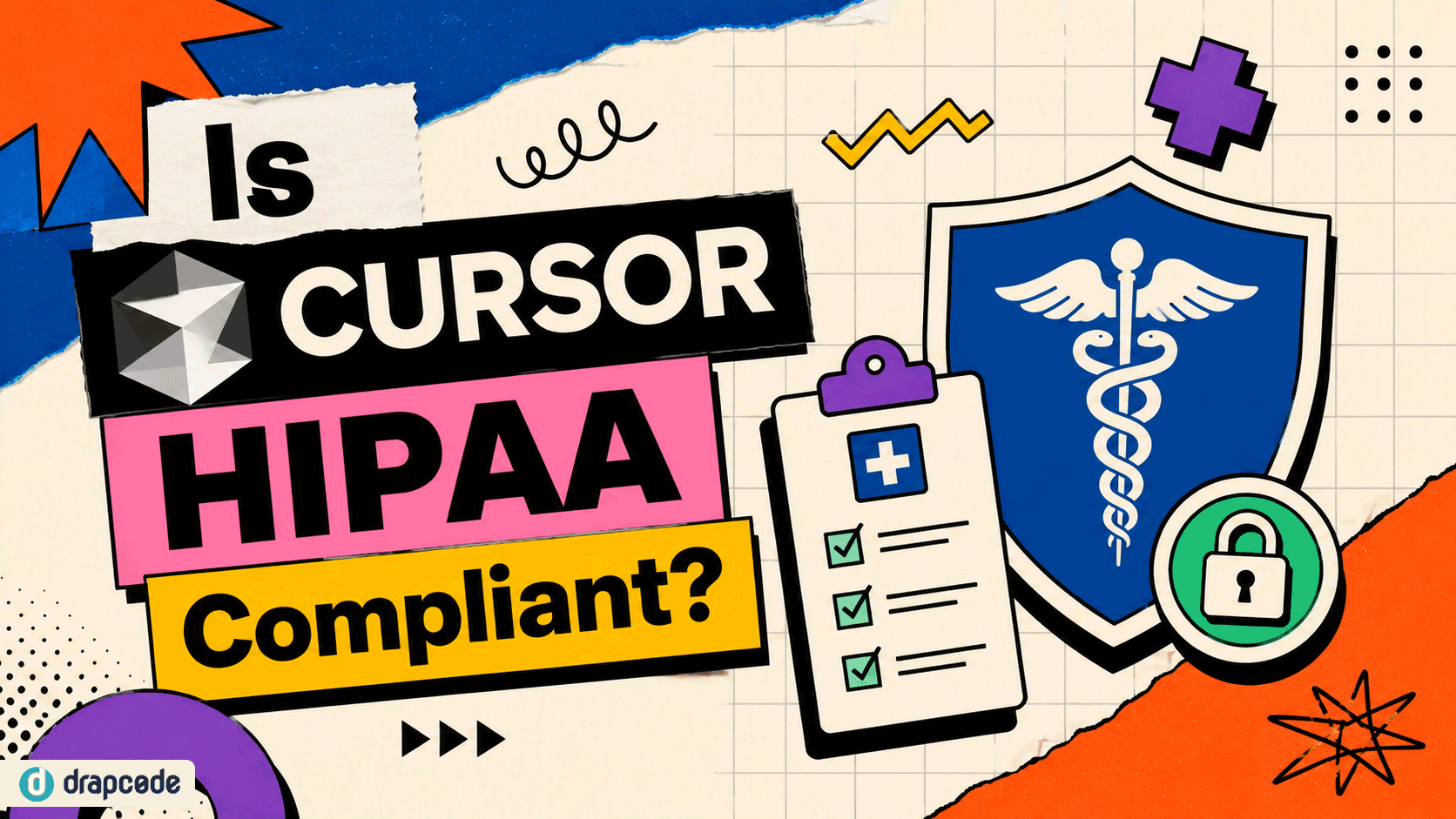
Yes, but only under specific conditions. Cursor supports HIPAA use for Enterprise customers with a signed BAA, Privacy Mode enabled and locked, and approved services/models; it is not HIPAA compliant by default.
AI has changed how developers write code.
Instead of switching between documentation, Stack Overflow, and multiple browser tabs, developers can now ask an AI assistant to generate components, explain errors, refactor code, and even build entire features without leaving their editor.
That's exactly why Cursor has become one of the fastest-growing AI coding tools.
For software teams, it's a huge productivity boost. Routine tasks become faster, repetitive coding is reduced, and developers can spend more time solving business problems instead of writing boilerplate.
Healthcare engineering teams are taking notice too.
Whether you're building a patient portal, a telehealth platform, an Electronic Medical Record (EMR), or a care management application, accelerating development with AI is incredibly appealing.
But healthcare introduces a question that doesn't exist in most industries.
Can you safely use Cursor to build software that handles patient data?
The answer isn't about whether Cursor writes good code.
It's about understanding where AI coding ends and healthcare compliance begins.
Based on Cursor's publicly available documentation at the time of writing, the platform provides enterprise security features such as Privacy Mode, SOC 2 Type II compliance, enterprise administration, and single sign-on capabilities. These features strengthen how organizations can adopt AI-assisted development. However, they do not automatically make the healthcare applications you build HIPAA-compliant.
Healthcare compliance depends on the complete development lifecycle, security architecture, deployment model, operational controls, and how Protected Health Information (PHI) is handled, not simply on the coding assistant your developers use.
Understanding that distinction is essential before introducing AI into healthcare software development.
Cursor Helps You Write Code. It Doesn't Design Your Healthcare Platform.
One of the biggest misconceptions surrounding AI development is that faster coding automatically leads to faster compliance.
In reality, they're two very different challenges.
Cursor can help developers:
- Generate backend APIs
- Create user interfaces
- Explain unfamiliar code
- Refactor existing applications
- Improve developer productivity
- Accelerate feature development
Those capabilities are incredibly valuable.
But once your application enters a healthcare environment, writing code becomes only one part of a much larger engineering process.
Healthcare applications also require:
- Secure authentication
- Role-based access controls
- Audit logging
- Encryption
- Healthcare interoperability
- Secure deployment
- Infrastructure monitoring
- Disaster recovery planning
- Compliance documentation
- Vendor governance
None of these responsibilities disappear because AI writes part of the code.
Instead, AI simply allows developers to complete implementation more efficiently.
The Biggest Risk Isn't the Code; It's the Data
Many discussions about AI in healthcare focus on whether AI-generated code is secure.
An equally important question is:
What information are developers sharing with the AI?
During development, engineers often copy code, database queries, API responses, log files, and debugging information into AI tools.
If those prompts contain Protected Health Information, healthcare organizations need to understand exactly how that information is handled.
Based on Cursor's publicly available documentation, organizations should review available privacy controls, enterprise options, data handling practices, and administrative settings before using AI-assisted development in environments that involve sensitive healthcare information.
A common best practice is to use:
- Synthetic test data
- De-identified healthcare records
- Sample FHIR resources
- Mock API responses
rather than real patient information during development whenever possible.
This approach reduces unnecessary risk while allowing engineering teams to benefit from AI-assisted coding.
Healthcare Software Isn't Just an Application
Building a modern SaaS platform and building healthcare software may look similar on the surface.
Both have user authentication.
Both have dashboards.
Both store data.
Both integrate with third-party services.
But healthcare software introduces an entirely different level of complexity.
A patient portal may need to communicate with multiple Electronic Health Record systems.
A telehealth application might integrate with scheduling, billing, laboratory systems, and pharmacy networks.
An EMR must manage clinical records while maintaining detailed audit trails.
Care management platforms often coordinate information across providers, patients, and payers.
These aren't simply software features.
They're healthcare workflows.
That's why successful healthcare products require engineering decisions that extend far beyond the IDE developers use every day.
AI can accelerate development.
It can't replace healthcare architecture.
Before Your First Line of Code, Ask These Questions
Choosing an AI coding assistant is only one technology decision.
Healthcare engineering teams should also ask:
- Where will PHI be stored?
- How will user permissions be managed?
- Which vendors require Business Associate Agreements (BAAs)?
- How will healthcare data be exchanged using FHIR?
- Can access to patient records be audited?
- Who is responsible for security monitoring and incident response?
These questions shape the success of the entire project far more than the choice of coding assistant.
That's why healthcare organizations treat AI development tools as productivity enhancers—not compliance solutions.
The goal isn't simply to build software faster.
It's to build healthcare software that providers, clinicians, and patients can trust.
Can Cursor Be Part of a HIPAA-Compliant Development Workflow?
The short answer is yes, but it shouldn't be confused with a HIPAA compliance solution.
Based on Cursor's publicly available documentation at the time of writing, the platform provides enterprise-focused capabilities such as Privacy Mode, administrative controls, and security features that help organizations adopt AI-assisted development more responsibly.
That's encouraging for engineering teams.
However, HIPAA compliance isn't determined by the IDE or AI coding assistant developers use.
It's determined by how the healthcare application is designed, deployed, monitored, and operated after the code is written.
Before releasing an application that handles Protected Health Information (PHI), healthcare organizations should evaluate questions such as:
- Where will patient data be stored?
- Who has access to production environments?
- How are encryption keys managed?
- Can every user action be audited?
- How will the application connect with Electronic Health Records (EHRs)?
- Which vendors require Business Associate Agreements (BAAs)?
- How will vulnerabilities be monitored and remediated?
These are engineering and operational decisions, not AI coding decisions.
Cursor can accelerate software development, but healthcare teams remain responsible for the overall compliance strategy.
Where Cursor Delivers the Most Value
Cursor isn't trying to replace software engineers.
It helps engineers become more productive.
That makes it particularly valuable for healthcare teams building complex applications where development speed matters.
Engineering teams can use Cursor to:
- Generate repetitive application code
- Build APIs and backend services
- Create responsive user interfaces
- Explain unfamiliar codebases
- Refactor legacy applications
- Write automated tests
- Accelerate feature delivery
For healthcare startups, this can reduce development cycles and help teams validate ideas more quickly.
But productivity is only one part of building healthcare software.
As products mature, engineering teams also need to think about:
- FHIR interoperability
- Clinical workflows
- Role-based permissions
- Healthcare data governance
- Audit logging
- Security reviews
- Regulatory documentation
- Long-term maintainability
Those capabilities aren't generated automatically by an AI coding assistant; they require thoughtful engineering and healthcare expertise.
Cursor vs DrapCode: Developer Productivity vs Healthcare Delivery
Cursor and DrapCode solve different problems.
Cursor focuses on making individual developers and engineering teams more productive by integrating AI directly into the coding experience.
DrapCode is a healthcare application development company that combines AI-assisted visual development with healthcare-specific capabilities, enabling organizations to build secure applications for providers, hospitals, clinics, and digital health businesses.
Here's how they compare from a healthcare perspective.
If Your Goal Is...
Cursor
DrapCode
Increase developer productivity
✓ Excellent
✓ AI-assisted visual development
Generate and refactor code
✓ Core capability
Limited emphasis
Build healthcare MVPs
✓ With engineering effort
✓ Purpose-built
Create patient portals
Requires custom development
✓ Supported
Develop EMR or EHR platforms
Significant engineering required
✓ Supported
Integrate FHIR APIs
Custom implementation
✓ Native healthcare integration support
Build healthcare workflows
Engineer everything yourself
✓ Built for healthcare
Enterprise healthcare deployment
Depends on your architecture
✓ Designed for healthcare organizations
Healthcare-focused expertise
General AI coding platform
✓ Healthcare application development company
The biggest difference isn't AI.
It's where the AI is applied.
Cursor helps developers write software faster.
DrapCode helps healthcare organizations deliver healthcare software faster.
Great Code Doesn't Automatically Create Great Healthcare Software
One of the biggest lessons healthcare startups learn is that engineering excellence alone isn't enough.
Many teams build beautifully engineered products.
Then their first healthcare customer asks questions that have nothing to do with code quality.
Can your application integrate with Epic or Cerner?
Do you support SMART on FHIR?
Can you provide detailed audit logs?
How are permissions managed for clinicians, administrators, and patients?
Can your security team complete our vendor assessment?
Do you have documentation covering incident response and disaster recovery?
These conversations reveal an important reality.
Healthcare software isn't judged only by the quality of its code.
It's judged by how well it supports clinical operations, protects patient information, integrates with healthcare ecosystems, and meets enterprise expectations.
That's why many organizations combine AI-assisted development with healthcare-specific platforms and experienced healthcare engineering teams.
AI Is Changing Development; Healthcare Still Demands Trust
AI coding assistants like Cursor are transforming how software is built.
Developers can deliver features faster, reduce repetitive work, and spend more time solving meaningful problems.
That's a significant advantage for healthcare innovation.
However, healthcare applications must do more than function correctly.
They must also earn the confidence of providers, hospitals, compliance teams, and patients.
Based on Cursor's publicly available information at the time of writing, organizations should carefully evaluate privacy controls, deployment practices, and internal development policies before using AI-assisted coding workflows for projects involving sensitive healthcare information.
The objective shouldn't be to replace good engineering with AI.
It should be to combine AI productivity with strong healthcare architecture, security, and governance.
Final Thoughts
Cursor is one of the most capable AI coding assistants available today.
For healthcare engineering teams, it can significantly improve developer productivity and reduce the time required to build new features.
But writing code is only one step in delivering successful healthcare software.
Production-ready healthcare applications require interoperability, security, governance, compliance planning, and long-term operational reliability.
If you're building an early-stage healthcare product, Cursor can help your developers move faster.
If you're building software that providers and healthcare organizations will rely on every day, partnering with a healthcare application development company like DrapCode provides a healthcare-first foundation designed for patient portals, EMRs, telehealth platforms, care management systems, and FHIR-enabled healthcare applications.
Frequently Asked Questions
Q1. Is Cursor HIPAA compliant?
Based on Cursor's publicly available documentation at the time of writing, Cursor provides enterprise security and privacy features. However, using Cursor does not automatically make your healthcare application HIPAA compliant. Compliance depends on your application's architecture, deployment, security controls, and operational processes.
Q2. Can healthcare developers use Cursor?
Yes. Cursor can be a valuable productivity tool for healthcare development teams, particularly when building features, APIs, interfaces, and backend services. Organizations should establish appropriate policies for handling sensitive healthcare information during development.
Q3. Should developers paste PHI into AI coding assistants?
As a best practice, healthcare teams should avoid sharing real Protected Health Information with AI development tools unless their organization has verified that doing so aligns with its security, privacy, contractual, and compliance requirements. Synthetic or de-identified data is generally a safer approach during development.
Q4. Can Cursor build FHIR applications?
Cursor can help developers write code for FHIR integrations and healthcare APIs. The design, implementation, testing, and compliance of those integrations remain the responsibility of the engineering team.
Q5. When should healthcare teams choose a healthcare-focused development platform?
If you're building production patient portals, EMRs, telehealth platforms, provider applications, or care management software, a healthcare-focused development company like DrapCode can help reduce development complexity while supporting healthcare interoperability and enterprise security.
Build Healthcare Software Faster without Losing Sight of Compliance
AI can accelerate development, but successful healthcare software depends on far more than fast code generation.
DrapCode helps healthcare organizations build secure, scalable applications including patient portals, EMRs, telehealth platforms, provider portals, care management systems, and FHIR-enabled healthcare software using AI-assisted visual development.
Whether you're enhancing an existing healthcare platform or launching a new digital health product, DrapCode helps you build with security, interoperability, and long-term growth in mind.