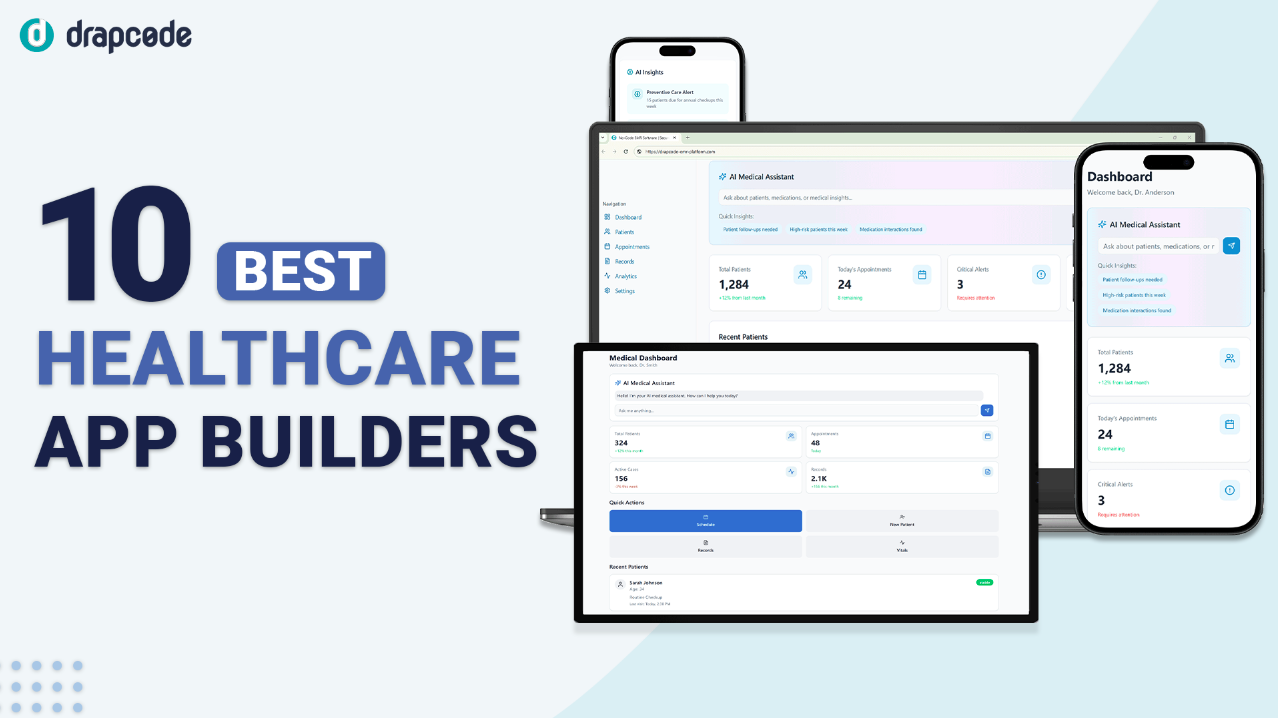
10 Best Healthcare App Builders in 2026
Building healthcare software is different from building a typical business application.
A clinic might need a patient intake portal. A digital health company might need a provider dashboard connected to an EHR. A care-management team may need a custom workflow that doesn't exist in its current software.
In all of these cases, the challenge isn't simply building screens and connecting a database.
The application may handle Protected Health Information (PHI), interact with healthcare systems, require role-based access, and eventually become part of a provider's daily workflow.
That's why choosing a healthcare app builder requires more than comparing drag-and-drop features or monthly pricing.
For this guide, we looked at platforms that publicly document HIPAA compliance, HIPAA attestation, HIPAA-ready offerings, or a BAA-supported path for applications that handle PHI. We also considered what each platform is actually suited to building—because a tool that works well for an internal workflow isn't necessarily the right choice for an EMR or patient-facing healthcare platform.
Important: HIPAA compliance is not created by selecting a platform alone. Your application architecture, configuration, integrations, access policies, operational safeguards, and organizational practices all matter.
The 10 Platforms at a Glance
Platform
Best For
HIPAA Position
Standout
DrapCode
Production healthcare applications
HIPAA-compliant infrastructure + BAA
Healthcare-focused development
Blaze
Rapid healthcare app development
HIPAA-compliant + BAA
Healthcare workflows and EHR connectivity
Knack Health
Healthcare operations
HIPAA-ready + BAA
Data-driven operational apps
Caspio
Database-driven healthcare apps
HIPAA Edition + BAA
Secure application database
Mendix
Enterprise healthcare platforms
HIPAA/HITECH attested
Enterprise low-code
OutSystems
Complex scalable applications
ODC Sentry HIPAA attested
Enterprise application engineering
Appian
Healthcare process automation
HIPAA-compliant cloud
Process orchestration
Unqork
Enterprise healthcare applications
HIPAA-supported
Complex enterprise workflows
Quickbase
Healthcare operations management
HIPAA Security Rule attestation + BAA
Workflow and data management
Google AppSheet
Lightweight healthcare workflows
HIPAA-supported + BAA
Fast internal/mobile apps
1. DrapCode - Best for Production Healthcare Applications
DrapCode takes a different approach from general-purpose app builders: healthcare is the product focus rather than one industry among many.
The platform is designed around healthcare applications such as patient portals, EHR/EMR systems, telemedicine platforms, practice management software, remote patient monitoring, care coordination, and healthcare CRM applications. DrapCode also supports API-first integrations with EHR/EMR systems, FHIR servers, laboratory systems, identity providers, and other healthcare technologies.
For compliance, DrapCode publicly states that healthcare projects are deployed on HIPAA-compliant infrastructure, with a signed BAA, encrypted hosting, audit logs, SOC 2 Type II, and ISO 27001.
Best fit: Healthcare organizations and digital health companies building production applications rather than simple departmental tools.
Why it stands out: Healthcare application development, security, interoperability, and deployment are treated as part of the same development journey.
2. Blaze - Best for Rapid Healthcare App Development
Blaze is one of the most healthcare-specific platforms in this category.
Its positioning centers on building custom healthcare software, including visual application development, workflow automation, a HIPAA-compliant database, user permissions, audit logs, and healthcare integrations. Blaze also advertises bidirectional integrations with major EHR/EMR systems and built-in FHIR support.
That makes it particularly interesting for healthcare teams that want to create custom applications without having to build every infrastructure component from scratch.
The platform is especially suited to operational applications, patient-facing workflows, intake, care management, and applications that need to connect with existing healthcare systems.
Best fit: Healthcare teams that want a visual builder with healthcare-specific capabilities and EHR connectivity.
Where it may not fit: Teams looking for a broader enterprise development platform may prefer a more general low-code ecosystem.
3. Knack Health - Best for Healthcare Operations
Knack Health is a good example of a platform where the use case matters more than flashy application generation.
Its healthcare offering is designed around applications such as patient portals, intake workflows, case management, scheduling, and internal operational systems. Knack Health describes itself as HIPAA-ready and offers BAAs on HIPAA-compliant plans. Its security controls include encryption, record-change logs, role-based permissions, two-factor authentication, optional SSO, IP allowlisting, backups, and monitoring.
This makes it particularly attractive when an organization is trying to replace spreadsheets, disconnected workflows, or manually maintained operational databases.
Best fit: Clinics and healthcare teams building operational and data-management applications.
Why it stands out: It brings structured data and workflow management together without requiring a traditional software development project.
4. Caspio - Best for Database-Driven Healthcare Applications
Caspio is particularly compelling when the database is at the heart of the application.
Its HIPAA Edition provides a dedicated HIPAA environment, signed BAA, encryption at rest and in transit, role-based access controls, audit trails, extended backup retention, and HIPAA-focused support.
The platform is well suited to applications where teams need to collect, manage, search, and present structured healthcare information.
Common use cases include patient portals, intake and registration, scheduling, care coordination, claims management, provider directories, and compliance dashboards.
Best fit: Organizations that need a secure, database-centric application without building the entire data layer themselves.
Why it stands out: Its HIPAA Edition is a clearly defined product offering, not a generic security claim.
5. Mendix - Best for Enterprise Healthcare Platforms
Mendix enters the list from the enterprise side.
It isn't primarily aimed at a small clinic that needs a simple scheduling application. Its strength lies in providing enterprise development teams with a broader low-code environment for building and maintaining complex applications.
Mendix states that its platform is attested to HIPAA/HITECH compliance and provides extensive security, audit, role, and application-level controls. Its cloud documentation also references a HIPAA assurance letter and independently audited security controls.
That makes it a candidate for larger healthcare organizations with established IT and development teams.
Best fit: Enterprise healthcare organizations and digital health companies with complex application requirements.
Why it stands out: Enterprise governance and application engineering are central to the platform.
6. OutSystems - Best for Complex, Scalable Applications
OutSystems is another platform that makes more sense as the application becomes a serious enterprise system.
One important qualification is necessary here: OutSystems' public compliance announcement specifically states that ODC Sentry applications have HIPAA and PCI compliance attestation.
That distinction matters. You shouldn't read "OutSystems supports HIPAA" to mean that every possible deployment automatically satisfies HIPAA requirements.
For organizations using the appropriate ODC environment, however, OutSystems provides a mature application development environment for complex applications, integrations, and enterprise-scale deployments.
Best fit: Large healthcare IT teams building sophisticated applications with significant integration and scalability requirements.
Why it stands out: It sits closer to enterprise software engineering than a simple visual app builder.
7. Appian - Best for Healthcare Process Automation
Appian is particularly strong when the problem isn't simply "we need another application."
It's:
"We have a complicated healthcare process involving multiple systems, people, approvals, and decisions."
Appian's healthcare capabilities include utilization management, prior authorization, governance, compliance, and other complex operational processes. Its Appian Cloud is said to comply with HIPAA security requirements, allowing customers to process and store PHI after executing a BAA.
This makes Appian particularly relevant for health plans, large healthcare organizations, and enterprise teams trying to connect fragmented processes.
Best fit: Healthcare organizations automating complex, multi-step processes.
Why it stands out: Process orchestration is the center of the platform rather than application UI alone.
8. Unqork - Best for Enterprise Healthcare Workflows
Unqork takes an enterprise-first approach to application development.
Its platform is designed for organizations that need to create sophisticated applications while maintaining centralized security and governance. Unqork states that its platform is designed to manage electronic PHI in accordance with HIPAA.
This makes it particularly relevant to large organizations with complex business processes, legacy-system integration requirements, and substantial governance needs.
Best fit: Enterprise healthcare organizations with complex application programs and large development backlogs.
Why it stands out: It is built around enterprise application transformation rather than simple app creation.
9. Quickbase - Best for Healthcare Operations Management
Quickbase is a different kind of healthcare app builder.
Its strength lies in operational data and workflow management rather than in building a sophisticated clinical product from the ground up.
Quickbase states that its SOC 2 Type II report includes independent attestation against applicable HIPAA Security Rule requirements. It also enables qualifying business and enterprise customers handling PHI to execute a BAA.
Its healthcare offering focuses on managing operational data, workflows, reporting, and processes across teams.
Best fit: Healthcare organizations looking to replace spreadsheets and coordinate complex internal operations.
Why it stands out: Strong operational workflow capabilities without requiring a conventional custom development project.
10. Google AppSheet - Best for Lightweight Healthcare Workflows
AppSheet is particularly interesting for organizations already invested in the Google ecosystem.
Google's documentation states that AppSheet can support customers' HIPAA compliance when configured appropriately, and customers intending to process or store PHI must execute a BAA before using AppSheet for that purpose.
The platform works well for lightweight internal applications, field workflows, mobile data collection, approvals, and operational tools.
That doesn't necessarily make it the right choice for building a complete EMR or a sophisticated patient-facing healthcare platform.
Best fit: Smaller operational workflows, internal tools, and mobile applications.
Why it stands out: Its connection to the broader Google ecosystem can make adoption easier for organizations already using Google Workspace and related services.
So, Which Healthcare App Builder Should You Choose?
There isn't one winner for every healthcare project.
The right choice depends on what you're actually trying to build.
Building a production healthcare application?
DrapCode is the strongest fit when healthcare application development itself is the priority, particularly for patient portals, EMRs, care management, telehealth, remote patient monitoring, and FHIR-connected applications.
Need a fast visual healthcare builder?
Blaze is a strong option, particularly when EHR connectivity and healthcare workflows are important.
Replacing spreadsheet-based healthcare operations?
Knack Health, Caspio, or Quickbase may be more appropriate depending on the complexity of the data and workflows.
Building an enterprise healthcare platform?
Mendix, OutSystems, Appian, or Unqork are better suited to organizations with substantial IT requirements and complex application environments.
Need lightweight internal applications?
Google AppSheet can make sense when the workflow is relatively straightforward, and the organization already operates heavily within Google's ecosystem.
What Should You Check Before Choosing?
A HIPAA badge shouldn't be the end of your evaluation.
It should be the beginning.
Before selecting a platform, ask:
Does the vendor sign a BAA?
If the platform will handle PHI on your behalf, understand exactly when and how the BAA applies.
Where does PHI go?
Map your complete data flow, not just your primary database.
Your application may send information to authentication providers, analytics tools, messaging platforms, AI services, EHRs, payment providers, and other third parties.
Can you control access?
Healthcare applications often have patients, physicians, nurses, administrators, billing teams, and other roles.
Fine-grained authorization matters.
Are actions auditable?
You need to understand what happened to sensitive information and who performed important actions.
Can it integrate with healthcare systems?
If your application needs EHR or EMR connectivity, look beyond generic REST APIs.
FHIR support, healthcare-specific integrations, authentication, data mapping, and interoperability workflows can dramatically affect development effort.
Can it grow with your product?
A platform that works for 500 records may not be the platform you want when you're managing millions of records, multiple organizations, and hundreds of healthcare users.
Healthcare App Builder vs. Healthcare Application Development
There's one distinction worth making before you decide.
A healthcare app builder gives you the technology to build an application.
A healthcare application development company goes further.
It can help with architecture, healthcare workflows, integrations, security requirements, interoperability, deployment, and the practical decisions involved in building software for healthcare organizations.
That's where DrapCode takes a different position.
DrapCode isn't trying to be a generic app builder for every industry. Its focus is healthcare application development from patient portals and EMRs to care management, telemedicine, remote patient monitoring, and FHIR-enabled applications.
For a simple internal workflow, a general-purpose platform may be all you need.
For a production healthcare product that needs to connect to the healthcare ecosystem, the development approach matters just as much as the underlying builder.
Final Verdict
The best healthcare app builder isn't necessarily the platform with the most features.
It's the one that fits the application you're actually trying to build.
Caspio makes sense when structured data is the center of the project.
Knack Health works well for operational healthcare workflows.
Quickbase is useful for coordinating complex internal processes.
AppSheet is attractive for lightweight applications inside the Google ecosystem.
Mendix, OutSystems, Appian, and Unqork make more sense when enterprise complexity, governance, and scale come into play.
Blaze is compelling for teams that want a healthcare-specific visual development environment with deep healthcare integrations.
And DrapCode is designed specifically for organizations that need to build production healthcare applications with healthcare workflows, security, and interoperability at the center.
The important part is not choosing the platform with the biggest feature list.
It's choosing the platform that won't force you to rethink your architecture six months after launch.
Because in healthcare, the application isn't just software.
It's part of the workflow that people depend on.
Frequently Asked Questions
Q1. What is the best healthcare app builder in 2026?
There isn't one universal answer. DrapCode is particularly suited to production healthcare applications, while platforms such as Blaze, Caspio, Knack, Mendix, and Appian address different healthcare development needs.
Q2. Are these healthcare app builders HIPAA compliant?
The platforms in this guide have publicly documented HIPAA compliance, HIPAA attestations, HIPAA-ready offerings, or BAA-supported HIPAA use cases. However, using a compliant platform does not automatically make every application compliant. Configuration, integrations, policies, and organizational safeguards remain important.
Q3. What is the difference between HIPAA compliant and HIPAA ready?
"HIPAA compliant" generally refers to a vendor's documented compliance position or applicable attestation, while "HIPAA ready" usually indicates that the platform provides the controls and contractual mechanisms needed to support a customer's HIPAA obligations. Always verify the exact plan, environment, BAA, and scope before processing PHI.
Q4. Can I build an EMR with a healthcare app builder?
Some platforms can support EMR development, but the difficulty varies significantly. An EMR typically requires much more than forms and dashboards, including clinical workflows, authorization, auditability, interoperability, data models, and integrations with healthcare systems.
Q5. Do I need FHIR support?
Not every healthcare application needs FHIR. However, if your application needs to exchange clinical information with modern EHRs and other healthcare systems, FHIR can be an important part of the architecture.
Q6. Is a healthcare-specific platform better than a general-purpose app builder?
Not always. A simple internal workflow may work perfectly well on a general-purpose platform. But healthcare-specific platforms can reduce the amount of healthcare architecture, integration, and compliance work your team needs to figure out on its own.
Build Your Healthcare Application With DrapCode
Have a healthcare application in mind?
Whether you're building a patient portal, EMR, care management platform, telemedicine application, or FHIR-connected healthcare product, DrapCode helps you move from idea to production with healthcare-focused development.
Build your healthcare application with DrapCode.