Is v0 by Vercel HIPAA-Compliant
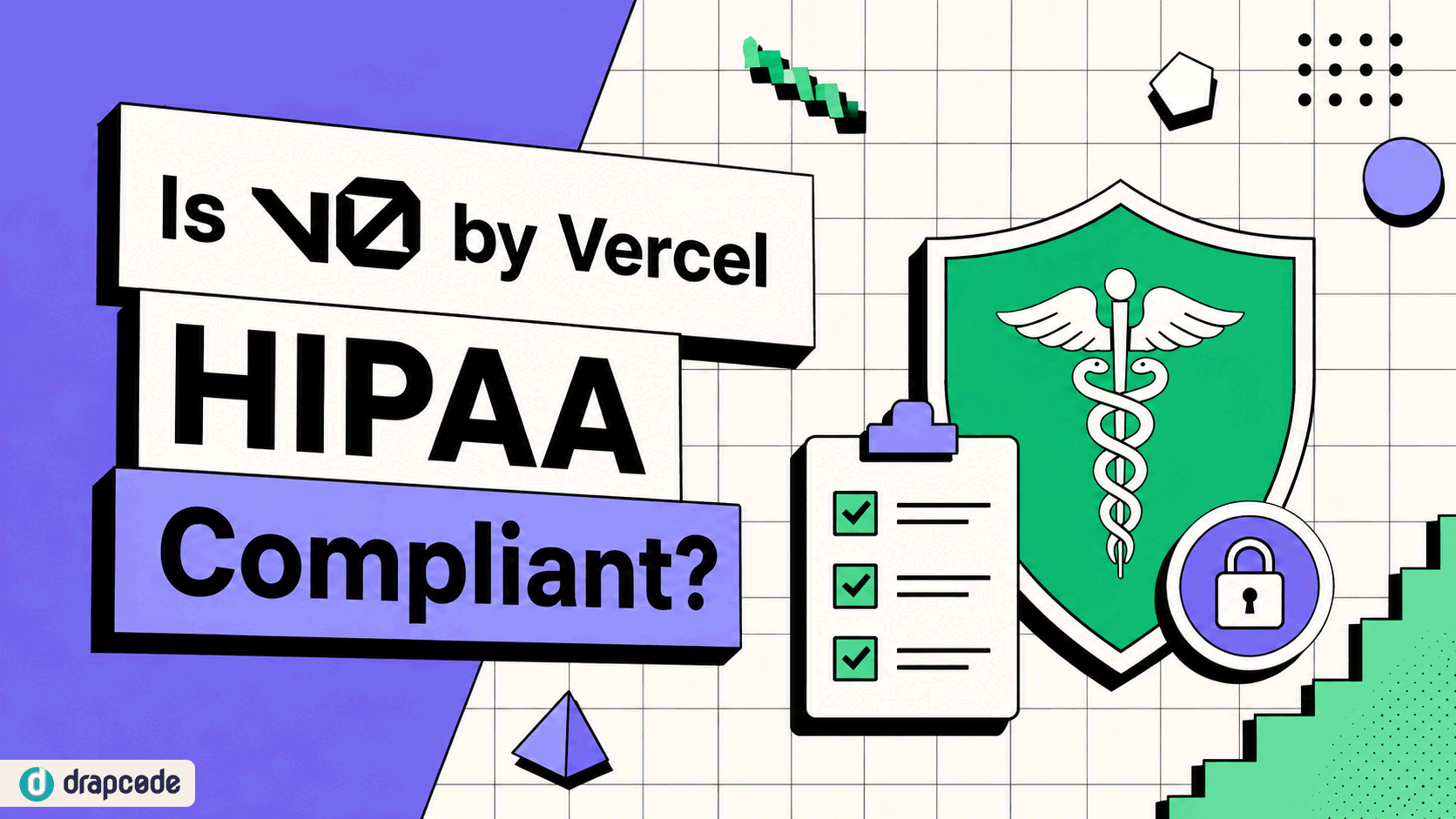
No, Vercel's v0 is not HIPAA-compliant for handling PHI. Vercel’s v0 API terms explicitly prohibit the use of v0 to create, receive, maintain, transmit, or process Protected Health Information (PHI).
Imagine this.
You type a single prompt into v0:
"Build a patient portal where users can log in, view upcoming appointments, download lab reports, and message their doctor."
A few moments later, you have a polished interface that looks remarkably close to a real healthcare application.
For many developers, that's an exciting experience.
Instead of spending days creating layouts, navigation, forms, and responsive components, you already have something that looks ready for users.
It's one of the reasons v0 by Vercel has become so popular among developers building modern web applications.
But then someone on your team asks a simple question:
"Could we actually use this in a healthcare product?"
That's where the conversation changes.
Creating an attractive interface is only one step in building healthcare software. Once an application begins handling Protected Health Information (PHI), developers must consider more than just design and development speed.
Questions around security, privacy, compliance, interoperability, and operational governance become just as important as the code itself.
If you're considering v0 for a healthcare project, here's what you should know before moving from prototype to production.
Why Developers Ask About HIPAA Before Choosing v0
Most developers don't start by asking whether a frontend tool is HIPAA-compliant.
They ask because healthcare software is different.
A startup building an e-commerce website can launch quickly, gather feedback, and improve over time.
Healthcare applications don't have that luxury.
If your application stores medical histories, appointment information, prescriptions, insurance details, or diagnostic reports, you're dealing with sensitive patient information. That changes the development process significantly.
When developers discover how quickly v0 can generate interfaces, it's natural to wonder whether those same applications can also support healthcare use cases.
The answer requires understanding what v0 is designed to do and what it isn't.
What v0 Actually Builds
Based on publicly available information at the time of writing, v0 is an AI-powered interface-generation tool that helps developers create React and Next.js components using natural-language prompts.
Its primary goal is to accelerate frontend development.
Instead of manually creating every page, developers can generate:
- Patient dashboards
- Registration screens
- Appointment booking pages
- Provider portals
- Clinical profile layouts
- Settings pages
- Administrative dashboards
For healthcare startups, this dramatically reduces the time needed to validate ideas and demonstrate concepts to investors, clinicians, or early customers.
Good interface design matters.
Patients expect intuitive digital experiences.
Doctors want applications that reduce administrative work rather than create more of it.
Healthcare administrators appreciate software that's easy to learn and simple to navigate.
v0 helps teams achieve those goals much faster.
But generating interfaces isn't the same as building healthcare software.
Does v0 Make Your Healthcare App HIPAA Compliant?
This is the question many teams really want answered.
The short answer is no.
Based on publicly available information at the time of writing, v0 is a frontend development tool. It should not be viewed as a HIPAA compliance solution, and using it does not automatically make an application HIPAA compliant.
HIPAA compliance depends on far more than how the user interface is created.
Healthcare organizations must evaluate areas such as:
- How Protected Health Information (PHI) is stored
- Where applications are hosted
- User authentication and access controls
- Encryption of data in transit and at rest
- Audit logging
- Vendor agreements, including Business Associate Agreements (BAAs) where applicable
- Security monitoring and incident response
- Compliance policies and workforce training
These responsibilities remain with the organization that builds and operates the healthcare application.
In other words, v0 can help you design what users see.
It doesn't determine how patient information is protected.
That's an important distinction for developers planning healthcare products.
The Moment a Prototype Becomes a Healthcare Product
Every healthcare application starts with an idea.
Maybe it's a telehealth platform.
A patient engagement portal.
An Electronic Medical Record (EMR).
Or a care coordination application.
Initially, success is measured by how quickly you can bring that idea to life.
Can users understand the workflow?
Is the interface intuitive?
Does the application solve a genuine problem?
AI tools like v0 are excellent at this stage because they enable teams to move from concept to prototype in hours rather than weeks.
Eventually, however, the questions become more demanding.
Can doctors access patient records securely?
Can administrators manage permissions across departments?
Can the application integrate with Electronic Health Record (EHR) systems?
Can every action involving patient information be tracked?
Can healthcare organizations trust the platform with sensitive clinical data?
These aren't design questions.
They're engineering and operational questions.
That's the point where healthcare software becomes much more than a collection of attractive screens.
Behind Every Healthcare Screen Is a Much Bigger Workflow
Open almost any healthcare application, and you'll find a clean, well-organized interface.
- Appointment calendars.
- Patient timelines.
- Clinical summaries.
- Prescription histories.
- Everything appears straightforward.
What users don't see is the complexity behind every interaction.
When a patient books an appointment, the application may also need to:
- Check clinician availability
- Validate insurance eligibility
- Create records in scheduling systems
- Notify healthcare staff
- Update Electronic Health Records
- Generate audit logs
- Trigger reminder notifications
- Synchronize multiple healthcare systems
The interface might represent only a small portion of the overall application.
The real value lies in the workflows operating behind the scenes.
That's why healthcare development isn't simply about creating beautiful interfaces.
It's about building systems that providers can depend on every day.
Should Developers Use v0 for Healthcare Projects?
Absolutely, but with realistic expectations.
v0 is an excellent choice for:
- Designing healthcare interfaces
- Building clickable prototypes
- Validating user experiences
- Accelerating frontend development
- Demonstrating ideas to stakeholders
- Creating internal proof-of-concepts
Those use cases play an important role in healthcare innovation.
However, developers should recognize where v0's responsibilities end.
As projects move towards production, engineering teams must also design secure backend services, implement healthcare integrations, establish access controls, manage infrastructure, and ensure that the overall solution meets applicable regulatory and organizational requirements.
Healthcare software succeeds because the entire system works together—not because one development tool generates an impressive interface.
What Healthcare Buyers Actually Evaluate
Many founders assume that if users love the interface, they'll love the product.
In healthcare, that's only part of the equation.
Hospitals, clinics, and digital health companies certainly appreciate modern, intuitive applications. A clean interface can improve adoption, reduce training time, and create a better experience for both patients and clinicians.
But before purchasing a healthcare platform, decision-makers usually ask a different set of questions.
- Can this integrate with our existing EHR or EMR?
- Does it support FHIR-based data exchange?
- How are user roles and permissions managed?
- Can we audit who accessed patient records?
- Is patient data encrypted?
- Can the platform scale as our organization grows?
- What security controls are in place?
- Can the vendor support our compliance requirements?
These conversations rarely focus on colors, layouts, or button styles.
Instead, they focus on trust.
The interface may attract attention, but secure workflows, interoperability, and operational reliability are what ultimately influence purchasing decisions.
Where v0 Fits in a Healthcare Development Workflow
One mistake developers make is assuming that a single tool should solve every problem.
That's rarely true.
Healthcare software is built using multiple technologies working together.
A typical development workflow might look like this:
- v0 helps designers and developers rapidly create frontend interfaces.
- Backend services manage business logic and application workflows.
- Authentication systems verify users and enforce access controls.
- FHIR APIs exchange healthcare data with external systems.
- Cloud infrastructure hosts and secures the application.
- Monitoring and logging tools help maintain reliability and security.
Seen this way, v0 isn't competing with your backend or your healthcare platform.
It's solving a very specific problem: accelerating frontend development.
The challenge begins when teams expect an interface generator to handle responsibilities that belong elsewhere in the technology stack.
v0 vs DrapCode: AI Interface Generation vs Healthcare Application Development
Although both platforms help teams build faster, they serve different purposes.
v0 focuses on generating modern frontend interfaces from natural language prompts, helping developers reduce the time spent building React and Next.js components.
DrapCode, on the other hand, is a healthcare application development company focused on helping healthcare organizations build secure, scalable applications with AI-assisted visual development, healthcare workflows, and interoperability.
Here's how they compare.
If Your Goal Is...
v0 by Vercel
DrapCode
Generate modern UI components
✓ Excellent
✓ Supported
Rapidly prototype healthcare interfaces
✓ Core strength
✓ Yes
Build complete patient portals
Frontend only
✓ End-to-end healthcare applications
Develop EMR or EHR software
Requires custom backend development
✓ Supported
Create provider portals
UI generation
✓ Supported
Build care management platforms
Significant engineering effort
✓ Supported
Connect with FHIR APIs
Custom implementation
✓ Native healthcare integration support
Automate healthcare workflows
Build separately
✓ Visual workflow development
Deploy production healthcare applications
Depends on your architecture
✓ Healthcare-focused delivery
The comparison isn't about which platform is better.
It's about choosing the right tool for the stage of your healthcare project.
If you need to create interfaces quickly, v0 is an excellent option.
If you need to build and deliver a complete healthcare application, you'll need far more than just the interface.
The Biggest Shift Happens After Your First Demo
Many healthcare startups experience the same turning point.
The first product demo generates excitement.
Stakeholders like the design.
Users understand the workflow.
Investors see the potential.
Then the technical questions begin.
How will patient records be stored?
How will the application integrate with existing healthcare systems?
What happens if multiple providers update the same patient record?
How are permissions managed across different user roles?
How will the platform support thousands of users?
These questions don't reduce the importance of a great interface.
They simply remind teams that healthcare software is judged by its reliability as much as its usability.
That's why successful healthcare products invest in architecture, integrations, security, and operational processes from the very beginning, not after launch.
Final Thoughts
v0 by Vercel is one of the most capable AI-powered interface generation tools available today.
It enables developers to transform ideas into polished user interfaces remarkably quickly, making it an excellent choice for prototyping, design exploration, and accelerating frontend development.
However, building healthcare software requires much more than generating beautiful screens.
Applications that handle patient information need secure architecture, robust access controls, interoperability, reliable workflows, and operational governance alongside a well-designed user experience.
If your objective is to design healthcare interfaces faster, v0 is a valuable addition to your development toolkit.
If your objective is to deliver production-ready patient portals, EMRs, provider platforms, telehealth applications, or care management systems, partnering with a healthcare application development company like DrapCode helps you move beyond prototypes and build healthcare software designed for real-world deployment.
Frequently Asked Questions
Q1. Is v0 by Vercel HIPAA compliant?
Based on publicly available information at the time of writing, v0 is an AI-powered interface generation tool. Using v0 does not, by itself, make a healthcare application HIPAA-compliant. Compliance depends on the application's architecture, infrastructure, security controls, operational processes, and the management of Protected Health Information (PHI).
Q2. Can developers use v0 to build healthcare applications?
Yes. v0 is well suited for designing healthcare interfaces, creating prototypes, and accelerating frontend development. Production-ready healthcare applications require additional backend services, integrations, security controls, and governance.
Q3. Can v0 connect to FHIR APIs?
v0 can generate frontend components that interact with FHIR-enabled services. The backend integrations, authentication, and healthcare data exchange logic must still be implemented separately.
Q4. Is v0 suitable for healthcare startups?
Yes. Healthcare startups can use v0 to quickly validate ideas, gather user feedback, and create high-quality interfaces before investing in full-scale development.
Q5. When should healthcare organizations consider a healthcare-focused development company?
If you're building production-ready healthcare software that includes patient portals, EMRs, telehealth platforms, provider applications, or care management systems, working with a healthcare-focused development company can simplify development while supporting interoperability, security, and long-term scalability.
Build Healthcare Applications Beyond the Interface
A polished interface creates a strong first impression, but healthcare software earns trust through secure workflows, interoperability, and reliable performance.
DrapCode is a healthcare application development company that helps providers, healthcare organizations, and digital health businesses build secure patient portals, EMRs, telehealth platforms, care management systems, and FHIR-enabled applications using AI-assisted visual development.
Whether you're validating a new healthcare idea or preparing for enterprise deployment, DrapCode helps you build applications designed for the realities of modern healthcare.