Is Lovable HIPAA Compliant?
No, Lovable is not HIPAA-compliant for handling PHI. Its current terms explicitly prohibit users from uploading or processing HIPAA-protected health information unless a separate agreement expressly permits it.
AI-powered app builders are changing how software gets built. Instead of spending weeks writing boilerplate code, platforms like Lovable can generate a working application from a simple prompt. For startups, that means faster prototypes, quicker investor demos, and a shorter path from idea to product.
But healthcare doesn't follow the same rules as every other industry.
If you're building a patient portal, telehealth platform, care management system, or any application that handles Protected Health Information (PHI), one question quickly becomes impossible to ignore:
Is Lovable HIPAA compliant?
It's a question we hear from healthcare founders, CTOs, and product teams almost every day.
The answer isn't simply yes or no.
No single development tool can guarantee HIPAA compliance. It depends on your application's entire architecture, security controls, infrastructure, vendor agreements, and operational processes. Lovable can certainly help accelerate development, but building a healthcare application that's production-ready requires much more than AI-generated code.
Let's break down what healthcare teams should know before choosing Lovable for their next project.
Why Everyone Is Asking Whether Lovable Is HIPAA Compliant
Healthcare startups are under pressure to move fast.
Investors expect rapid product validation. Customers want modern digital experiences. Product teams want to ship features in weeks instead of months.
That's exactly why AI application builders have become so popular.
With Lovable, you can describe an application in plain English and receive a functional web app remarkably quickly. For many founders, that's an exciting shift from traditional software development.
However, once a healthcare product moves beyond the prototype stage, the conversation changes.
Instead of asking:
"Can we build this?"
Teams begin asking:
- Can we store patient information securely?
- Will hospitals trust this platform?
- Can we integrate with existing EHR systems?
- Are we meeting HIPAA requirements?
- Can we scale this into a production healthcare application?
These are very different questions, and they're the ones that determine whether a healthcare product is ready for real-world use.
What "HIPAA Compliant" Actually Means
One of the biggest misconceptions in healthcare software is that HIPAA compliance comes from using a particular technology.
It doesn't.
An application doesn't become HIPAA compliant simply because it uses encrypted databases, HTTPS, or a modern development framework.
HIPAA is a combination of technical, administrative, and operational safeguards designed to protect patient information.
Healthcare organizations typically need to consider:
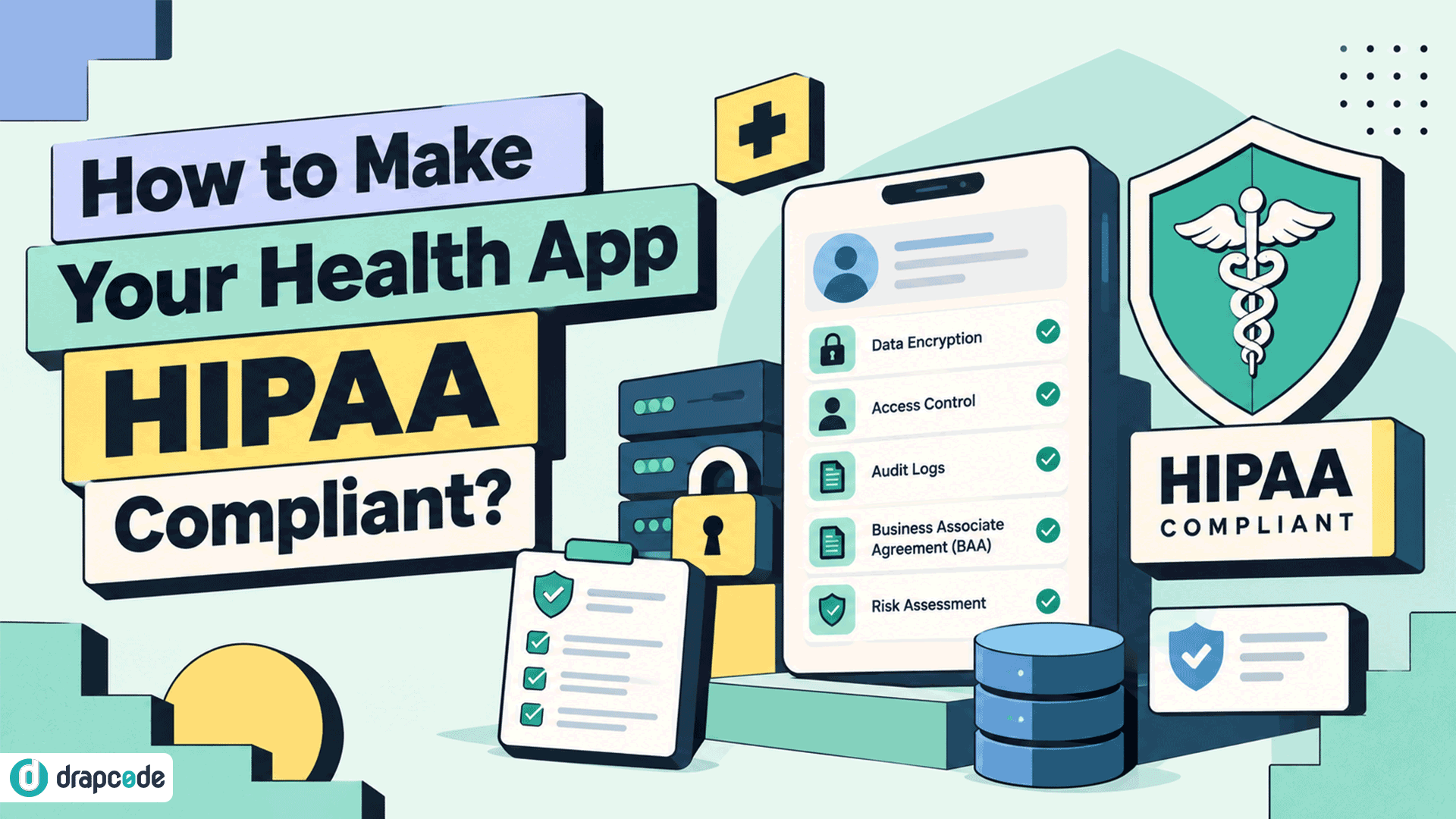
- Encryption for data at rest and in transit
- Role-based access controls
- User authentication
- Audit logs
- Backup and disaster recovery
- Secure infrastructure
- Vendor management
- Business Associate Agreements (BAAs)
- Security monitoring
- Risk assessments
- Employee policies and procedures
Notice that only a small portion of these requirements relate to writing code.
Most involve how the entire healthcare application is designed, deployed, managed, and operated.
That's why evaluating a development platform requires looking beyond its AI capabilities.
Inside Lovable: Great for Building Apps, Not Responsible for Your Compliance
Lovable is designed to help developers and product teams generate applications quickly using AI.
It's excellent for accelerating development, experimenting with ideas, and reducing repetitive coding tasks.
However, healthcare organizations should understand where Lovable's responsibility ends.
Generating an application is only one part of delivering healthcare software.
Your application will still depend on:
- Hosting infrastructure
- Authentication providers
- Databases
- APIs
- Third-party integrations
- Security configurations
- Monitoring tools
- Deployment environments
Each of these components plays a role in HIPAA compliance.
If one part of the stack isn't configured appropriately, your application could still fail to meet regulatory expectations even if the generated application itself works perfectly.
The important distinction is this:
Lovable helps you build software. Your organization remains responsible for building a HIPAA-ready healthcare system.
The Biggest Compliance Questions Healthcare Teams Should Ask
Instead of asking whether a platform is "HIPAA compliant," healthcare teams should ask more practical questions.
Who signs the Business Associate Agreement?
If vendors access, process, or store Protected Health Information, they may need a BAA, depending on their role in your architecture. If you’re unsure which relationships require an agreement, start with our guide to when your healthcare startup needs a BAA.
Where is patient information stored?
Understanding where data resides and who can access it is essential for security and compliance planning.
Can every user action be audited?
Healthcare providers often need detailed activity logs showing who viewed, edited, or downloaded sensitive information.
How are permissions managed?
Doctors, nurses, administrators, billing staff, and patients all require different levels of access.
Can the platform integrate with healthcare systems?
Modern healthcare applications frequently connect with EHRs, laboratories, pharmacies, billing systems, and insurance providers using standards such as FHIR.
These questions often have a much bigger impact on compliance than the AI builder itself.
Can You Make Lovable Work for Healthcare?
Yes, but there's an important difference between building with Lovable and building a healthcare-ready application.
Many healthcare startups successfully use AI development tools during the early stages of product development.
For example, Lovable can be useful for:
- Investor demonstrations
- Product validation
- User interface design
- Internal workflow testing
- Rapid proof-of-concepts
These are situations where speed is often more important than production-grade compliance.
However, once your application begins handling real patient information, additional work becomes necessary.
You'll likely need to implement secure hosting, authentication, encryption, audit logging, access controls, monitoring, compliance documentation, and healthcare-specific integrations.
In other words:
Lovable can accelerate development, but it doesn't eliminate the work required to build a secure healthcare application.
When a General AI Builder Stops Being Enough
Every healthcare startup reaches a point where rapid development is no longer the biggest challenge.
Instead, customers begin asking questions like:
"Can you integrate with Epic?"
"Do you support FHIR APIs?"
"Can we configure role-based permissions?"
"Do you have detailed audit logs?"
"Can we review your security documentation?"
At this stage, healthcare software becomes significantly more complex.
Development is no longer just about building features.
It's about interoperability, compliance, scalability, governance, and long-term maintenance.
These are areas where many general-purpose AI application builders require substantial additional engineering effort.
Lovable vs DrapCode: Different Goals, Different Platforms
Comparing Lovable and DrapCode isn't about deciding which platform is universally better; it's about choosing the right solution for your healthcare project.
Lovable is designed to help teams rapidly generate applications using AI, making it an excellent choice for prototypes, MVPs, and general-purpose web apps. DrapCode, on the other hand, is a healthcare application development company focused on building secure, scalable healthcare software for providers, healthcare organizations, and digital health businesses.
If you're planning to build an application that will eventually handle patient data, integrate with EHR systems, or support clinical workflows, the differences become much more significant.
Capability
Lovable
DrapCode
Primary Focus
AI-powered application generation
Healthcare application development
Best For
MVPs, prototypes, internal tools
Production-ready healthcare applications
Healthcare-Specific Development
Limited
✓ Purpose-built for healthcare
HIPAA-Focused Development
Requires additional planning and implementation
✓ Designed for secure healthcare applications
FHIR Integration
Requires custom implementation
✓ Built for FHIR-enabled applications
Patient Portal Development
Possible with custom development
✓ Supported
EMR & EHR Applications
Custom implementation required
✓ Supported
Care Management Platforms
Custom implementation required
✓ Supported
Healthcare Workflow Automation
Requires additional configuration
✓ Built for healthcare workflows
Integration with Healthcare Systems
Custom APIs and integrations
✓ FHIR, healthcare APIs, and enterprise integrations
Enterprise Security Features
Depends on implementation
✓ Enterprise-grade security, RBAC, and audit logging
AI-Assisted Development
✓ Yes
✓ Yes
Long-Term Scalability
Suitable for general applications
Optimized for enterprise healthcare applications
The biggest difference isn't AI; it's healthcare expertise.
Lovable helps you generate applications faster, regardless of industry. DrapCode combines AI-assisted development with deep healthcare capabilities, enabling teams to build patient portals, EMRs, care management platforms, provider portals, telehealth solutions, and FHIR-enabled healthcare applications without having to start from scratch.
If your goal is to quickly validate an idea, Lovable can be a great place to start. If your goal is to launch a secure, interoperable healthcare product that can scale with providers and healthcare organizations, DrapCode offers a foundation built specifically for those requirements.
For a closer look at their healthcare capabilities and delivery models, read our DrapCode vs Lovable comparison.
So... Should You Use Lovable for Healthcare?
The answer depends on what you're building.
If your goal is to validate an idea, create a prototype, or demonstrate a concept to investors, Lovable can dramatically accelerate development and help your team move faster.
Preparing for production means evaluating HIPAA-compliant hosting, authentication, encryption, access controls, audit logging, monitoring, and compliance documentation.
Healthcare software demands much more than rapid development.
It requires secure architecture, interoperability, governance, scalability, and a clear compliance strategy from day one.
Choosing a healthcare-focused development partner can make that journey significantly smoother.
For a practical next step, explore our guide to moving a Lovable prototype to a HIPAA-compliant healthcare app.
Final Thoughts
Lovable represents an exciting step forward in AI-assisted software development, and it's helping teams build applications faster than ever before.
However, healthcare is one of the most heavily regulated industries in the world. Building software for patients, providers, and healthcare organizations requires careful planning that extends well beyond generating code.
Before selecting any development platform, evaluate how it supports your security requirements, interoperability goals, compliance responsibilities, and long-term product roadmap.
If your vision involves building production-ready healthcare software, not just a working prototype, working with a healthcare application development company that specializes in secure, scalable, and interoperable healthcare applications can provide a stronger foundation for growth.
Frequently Asked Questions
Q1. Is Lovable officially HIPAA compliant?
HIPAA compliance cannot be determined by a single development platform alone. It depends on the complete application architecture, security controls, hosting environment, operational processes, and vendor relationships.
Q2. Can I build a healthcare application with Lovable?
Yes. Lovable can be used to prototype healthcare applications and accelerate development. Production systems handling PHI require additional security, compliance, and infrastructure planning.
Q3. Can Lovable connect with healthcare systems?
Healthcare integrations, such as FHIR APIs and EHR connections, are possible but generally require additional implementation tailored to your application's requirements.
Q4. What should healthcare teams evaluate before choosing an AI app builder?
Look beyond development speed. Consider security, interoperability, compliance support, enterprise scalability, authentication, audit logging, deployment flexibility, and long-term maintenance.
Q5. When should I consider a healthcare-focused development company?
If you're building patient-facing applications, provider platforms, EMRs, telehealth solutions, or care management software, working with a healthcare application development company can help reduce complexity while supporting security, interoperability, and enterprise scalability.