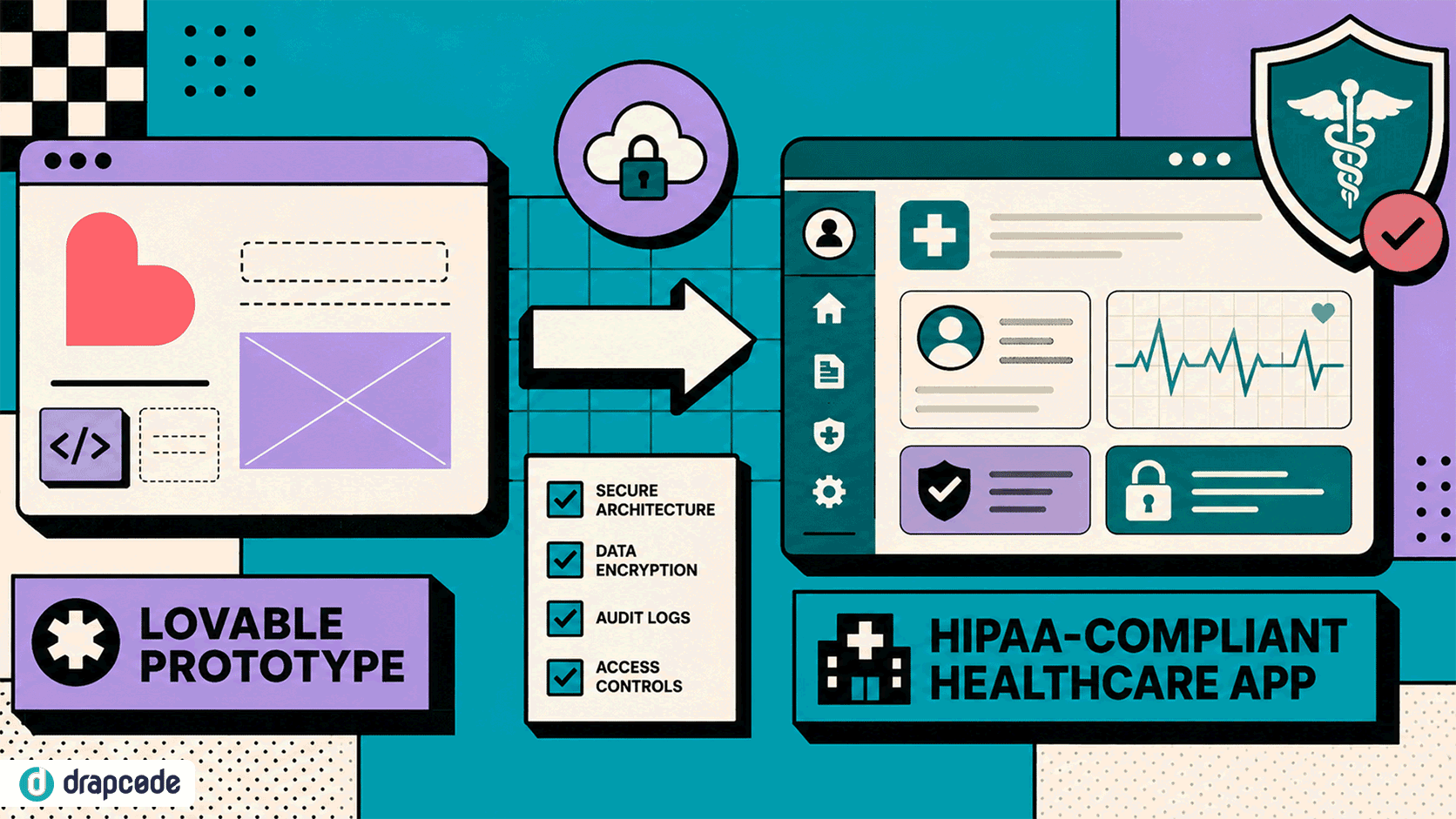
Lovable Prototype to a HIPAA-Compliant Healthcare App
There’s a good chance your healthcare idea started with a simple prompt.
"Build a patient portal where users can book appointments, upload medical records, and message their doctor."
A few minutes later, Lovable generated a working application.
The forms looked polished. The dashboard felt intuitive. The workflow made sense. Suddenly, your idea wasn't just a concept; it was something investors could click through, clinicians could review, and potential customers could experience.
That's exactly why tools like Lovable have become so popular.
They remove the biggest barrier to innovation: getting started.
But then something changes.
A hospital expresses interest.
A pilot customer wants to test the product.
A clinic asks whether patient data will be secure.
Someone inevitably asks:
"Is this ready for real healthcare users?"
That's usually the moment founders realize there's a significant difference between a working prototype and a production-ready healthcare application.
The good news?
You probably don't need to start over.
You simply need to build the right foundation beneath what you've already created.
Your Prototype Has Already Done Its Job
Many founders underestimate the value of a prototype.
They worry that because it isn't production-ready, all the time invested was wasted.
In reality, the opposite is true.
Your Lovable prototype has likely answered some of the hardest product questions:
- Do users understand the workflow?
- Does the interface solve a real problem?
- Which features matter most?
- Where do users get confused?
- Is the product worth building?
Those insights are incredibly valuable.
Changing the technology behind the application doesn't erase everything you've learned.
Instead, it gives you an opportunity to turn a validated concept into software that healthcare organizations can confidently adopt.
Don't Throw Everything Away; Know What to Keep
One of the biggest misconceptions about migrating from a prototype is that the entire application needs to be rebuilt.
That's rarely the case.
In many situations, the parts users interact with every day can continue to guide the next phase of development.
Your product's navigation, branding, workflows, and user experience often represent months of valuable feedback and iteration.
The biggest changes usually happen behind the scenes.
Here's a simple way to think about it.
You Can Usually Keep
You Should Rebuild or Strengthen
User journeys
Authentication and identity management
Screen layouts
Backend architecture
Branding and design
Database structure
Forms and workflows
Access controls and permissions
User feedback
Audit logging
Product vision
Healthcare integrations
The goal isn't to replace what works.
It's to strengthen the parts users never see, but healthcare organizations rely on every day.
The First Real Patient Changes Everything
During the prototype stage, teams often use sample data.
Fake patient names.
Demo appointments.
Placeholder medical histories.
That's perfectly normal.
But the moment your application begins handling Protected Health Information (PHI), the expectations change dramatically.
You're no longer building a product that simply demonstrates an idea.
You're building software that people trust with some of their most sensitive information.
Questions become much more serious.
- How is patient information encrypted?
- Who can access medical records?
- Can administrators track every important action?
- How are user roles managed?
- Which vendors process healthcare data?
- What happens if credentials are compromised?
These aren't questions your prototype was designed to answer.
They're questions every production healthcare application must address.
Why Most Healthcare MVPs Need a New Backend
One of the biggest surprises for first-time healthcare founders is discovering that the interface is rarely the difficult part.
Modern AI tools can generate impressive user interfaces in hours.
The challenge lies underneath.
A healthcare application isn't just a collection of screens.
It's a network of services working together.
When a patient schedules an appointment, the application may also need to:
- Verify the patient's identity
- Check provider availability
- Update scheduling systems
- Send confirmation notifications
- Record audit events
- Synchronize Electronic Health Record (EHR) data
- Trigger follow-up workflows
Those processes happen long after someone clicks a button.
That's why migrating from a prototype usually focuses on rebuilding the backend rather than redesigning the frontend.
A stronger architecture allows the application to support real users, real healthcare workflows, and long-term growth.
A Practical Roadmap for Moving Beyond the Prototype
Migration doesn't have to be overwhelming.
Breaking the process into clear stages makes it far easier to manage.
Stage 1: Review What Already Works
Start by identifying the parts of your prototype that users genuinely like.
These often include:
- Navigation
- User flows
- Core features
- Product branding
- Overall experience
There's no reason to replace successful ideas.
Stage 2: Redesign the Foundation
This is where engineering takes priority.
Focus on:
- Secure backend services
- User authentication
- Role-based access controls
- Database architecture
- API design
- Infrastructure planning
These decisions will influence every future feature.
Stage 3: Add Healthcare Capabilities
Once the architecture is in place, begin introducing healthcare-specific functionality such as:
- FHIR interoperability
- Provider workflows
- Clinical data exchange
- Patient record management
- Reporting
- Audit logging
Building these capabilities on a secure foundation is much easier than trying to retrofit them later.
Stage 4: Prepare for Production
Before launch, evaluate areas including:
- Performance
- Security testing
- User permissions
- Backup strategies
- Operational monitoring
- Deployment processes
At this point, your application has evolved far beyond its original prototype.
It has become software designed for real healthcare environments.
Common Mistakes Founders Make During the Migration
Moving from a prototype to a production healthcare application isn't just a technical exercise; it's a mindset shift.
Many teams successfully validate their product, secure early customer interest, and then unknowingly introduce risk during the next phase of development.
Here are some of the most common mistakes.
Treating the Prototype Like Production Software
A prototype is designed to prove an idea quickly.
It's not designed to support healthcare providers, manage sensitive patient information, or meet enterprise security expectations.
Trying to scale a prototype without strengthening its architecture often creates technical debt that's much harder to fix later.
Waiting Too Long to Think About Security
Security is easiest to implement when it's part of the application's design.
Leaving authentication, access controls, audit logging, and encryption until the final stages usually means revisiting large parts of the application.
Building with security in mind from the beginning saves both time and effort.
Ignoring Healthcare Integrations
Healthcare applications rarely operate alone.
As your product grows, customers may expect integrations with:
- Electronic Health Records (EHRs)
- Electronic Medical Records (EMRs)
- FHIR APIs
- Scheduling systems
- Billing platforms
- Identity providers
Planning for interoperability early makes future integrations much smoother.
Assuming Every Customer Has the Same Requirements
A digital health startup, a specialty clinic, and a large hospital often have very different expectations.
Building a flexible architecture gives your application room to adapt as your customer base expands.
When Lovable Is the Right Tool and When It's Time to Move Forward
Lovable is excellent at helping founders answer an important question:
"Is this idea worth building?"
If your objective is to:
- Validate a healthcare concept
- Demonstrate an MVP to investors
- Collect feedback from clinicians
- Test user journeys
- Iterate on product design
then Lovable can dramatically accelerate the process.
However, the conversation changes when you're preparing for production.
Healthcare organizations begin asking different questions.
- Can this integrate with our EHR?
- How are patient records protected?
- Can we control user permissions?
- Does the application support interoperability?
- Can it scale across multiple departments or locations?
At this stage, success depends less on how quickly the interface was created and more on the strength of the application's architecture.
That's why many healthcare startups evolve from rapid prototyping to a more structured development approach as their product matures.
Lovable vs DrapCode: Different Stages of the Same Journey
Comparing Lovable and DrapCode isn't really about choosing one instead of the other.
They're designed to solve different problems.
Lovable helps founders move from an idea to a working prototype with remarkable speed.
DrapCode helps healthcare organizations move from a validated concept to a production-ready healthcare application.
Here's how the two approaches compare.
Development Goal
Lovable
DrapCode
Validate a healthcare idea
✓ Excellent
✓ Supported
Build clickable prototypes
✓ Core strength
✓ Supported
Rapid UI generation
✓ AI-generated
✓ AI-assisted visual development
Patient portals
Prototype quickly
✓ Production-ready development
EMRs and EHR applications
Requires significant custom engineering
✓ Supported
FHIR interoperability
Custom implementation
✓ Native healthcare integration support
Healthcare workflow automation
Limited to prototype logic
✓ Healthcare-focused workflows
Production healthcare applications
Additional engineering required
✓ Healthcare application development company
The important takeaway is that these platforms don't have to compete.
One helps you discover the right product.
The other helps you deliver it to healthcare organizations with confidence.
What Changes When You Build with DrapCode?
Once a healthcare product has proven its value, the focus shifts from experimentation to reliability.
Instead of asking, "Can we build this feature?" healthcare teams start asking:
- Can this support thousands of patients?
- Can providers trust the platform?
- Can we integrate with existing healthcare systems?
- Can we deliver updates without disrupting clinical workflows?
That's where DrapCode comes in.
As a healthcare application development company, DrapCode helps organizations build secure, scalable healthcare software such as:
- Patient portals
- Care management platforms
- Electronic Medical Record (EMR) systems
- Provider applications
- Telehealth platforms
- FHIR-enabled healthcare solutions
Rather than starting from scratch, the goal is to build upon everything you've already learned during prototyping.
Your validated workflows, product ideas, and user feedback remain valuable.
They simply become part of a stronger, production-ready foundation.
Final Thoughts
Building a prototype is a milestone, not the finish line.
If you've used Lovable to validate a healthcare idea, you've already completed one of the most difficult parts of product development. You've proven that the problem is worth solving and gained valuable feedback from real users or stakeholders.
The next challenge is preparing your application for the realities of healthcare.
That means thinking beyond the interface and investing in architecture, interoperability, security, governance, and long-term scalability.
You don't have to abandon your prototype.
You simply need to evolve it.
With the right development approach, your Lovable prototype can become the foundation for a secure, production-ready healthcare application that providers, clinicians, and patients can trust.
Frequently Asked Questions
Q1. Can I use my Lovable prototype as the foundation for a healthcare app?
Yes. In many cases, your user flows, interface, and product design can serve as the starting point. The backend, security, integrations, and infrastructure typically require additional work before the application is ready for production healthcare use.
Q2. Do I need to rebuild everything?
Not necessarily. Most teams keep the product vision, user experience, and workflows while strengthening the backend architecture, authentication, data management, and healthcare integrations.
Q3. When should I migrate from a prototype?
A good time to start planning the migration is when you're preparing for pilot customers, handling real patient data, integrating with healthcare systems, or moving toward commercial deployment.
Q4. Why are healthcare integrations important?
Healthcare organizations often rely on EHRs, EMRs, FHIR APIs, scheduling systems, and other clinical software. Supporting interoperability helps your application fit into existing healthcare workflows.
Q5. Why choose DrapCode after prototyping?
DrapCode focuses exclusively on healthcare application development. It helps healthcare organizations build secure, scalable software with AI-assisted visual development, healthcare workflows, FHIR interoperability, and enterprise-ready architecture.
Ready to Turn Your Prototype Into a Healthcare Product?
Your prototype proved that the idea works.
Now it's time to build software that's ready for healthcare organizations, providers, and patients.
DrapCode is a healthcare application development company that helps healthcare startups and enterprises transform prototypes into secure, scalable applications. From patient portals and EMRs to telehealth platforms and FHIR-enabled solutions, we help teams move from validation to production with confidence.