DrapCode Achieves HIPAA-Compliant Certification: What It Means for Healthcare App Development
Healthcare applications handle some of the most sensitive information people share. Patient records, medical histories, diagnostic reports, prescriptions, and insurance details all require careful protection. For organizations building healthcare software, data security and regulatory compliance must be considered from the beginning.
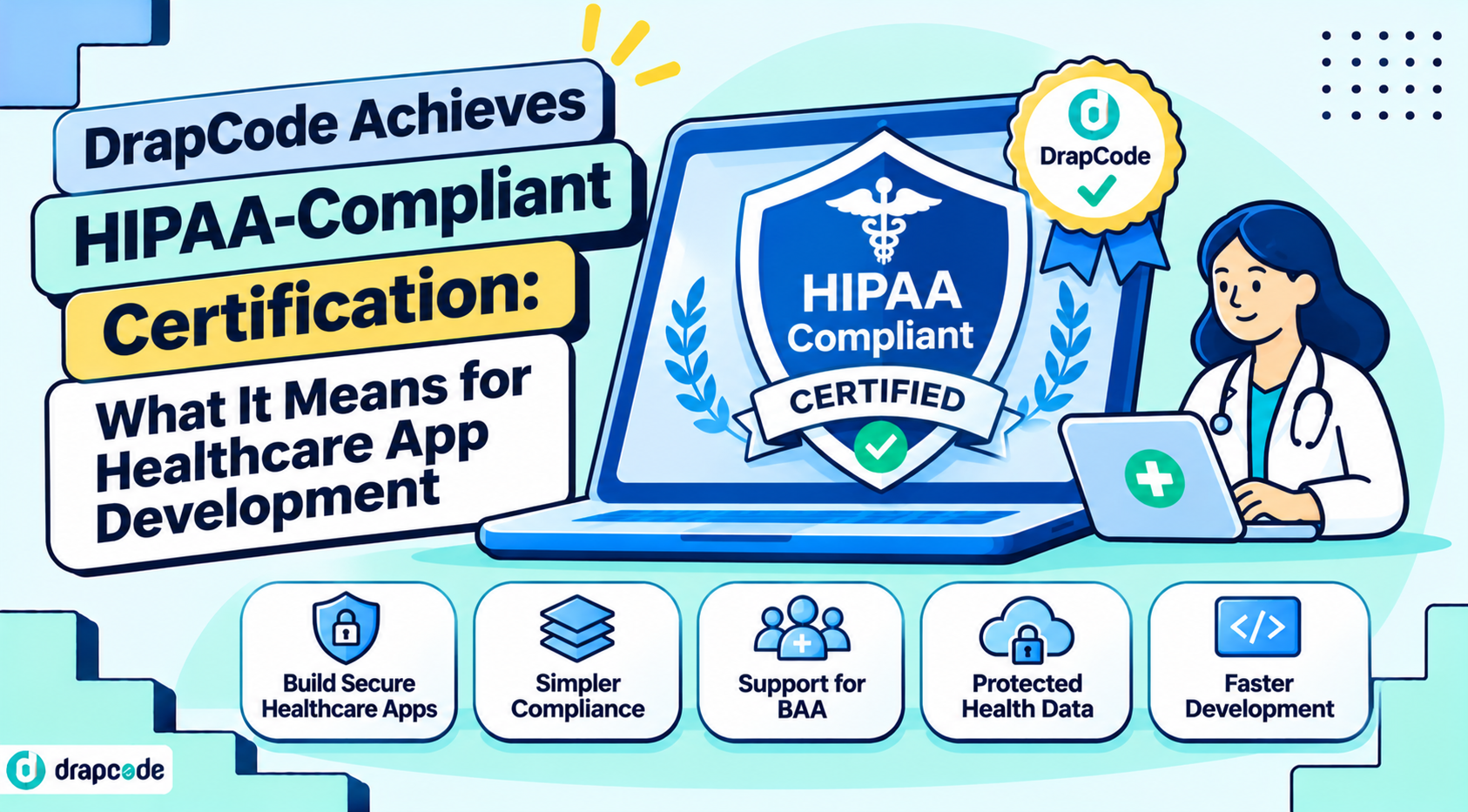
DrapCode has achieved HIPAA-compliant certification, strengthening its position as an application development platform for healthcare organizations and businesses working with protected health information (PHI). This achievement reflects DrapCode's commitment to providing a secure environment for developing healthcare applications.
But what does this certification mean for businesses using DrapCode? Does it mean every application built on the platform is automatically HIPAA compliant?
Not necessarily. DrapCode provides a HIPAA-compliant foundation, but individual applications may require additional configuration, security controls, and implementation work depending on how they collect, process, store, and share patient information.
This article explains DrapCode's HIPAA achievement, the security capabilities behind it, and what healthcare teams should consider when building applications that handle sensitive patient data.
What Is HIPAA Compliance?
The Health Insurance Portability and Accountability Act (HIPAA) is a United States law that establishes requirements for protecting sensitive health information. Its rules apply to covered entities, including healthcare providers and health plans, as well as business associates that perform certain services involving protected health information on their behalf.
HIPAA's requirements focus on protecting the privacy and security of patient information. Organizations handling electronic protected health information (ePHI) must implement appropriate administrative, physical, and technical safeguards.
These safeguards address areas such as:
- Access management: Restricting patient information to authorized individuals.
- Data protection: Protecting sensitive information during storage and transmission.
- Audit controls: Recording and reviewing relevant system activity.
- Risk management: Identifying security risks and addressing vulnerabilities.
- Incident response: Establishing procedures for responding to security incidents and breaches.
For healthcare software providers, these responsibilities extend beyond the application interface. The hosting environment, database, authentication system, integrations, and operational processes all contribute to protecting patient information.
DrapCode Has Achieved HIPAA-Compliant Certification
DrapCode has achieved HIPAA-compliant certification following its compliance assessment process. This achievement demonstrates the platform's commitment to maintaining security practices and infrastructure designed for healthcare application development.
For healthcare organizations, choosing a platform with an established compliance foundation can simplify an important part of the technology evaluation process. Instead of starting with a general-purpose development environment, teams can work with a platform designed to support healthcare data protection requirements.
DrapCode's healthcare infrastructure includes capabilities such as:
- Encryption for protecting sensitive information.
- Access controls for managing user permissions.
- Audit logging for tracking important activities.
- Secure authentication and application access.
- Infrastructure and hosting safeguards for healthcare workloads.
- Business Associate Agreement (BAA) support for eligible healthcare arrangements.
These capabilities provide a foundation for developing applications that handle sensitive healthcare information.
An important distinction: DrapCode's certification applies to the platform and its assessed scope. It does not automatically certify every application developed with DrapCode. The application's configuration, integrations, data handling, and operating practices must also meet the applicable requirements.
How DrapCode Protects Healthcare Data
Protecting patient information requires multiple security measures working together. DrapCode provides healthcare-focused security capabilities to help developers and organizations build applications with data protection in mind.
Data Encryption
Encryption helps prevent unauthorized access to sensitive information while it is stored or transferred. DrapCode provides encryption safeguards for healthcare application data, supporting the protection of information throughout its handling.
Healthcare teams should also review their application architecture and connected services to confirm that sensitive information remains protected across all data flows.
Role-Based Access Control
Healthcare applications often serve different user groups, including doctors, nurses, administrators, patients, and support staff. Each group needs access to different information and application functions.
Role-based access control helps restrict actions according to assigned responsibilities. For example, a doctor may need access to clinical records, while an administrative user may only need appointment and registration information.
Configuring permissions carefully helps reduce unnecessary access to patient data.
Audit Logging and Activity Tracking
Understanding who accessed information and what actions they performed is important for healthcare security.
Audit logging helps maintain records of relevant application activities, such as user access and changes to information. These records can support security reviews, internal investigations, and compliance processes.
Healthcare organizations should define which activities need to be recorded and establish appropriate log review and retention procedures.
Secure Hosting Infrastructure
The infrastructure hosting an application is an important part of its security environment. Database protection, network controls, backups, infrastructure access, and operational safeguards all contribute to protecting sensitive information.
DrapCode provides hosting capabilities designed to support healthcare workloads. Organizations should confirm the applicable hosting configuration, service scope, data location, and contractual arrangements before deploying applications that process PHI.
Secure API Communication
Healthcare applications rarely operate in isolation. They often connect with EHR systems, billing software, laboratory platforms, scheduling services, and other healthcare tools.
These connections must protect information as it moves between systems. DrapCode supports API-based integrations, allowing teams to connect application workflows with external services while configuring appropriate authentication, permissions, and data exchange controls.
Each connected provider should be assessed separately when PHI is involved.
Why a Business Associate Agreement Matters
A Business Associate Agreement is a written agreement that establishes how a business associate may use and disclose protected health information and what responsibilities it has for protecting that information.
A BAA is generally required when a service provider creates, receives, maintains, or transmits PHI on behalf of a covered entity or another business associate, subject to HIPAA's applicable requirements.
DrapCode offers BAA support for eligible healthcare arrangements. This allows healthcare organizations to establish the relevant contractual relationship before using supported DrapCode services to handle PHI.
Before signing or relying on a BAA, organizations should confirm:
- Which DrapCode services and environments are covered.
- What types of information may be processed.
- How security responsibilities are divided.
- How incidents and suspected breaches are handled.
- What happens to information when the agreement or service ends.
A BAA is an important part of the compliance relationship, but it does not replace the organization's responsibility to configure and operate its application securely.
Does DrapCode Make Every Application HIPAA Compliant?
No. This is an important distinction for anyone planning to build healthcare software.
DrapCode has achieved HIPAA-compliant certification and provides a platform with healthcare-focused security infrastructure. However, the final application's compliance depends on how it is developed, configured, connected, and used.
For example, a patient portal may require secure registration, identity verification, role-based permissions, protected medical record access, and carefully managed EHR integrations. A telemedicine application may need additional safeguards around consultations, communication, and associated patient information.
These requirements differ from one application to another.
Depending on the use case, additional work may include:
Application configuration: Set up appropriate user roles, access permissions, authentication, and session controls.
Data management: Identify what PHI the application collects, where it is stored, and how it is shared.
Integration review: Assess third-party services that may access or process patient information and establish BAAs where required.
Security testing: Validate permissions, data flows, authentication, and other relevant security controls before production use.
Organizational procedures: Establish workforce training, incident response, access reviews, data retention, and other required policies.
DrapCode can help customers configure and implement the application requirements relevant to their use case. The final assessment must still cover the complete application and the organization operating it.
Build Healthcare Applications with DrapCode
Healthcare organizations often need applications that fit their specific clinical and administrative workflows. Generic software may not provide the flexibility required to support specialized processes, integrations, and user experiences.
DrapCode combines AI-assisted development with visual application building, helping teams turn application requirements into functional healthcare software.
You can describe what you want to build, use AI to generate and refine supported functionality, and configure interfaces, data structures, workflows, integrations, and business logic visually.
Healthcare applications that can be developed include:
- Patient Portals: Give patients access to records, appointments, and healthcare services.
- Telemedicine Platforms: Support virtual consultations, scheduling, and follow-up workflows.
- EHR and EMR Applications: Manage patient information and connected clinical workflows.
- Practice Management Systems: Organize appointments, patient intake, staff activities, and administrative operations.
- Remote Patient Monitoring Applications: Support connected patient monitoring and health data workflows.
- Healthcare Analytics Platforms: Present operational and clinical information through structured dashboards.
For example, a healthcare organization building a patient portal can define its patient registration process, configure provider and patient roles, create appointment workflows, and plan its EHR integrations. The team can then review and implement the security controls required for its specific deployment.
With DrapCode, organizations can work toward production-ready healthcare applications without treating compliance as an afterthought.
Learn more about building healthcare applications with DrapCode and the platform's HIPAA-compliant infrastructure.
Why Choose DrapCode for Healthcare App Development?
Choosing a healthcare application development platform involves more than evaluating how quickly a team can build screens and workflows. Organizations also need to consider security, compliance, integrations, deployment, and long-term application ownership.
DrapCode brings these requirements together through:
HIPAA-Compliant Certification: A platform-level compliance achievement supporting DrapCode's healthcare application development capabilities.
AI-Assisted App Building: Describe application requirements and use AI to generate and refine supported functionality.
Visual Development: Configure interfaces, data models, workflows, and business logic without relying entirely on traditional development.
Healthcare Integrations: Connect applications with EHRs, APIs, and other healthcare services through supported integration capabilities.
Security Infrastructure: Use encryption, access controls, audit logging, and hosting safeguards designed for healthcare workloads.
BAA Support: Establish the appropriate contractual arrangement for eligible healthcare use cases involving PHI.
Together, these capabilities help healthcare organizations develop applications around their operational requirements while keeping security and compliance considerations part of the development process.
Frequently Asked Questions
Q1. Is DrapCode HIPAA certified?
Yes. DrapCode has achieved HIPAA-compliant certification. This reflects the platform's commitment to healthcare data protection and its compliance assessment. Organizations should review the applicable certification documentation and service scope when evaluating the platform.
Q2. Does DrapCode automatically make every application HIPAA compliant?
No. DrapCode provides a HIPAA-compliant platform foundation, but each application must be configured and implemented according to its specific requirements. Data handling, access permissions, integrations, organizational policies, and operational safeguards all contribute to the final compliance assessment.
Q3. Does DrapCode provide a Business Associate Agreement?
DrapCode offers BAA support for eligible healthcare arrangements. Healthcare organizations should confirm the applicable services, scope, and contractual terms before processing PHI through the platform.
Q4. What security features does DrapCode provide for healthcare applications?
DrapCode provides healthcare-focused security capabilities, including encryption, access controls, audit logging, secure authentication, and hosting safeguards. The exact configuration and service scope should be reviewed for each deployment.
Q5. Can I build a HIPAA-compliant patient portal using DrapCode?
Yes. DrapCode can be used to develop patient portals with features such as registration, appointment management, patient dashboards, and EHR integrations. The application must be configured, tested, and assessed against the applicable HIPAA requirements before handling production PHI.
Q6. Can DrapCode help configure an application for HIPAA requirements?
Yes. DrapCode can help customers implement application functionality and relevant security configurations based on their use case. Additional work may be needed depending on the application's architecture, integrations, data flows, and organizational requirements.
Q7. How can I check whether my healthcare application is HIPAA-ready?
Start by reviewing how your application collects, stores, accesses, and shares PHI. Assess authentication, permissions, encryption, audit logging, hosting, integrations, vendor agreements, and organizational procedures.
You can use the DrapCode HIPAA Readiness Check to identify potential gaps. It is a preliminary assessment, not a replacement for a formal HIPAA Security Risk Analysis.
Build Healthcare Applications on a HIPAA-Compliant Foundation
Healthcare software needs to support real-world workflows while protecting sensitive patient information. DrapCode brings HIPAA-compliant certification, AI-assisted app building, visual development, and healthcare-focused security infrastructure together to support this work.
Whether you are developing a patient portal, telemedicine platform, EHR-connected application, or healthcare management system, DrapCode provides a foundation for building around your requirements.
Build your healthcare application with DrapCode and work toward production readiness with security and compliance considered from the start.