LLM Agents in AI Development: How They Work and Where They Fit
Artificial intelligence has moved beyond systems that simply answer questions or generate text. Modern AI applications can interpret a goal, break it into smaller tasks, retrieve information, interact with external tools, and use the results to decide what to do next.
This shift has brought Large Language Model (LLM) agents into application development. Instead of responding to every instruction with a standalone answer, an agent can work through a sequence of actions to complete a defined objective.
For developers and businesses, this creates new possibilities for building applications that do more than display information or respond to user input. They can assist with research, coordinate workflows, retrieve business data, and interact with connected systems.
But what makes an LLM agent different from a chatbot? How does its architecture work, and what should teams consider before putting one into production?
What Are LLM Agents?
An LLM agent is a software system that uses a large language model to interpret goals, decide which actions to take, and interact with tools or external systems to complete tasks.
A conventional chatbot generally responds to a user's prompt with generated text. An LLM agent can take additional steps when the task requires them.
For example, consider a customer who asks an application to check the status of an order and update their delivery preferences.
A basic chatbot might explain how to find the order status. An agent could:
- Identify the order number from the request.
- Query the connected order management system.
- Retrieve the latest delivery information.
- Check whether the requested change is allowed.
- Submit an update if the required permissions are available.
- Confirm the result to the customer.
The agent does not perform these actions through language generation alone. It relies on tools, application interfaces, permissions, and execution logic that connect the model to external systems.
The language model provides reasoning and decision-making capabilities, while the surrounding software determines what the agent can access and do.
How LLM Agents Work
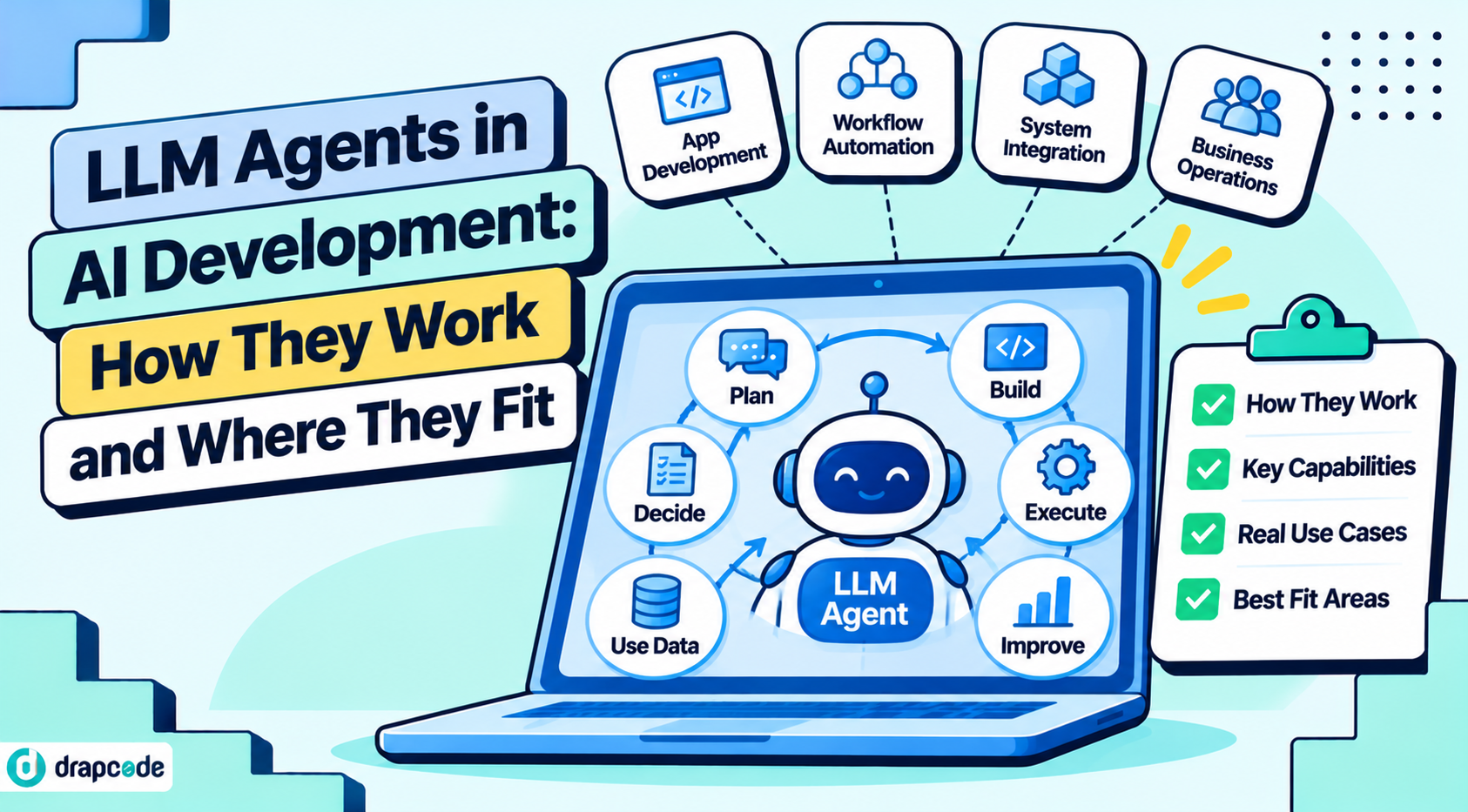
An LLM agent typically operates through a cycle of understanding, planning, action, and feedback. The exact architecture varies depending on the task, the model, and the tools available.
Understand the Request
The process begins when a user provides an instruction or a system receives an event.
The agent interprets the request, identifies the intended outcome, and determines what information is needed. It may also use previous conversation context, application data, or instructions that define its role.
For example, an employee might ask an agent to prepare a summary of all unresolved customer support requests from the previous week.
Plan the Steps
The agent determines how to approach the task. It may break a broad instruction into smaller operations and decide which tools are needed.
A support summary might require retrieving tickets, filtering them by status and date, grouping them by category, and preparing a report.
Planning is not always a fixed sequence. An agent may adjust its next step after receiving information from a tool or encountering an unexpected result.
Use Tools and APIs
An LLM agent needs a way to interact with the systems where information is stored or actions are performed.
Depending on its configuration, it may use:
- APIs to retrieve or update application records.
- Databases to search structured information.
- Search tools to find external information.
- Business applications to create tasks or update records.
- Code execution tools for calculations and data processing.
- Other agents to delegate specialized tasks.
The model decides when an available tool is appropriate, but the application must validate the request and control whether the action is permitted.
Review the Results
After a tool runs, the agent receives its output. It can interpret the result, identify missing information, and decide whether another action is needed.
For example, if a database query returns incomplete information, the agent might request another field or ask the user for clarification.
This feedback loop allows an agent to work through multi-step tasks instead of treating every interaction as a single prompt and response.
Complete or Escalate the Task
Once the objective is achieved, the agent provides the result or updates the relevant system.
If it encounters an uncertain decision, missing permission, or an action that requires human approval, it should stop and request assistance rather than proceeding without authorization.
Key Components of an LLM Agent
An effective agent requires more than a language model. Its surrounding architecture determines how it behaves, what information it can access, and how reliably it performs tasks.
Language model
The model interprets instructions, processes context, generates plans, and selects suitable actions. Its capabilities influence how well the agent handles complex requests.
Tools and integrations
Tools connect the agent to external applications, APIs, databases, and services. They allow it to retrieve information and perform actions beyond generating text.
Memory and context
Memory helps an agent retain relevant information across steps or interactions. This may include conversation history, task state, user preferences, or information retrieved from an external knowledge source.
Memory design should account for relevance, retention, access permissions, and data privacy.
Planning and orchestration
The planning layer organizes tasks and determines how the agent should move between operations. Orchestration manages tool execution, workflow state, and interactions between multiple agents when required.
Permissions and safeguards
Access controls define which information the agent can retrieve and which actions it can perform. Validation rules, approval steps, monitoring, and audit records help keep its behavior within defined boundaries.
These components work together. A capable model without reliable tools or appropriate permissions is not enough to deliver a dependable application.
LLM Agents vs. Traditional Chatbots
Although both can use large language models, their responsibilities are different.
A chatbot is often the better choice for straightforward questions and guided conversations. An agent becomes useful when a task involves multiple steps, external information, and actions that need to be coordinated.
Not every AI feature needs an agent. For predictable tasks, a conventional workflow or a single model call may be simpler, cheaper, and easier to control.
Where LLM Agents Are Used
LLM agents can support different industries and business functions. Their usefulness depends on the quality of connected data, the available tools, and the level of autonomy permitted.
Customer Support
An agent can retrieve order details, review support history, classify requests, draft responses, and create or update tickets. More sensitive actions can be routed to a human support representative for approval.
Software Development
Development agents can inspect code, search documentation, generate changes, run tests, and report errors. They can assist developers across multiple stages of a software project, although generated code still needs review and validation.
Healthcare Operations
Healthcare applications can use carefully scoped agents to assist with administrative activities such as organizing non-clinical requests, preparing operational summaries, or routing tasks to the appropriate team.
Any use involving patient information requires appropriate privacy, security, access controls, and contractual safeguards. Clinical recommendations and patient-care decisions require additional clinical validation and appropriate professional oversight.
Financial Services
Agents can support document classification, customer service, application status enquiries, and internal operational workflows. Actions involving financial transactions, credit decisions, or sensitive customer information require strong validation and authorization.
Research and Data Analysis
Research agents can retrieve information from approved sources, compare documents, organize findings, and prepare summaries. Data analysis agents can query permitted datasets and perform calculations through connected tools.
Single-Agent and Multi-Agent Architectures
Not every application needs several agents. The choice between a single-agent and multi-agent architecture depends on the complexity of the task.
Single-agent architecture
One agent manages the task, selects tools, and coordinates the required steps. This is often a sensible starting point because it is easier to test, monitor, and improve.
For example, a customer service agent might retrieve customer details, check an order, and prepare a response using a small set of authorized tools.
Multi-agent architecture
A multi-agent system assigns different responsibilities to specialized agents. One agent may retrieve information, another may analyze it, and a coordinating agent may combine their results.
For example, a research application could use separate agents for document retrieval, data analysis, and report preparation.
This approach can help organize complex tasks, but it also introduces additional coordination, latency, cost, and failure points. Teams should begin with a simpler design and introduce multiple agents only when the task genuinely benefits from specialization.
Challenges in Building LLM Agents
Agents can make applications more capable, but they also introduce technical and operational challenges.
Unreliable outputs: Language models can misunderstand instructions or generate incorrect information. Important outputs need validation against trusted data and defined rules.
Tool execution errors: An agent may select the wrong tool or supply incorrect parameters. Tool calls should be validated before execution, and failures should be handled explicitly.
Data privacy: Agents may access sensitive information through prompts, memory, logs, or connected systems. Data access must be restricted to what the task requires.
Uncontrolled actions: Excessive autonomy can create risks when agents update records, send communications, or initiate transactions. Use permission boundaries and human approval for consequential actions.
Cost and response time: Multi-step reasoning and repeated tool calls can increase model usage and processing time. Teams should measure performance and optimize the workflow.
Testing and monitoring: An agent may produce different results for similar requests. Evaluation should cover task completion, accuracy, tool selection, permission enforcement, failure handling, and operational cost.
These challenges are reasons to design agents around clear objectives and controlled actions rather than giving them unrestricted access to business systems.
How DrapCode Supports AI Application Development
Building an AI-powered application involves more than connecting a language model to a chat interface. The application also needs user screens, structured data, business logic, permissions, and integrations with the systems that support its workflows.
DrapCode is an AI App Builder that helps teams develop applications through natural-language instructions and visual configuration. Users can describe their application requirements, generate and refine supported functionality, and configure interfaces, data models, workflows, and integrations.
This provides an application development foundation for products that may include AI-powered features.
For example, a team developing a customer support application could build the interface, organize customer and ticket data, configure user permissions, and connect the application with supported external services. An AI agent can then be integrated through the relevant model, API, and execution architecture.
DrapCode also provides an MCP Server that allows compatible AI development tools to connect with capabilities exposed by DrapCode. This is different from claiming that every application built with DrapCode automatically contains an autonomous LLM agent. The agent's reasoning, tools, and execution behavior depend on the chosen AI system and implementation.
You can learn more about DrapCode's AI App Builder features, its MCP Server for AI development, and available integrations.
For regulated applications, security and compliance requirements must be considered throughout development. DrapCode provides compliance infrastructure that includes encryption, audit logging, applicable hosting safeguards, and BAA support for eligible healthcare arrangements. The complete application still needs appropriate configuration, vendor assessment, access policies, testing, and operational controls.
Building the Next Generation of AI Applications
LLM agents are changing what software can do. Instead of limiting AI to text generation and basic assistance, developers can build systems that plan tasks, use tools, retrieve information, and coordinate actions across connected applications.
The most effective implementations will not necessarily be the ones with the greatest autonomy. They will be the ones that combine useful model capabilities with reliable integrations, clear permissions, measurable performance, and human oversight where needed.
For teams building these products, the application foundation matters just as much as the AI model. DrapCode helps turn application requirements into functional software through AI-assisted development and visual configuration, giving teams a way to build the interfaces, data, workflows, and integrations around their AI-powered ideas.