DrapCode Is ISO 27001 Certified: What It Means for Data Security
When businesses choose an application development platform, they need to consider more than its features and development capabilities. They also need confidence that the company behind the platform takes information security seriously.
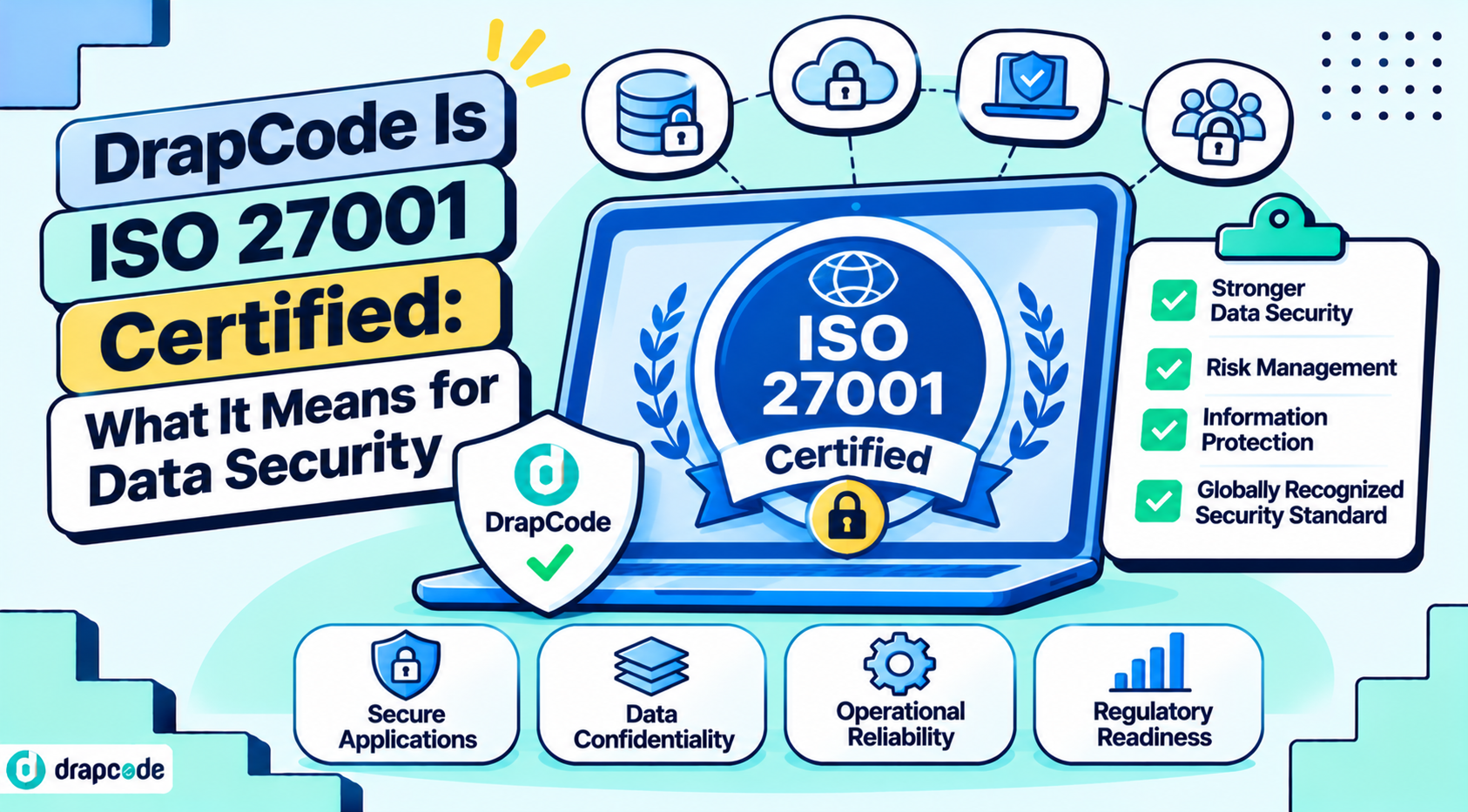
DrapCode is ISO 27001 certified, demonstrating its commitment to managing information security through an internationally recognized framework. This certification is an important part of DrapCode's approach to protecting business information and supporting organizations that build applications for industries where data security matters.
For companies working in healthcare, fintech, legal tech, insurance, and other regulated sectors, a platform's security practices can influence vendor selection, risk assessments, and internal approval processes.
But what does ISO 27001 certification actually mean? What does it cover, and how does it benefit businesses building applications with DrapCode?
Let's look at the standard, DrapCode's certification, and what organizations should understand when evaluating an application development platform.
What Is ISO 27001 Certification?
ISO/IEC 27001 is an internationally recognized standard for establishing, implementing, maintaining, and continually improving an Information Security Management System (ISMS).
An ISMS is the combination of policies, processes, responsibilities, and security controls an organization uses to protect the information it handles. Rather than relying on individual security tools, the standard takes a structured approach to identifying information security risks and managing them.
The framework focuses on three fundamental principles:
- Confidentiality: Information should only be accessible to people and systems authorized to use it.
- Integrity: Information should remain accurate, complete, and protected against unauthorized changes.
- Availability: Information and systems should be accessible when authorized users need them.
ISO 27001 certification involves an independent assessment of an organization's information security management system against the standard's requirements. It demonstrates that the organization has established a structured approach to managing information security risks within the defined certification scope.
The certification does not mean that security risks no longer exist. Instead, it demonstrates that information security is managed through an established system rather than treated as an occasional technical exercise.
DrapCode Has Achieved ISO 27001 Certification
DrapCode has achieved ISO 27001 certification, marking an important milestone in its commitment to information security.
The certification reflects DrapCode's focus on establishing and maintaining structured security management practices. It provides customers with additional assurance when evaluating DrapCode as a platform for developing and operating business applications.
For organizations handling confidential business information or working in regulated industries, evaluating a technology provider's security management practices is an important part of vendor due diligence.
DrapCode's certification helps demonstrate that information security is an organizational priority, supported by a formal management framework.
It also complements DrapCode's broader platform capabilities, which bring AI-assisted application development, visual development, integrations, workflows, and hosting together in one environment.
An important distinction: ISO 27001 certification applies to the organization and the Information Security Management System within the certificate's defined scope. It does not automatically certify every application a customer builds using DrapCode. Each application still needs appropriate security configuration, testing, and operational safeguards.
Why ISO 27001 Matters for Businesses
Choosing a technology provider involves trusting that provider with information, systems, and business processes. ISO 27001 gives organizations a recognized framework for evaluating how a provider approaches information security.
Here are some of the reasons the certification matters when selecting an application development platform.
Structured Security Risk Management
Information security risks can arise from unauthorized access, human error, system vulnerabilities, service interruptions, and third-party dependencies.
ISO 27001 requires organizations to establish a process for identifying, assessing, and treating information security risks. This encourages a more systematic approach to security decisions and helps ensure that risks are considered as business operations evolve.
Better Information Protection Practices
Protecting information involves more than installing security software. Organizations need defined responsibilities, policies, processes, and controls for handling the information they manage.
An ISO 27001-aligned management system brings these elements together. It provides a framework for managing information throughout its lifecycle, from access and storage to sharing and eventual disposal.
Greater Customer Confidence
Customers increasingly ask technology providers about their security practices before approving a new platform.
ISO 27001 certification gives businesses a recognized credential they can consider during vendor evaluations, procurement discussions, and security reviews.
It does not replace a customer's own due diligence, but it provides meaningful evidence that the provider has undergone an independent assessment of its information security management system.
Support for Vendor Risk Assessments
Organizations in healthcare, fintech, insurance, and legal technology often need to assess the security practices of their technology vendors.
A provider's ISO 27001 certification can support this process by demonstrating that information security is managed through a formal framework.
Customers should still review the certificate's scope, validity, and other relevant security documentation to understand exactly what has been assessed.
How ISO 27001 Supports Ongoing Information Security
Achieving certification is not the end of an organization's security responsibilities. ISO 27001 is designed around maintaining and continually improving an Information Security Management System.
This means information security needs to remain part of everyday business operations.
An effective ISMS generally involves several ongoing activities.
Risk Assessments: Identify potential threats to business information, evaluate their impact, and determine how identified risks should be addressed.
Security Policies: Establish documented expectations and responsibilities for protecting company and customer information.
Access Management: Define who can access information and systems, and ensure permissions are appropriate to their responsibilities.
Employee Awareness: Help employees understand their security responsibilities and recognize risks associated with handling information.
Internal Reviews: Review the effectiveness of security processes and identify areas that need improvement.
Incident Management: Establish procedures for identifying, reporting, investigating, and responding to information security incidents.
Continual Improvement: Review the management system and make changes as business operations, technologies, and risks evolve.
These activities help make information security an ongoing management responsibility rather than a one-time certification exercise.
What ISO 27001 Means for DrapCode Customers
For businesses building applications with DrapCode, the certification adds an important layer of confidence in the platform provider's approach to information security.
Customers can consider DrapCode's certification as part of their technology vendor assessment, alongside the platform's security documentation, contractual terms, hosting arrangements, and technical capabilities.
This is particularly relevant when developing applications that manage business-critical information or support regulated workflows.
For example:
- Healthcare: Organizations can consider the certification when evaluating a platform for patient portals, healthcare management applications, and connected clinical workflows.
- Fintech: Lending businesses can include the certification in their assessment of platforms used to develop loan origination, loan management, and borrower-facing applications.
- Legal Tech: Legal service providers can evaluate the platform's security management practices when building applications that handle confidential case information and client workflows.
- Insurance: Insurance businesses can consider the certification when assessing platforms used for policy management, claims processing, and customer portals.
The certification is one part of this evaluation. Customers should also assess their application's architecture, data flows, access permissions, connected vendors, and operational requirements.
Building Applications with Security in Mind
Security should be considered throughout application development, not added only when a product is ready for launch.
DrapCode combines AI-assisted application development with visual development capabilities, allowing teams to describe application requirements, generate and refine supported functionality, and configure interfaces, data structures, workflows, integrations, and business logic.
This approach supports businesses building applications across healthcare, fintech, legal tech, and insurance.
For example, a lending business can develop borrower onboarding workflows, configure application roles, connect external services, and build loan processing dashboards. A healthcare organization can create patient-facing applications and plan the necessary EHR integrations and data access controls.
DrapCode's ISO 27001 certification provides an additional security credential when evaluating the platform. The application itself must still be designed and configured with appropriate safeguards for its intended use.
You can learn more about DrapCode's security practices, cloud hosting capabilities, and application integrations.
ISO 27001 Certification Does Not Mean Zero Security Risk
An important point for businesses evaluating certified technology providers is understanding what the certification does and does not establish.
ISO 27001 certification demonstrates that an organization's Information Security Management System has been independently assessed against the standard within a defined scope.
It does not guarantee that security incidents can never occur, that every vulnerability has been eliminated, or that every customer application is automatically secure.
It also does not independently establish compliance with every regulation. For example, businesses handling protected health information must consider their applicable HIPAA responsibilities, while financial and insurance organizations must evaluate the requirements relevant to their own operations.
Customers should therefore consider ISO 27001 certification alongside other relevant evidence, including:
- The current certification and its defined scope.
- Security policies and technical documentation.
- Hosting and infrastructure arrangements.
- Data access and encryption practices.
- Third-party service and integration assessments.
- Applicable contractual and regulatory requirements.
This gives organizations a more complete understanding of the platform's security posture and whether it fits their application requirements.
Frequently Asked Questions
Q1. Is DrapCode ISO 27001 certified?
Yes. DrapCode is ISO 27001 certified. The certification demonstrates that DrapCode's Information Security Management System has been assessed against the requirements of the internationally recognized information security standard within its defined scope.
Q2. What is ISO 27001 certification?
ISO 27001 is an international standard for Information Security Management Systems. Certification demonstrates that an organization's approach to identifying, managing, and continually improving information security risks has been independently assessed against the standard.
Q3. Why is ISO 27001 important when choosing an application development platform?
It provides an additional point of assurance during vendor evaluation. Businesses can consider a provider's certification when reviewing its information security management practices, alongside technical documentation, hosting arrangements, and contractual commitments.
Q4. Does ISO 27001 certification guarantee complete data security?
No. Certification does not eliminate every security risk or guarantee that incidents will never happen. It demonstrates that an organization's information security management system meets the standard's requirements within its defined scope.
Q5. Does DrapCode's ISO 27001 certification cover every application built on the platform?
No. The certification applies to DrapCode's organization and the scope defined in its certificate. Applications developed by customers require their own appropriate security configuration, testing, and operational safeguards.
Q6. Is ISO 27001 the same as HIPAA compliance?
No. ISO 27001 is an information security management standard, while HIPAA is a United States law governing the protection of certain health information. They address different requirements. DrapCode has achieved ISO 27001 certification and HIPAA-compliant certification, but organizations must still assess their own applicable obligations and application configurations.
Q7. How can I verify DrapCode's ISO 27001 certification?
Request DrapCode's current certificate or verification details. Review the issuing certification body, certificate number, validity, applicable standard edition, and defined certification scope.
Choose a Platform That Takes Information Security Seriously
Building business applications requires a development platform that supports both application functionality and responsible information management.
DrapCode combines AI-assisted app building, visual development, integrations, workflows, and hosting capabilities with its ISO 27001 certification and commitment to information security.
For businesses developing applications in healthcare, fintech, legal tech, and insurance, this provides an important credential to consider during platform evaluation.
Build with DrapCode and develop applications on a platform that puts information security at the center of its operations.